



Ram's birthplace Ayodhya is in Pakistan, reveals book

May 8, 2015

Hyderabad, May 8: Ayodhya, the birthplace of Hindu warrior-god Ram, is in Pakistan, claims a book by a top Muslim leader.
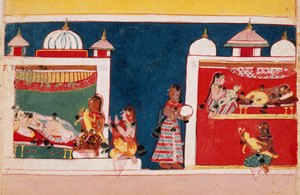
Ramayana
Ayodhya in Faizabad district of Uttar Pradesh is not the original city by the same name as it was inhabited by human beings only in 7th century BC while Rama is believed to have been born 18 million years ago, says "Facts of Ayodhya Episode" authored by Abdul Rahim Quraishi, assistant general secretary of the All India Muslim Personal Law Board (AIMPLB).

Quoting research papers of Jassu Ram and other archaeologists of the Archaeological Survey of India (ASI), the book reveals that there were two Ayodhyas - one which was built by King Raghu, great grandfather of Ram, and the second built by Ram himself.

"Jassu Ram in 'Ancient Geography of the Ramayana' says that both Ayodhyas are in Dera Ismail Khan district of Pakistan's North West Frontier Province (now Khyber Pakhtunkhwa)," says Quraishi, also president of Majlis Tameer-e-Millat, a socio-religious organization.

Quraishi, a key figure in the committee constituted by the AIMPLB to fight the Babri Masjid case, said Ayodhya in Faizabad district was known as Saket in 7th century BC.

In all probability, Hindus in 11th century CE gave the name of Ayodhya to the town. They also gave names connected with Ram Katha to various areas of the town.

The writer says that if the present Ayodhya was the birthplace of Ram, it would have been mentioned in Ramayana of Tulsidas, who penned the epic in 1574 CE in Ayodhya. Tulsidas wrote Ramayana during the time of Mughal emperor Akbar, the grandson of Babar.

"If Babri Masjid was constructed by demolishing a temple, he would have mentioned this," Quraishi told media persons.

He believes all these evidences may be produced during the hearing of the case in the Supreme Court, where the AIMPLB has challenged the 2010 verdict of the Allahbad High Court on the Babri Masjid title suit.

The Urdu version of the 82-year-old leader's book has hit the stands. The English translation is expected to be published soon.

Quraishi pointed out that the excavations undertaken by Banaras Hindu University and ASI and those on the orders of Allahbad High Court found nothing to prove that a temple existed there. There was no objection by Hindus when Babri Masjid was constructed in 1528.

He referred to a 1855 incident in which 'bairagies' (Hindu ascetics) returned Babri Masjid to Muslims after occupying it for some days.

It was in 1885 that a Mahant filed a suit for permission to construct a temple on chabutra or platform in the outer courtyard of the Babri Masjid claiming it to be the birthplace of Ram.

The sub-judge of Faizabad, Pandit Hari Kishan, on Dec 24, 1885, refused to give permission. Neither Mahant Dharam Das in his plaint stated nor sub-judge, a Hindu Pandit, remarked that Babar built the mosque at a scared place of Hindus.

The author said the Allahbad High Court decided the Babri Masjid title suit on the basis of belief. "The findings of the three-judge bench are patently wrong. In 1855, the Hindus of Ayodhya did not believe that the Babri Masjid stood on Ram Janmasthan." The book has dealt in detail with developments leading to the night of December 22, 1949, when idols of Ram and other gods were planted in Babri Masjid.

Quoting extensively from the orders of various courts, reports of commissions and books, Quraishi has written in detail how the conspiracy was hatched by the Hindu Mahasbha and implemented by K.K.K. Nayar, the then deputy commissioner-cum-district magistrate.

The Babri Masjid was demolished by a mob of Hindu zealots on December 6, 1992, and and a makeshift shrine was constructed on its debris.

Comments

Add new comment

  • Coastaldigest.com reserves the right to delete or block any comments.
  • Coastaldigset.com is not responsible for its readers’ comments.
  • Comments that are abusive, incendiary or irrelevant are strictly prohibited.
  • Please use a genuine email ID and provide your name to avoid reject.
News Network
December 7,2025

Mangaluru, Dec 7: A 34-year-old fruit and vegetable trader in Mangaluru has reportedly lost ₹33.1 lakh after falling victim to an online investment scam run through a fake mobile app.

Police said the scam began in September, when the victim received a link on Facebook. Clicking it connected him to a WhatsApp number, where an unidentified person introduced a high-return investment scheme and instructed him to download an app.

To build trust, the fraudster asked him to invest ₹30,000 on September 24. The trader soon received ₹34,000 as “profit,” convincing him the scheme was genuine. Over the next two months, he transferred money in multiple instalments via Google Pay and IMPS to different scanner codes and bank accounts shared by the scammers. Between September 24 and December 3, he ended up sending a total of ₹33.1 lakh.

When he later requested a refund of his investment and promised returns, the scammers demanded additional payments, claiming he needed to pay a “service tax” first. Even after he paid a small amount, no money was returned, and the scammers continued pressuring him for more.

A case has been registered at the CEN Crime Police Station.

Comments

Add new comment

  • Coastaldigest.com reserves the right to delete or block any comments.
  • Coastaldigset.com is not responsible for its readers’ comments.
  • Comments that are abusive, incendiary or irrelevant are strictly prohibited.
  • Please use a genuine email ID and provide your name to avoid reject.
News Network
December 4,2025

Mangaluru: Chaos erupted at Mangaluru International Airport (MIA) after IndiGo flight 6E 5150, bound for Mumbai, was repeatedly delayed and ultimately cancelled, leaving around 100 passengers stranded overnight. The incident highlights the ongoing country-wide operational disruptions affecting the airline, largely due to the implementation of new Flight Duty Time Limitations (FDTL) norms for crew.

The flight was initially scheduled for 9:25 PM on Tuesday but was first postponed to 11:40 PM, then midnight, before being cancelled around 3:00 AM. Passengers expressed frustration over last-minute communication and the lack of clarity, with elderly and ailing travellers particularly affected. “Though the airline arranged food, there was no proper communication, leaving us confused,” said one family member.

An IndiGo executive at MIA cited the FDTL rules, designed to prevent pilot fatigue by limiting crew working hours, as the cause of the cancellation. While alternative arrangements, including hotel stays, were offered, about 100 passengers chose to remain at the airport, creating tension. A replacement flight was arranged but also faced delays due to the same constraints, finally departing for Mumbai around 1:45 PM on Wednesday. Passengers either flew, requested refunds, or postponed their travel.

The Mangaluru delay is part of a broader crisis for IndiGo. The airline has been forced to make “calibrated schedule adjustments”—a euphemism for widespread cancellations and delays—after stricter FDTL norms came into effect on November 1.

While an IndiGo spokesperson acknowledged unavoidable flight disruptions due to technology issues, operational requirements, and the updated crew rostering rules, the DGCA has intervened, summoning senior airline officials to explain the chaos and outline corrective measures.

The ripple effect has been felt across the country, with major hubs like Bengaluru and Mumbai reporting numerous cancellations. The Mangaluru incident underscores the systemic operational strain currently confronting India’s largest carrier, leaving passengers nationwide grappling with uncertainty and delays.

Comments

Add new comment

  • Coastaldigest.com reserves the right to delete or block any comments.
  • Coastaldigset.com is not responsible for its readers’ comments.
  • Comments that are abusive, incendiary or irrelevant are strictly prohibited.
  • Please use a genuine email ID and provide your name to avoid reject.
News Network
December 15,2025

Mangaluru, Dec 15: Air India Express has announced that it will resume direct flight services between Mangaluru and Muscat from March 2026, restoring an important international air link for passengers from the coastal region.

Airport authorities said the service will operate twice a week—on Sundays and Tuesdays—from March 1. The initial flights are scheduled on March 3, 8 and 10, followed by March 15 and 17, with the same operating pattern to continue thereafter. The flight duration is approximately three hours and 25 minutes.

The Mangaluru–Muscat route was earlier operated under the 2025 summer schedule, with services beginning on July 14. At that time, Air India Express had operated four flights a week before suspending the service.

Officials said the summer schedule will come into effect from March 29, after which changes in flight timings and departure schedules from Mangaluru are expected. Passengers have been advised to check the latest schedules while planning their travel.

The resumption of direct flights to Muscat is expected to significantly benefit expatriates, business travellers and others, further strengthening Mangaluru’s air connectivity with the Gulf region.

Comments

Add new comment

  • Coastaldigest.com reserves the right to delete or block any comments.
  • Coastaldigset.com is not responsible for its readers’ comments.
  • Comments that are abusive, incendiary or irrelevant are strictly prohibited.
  • Please use a genuine email ID and provide your name to avoid reject.