Rename Aligarh Muslim University after Raja Mahendra Pratap: Haryana FM

Agencies
May 14, 2018

Rewari (Haryana), May 14: Amid the controversy surrounding the Aligarh Muslim University, Haryana Finance Minister Captain Abhimanyu wants the varsity to be renamed after Raja Mahendra Pratap, also known as 'Jat King.'

"The picture of the one who broke the nation into pieces hangs inside Aligarh Muslim University's campus, but there is no picture of Raja Mahendra Pratap Singh. I demand that the AMU must be renamed as Raja Mahendra Pratap Vishwavidyalaya," he said while addressing a gathering here on Sunday.

Earlier this month, a number of groups protested against the portrait of Pakistan's founder Muhammad Ali Jinnah being hung at the AMU student union's office.

The matter grabbed headlines first after Bharatiya Janata Party's (BJP) Aligarh MP Satish Gautam questioned the portrait's presence in the office.

Soon after, AMU Vice-Chancellor Professor Tariq Mansoor dubbed the Jinnah portrait controversy as a 'non-issue' and underscored that latter's portrait is also present at the Bombay High Court and the Sabarmati Ashram in Gujarat.

Talking to ANI, AMU vice-chancellor Professor Tariq Mansoor said, "Jinnah's portrait has been here since 1938. Jinnah's portrait is at many places including Bombay HC and Sabarmati Ashram and Nehru Museum too. No one was worried about the portraits until now; I think it is a non-issue."

Professor Mansoor also asserted that the agitation by students in the university had no connection with the Jinnah portrait row.

"Students' agitation had no relation to Jinnah portrait row, they were protesting against people who came to AMU to disturb the peace on May 2. Spoken to chief secretary for a judicial inquiry into the incident," he said while reacting to the ruckus due to which the event of former vice-president Hamid Ansari was cancelled. (ANI)

Comments

Dr,Krishna Cha…
 - 
Sunday, 27 Sep 2020

University is a temple of education and a fountain of learning now. We all know what for a temple stand in our society.
We must have the welfare of every body in mind to be fruitful to the country-an asset to the country like like Dr.A.P.J.Kalam.

Dr,Krishna Cha…
 - 
Friday, 25 Sep 2020

Since the insitution being given the tag of institution of National importance at present by the Govt.of India and huge funds have been given to the university after partition,thus changing the very face of the university,best brains of the country must govern this university and the staff and students must be properly selected and screened
The faculty must inculcate a sense of belonging to the nation in the students.

Kumar
 - 
Monday, 14 May 2018

I support Haryana FM Captain Abhimanyu in changing name of Aligarh Muslim University.  Instead of renaming it after Raja Mahendra Pratap it should be after Father (if he is real) of this great FM  who sacrifriced his life for independence of India.   Almost all the forefathers of Captain Abhimanya died while fighting britishers.   Also name of country should also be changed after Abhimanyu Father or grand Father.  Likewise all the old buildigns should be renamed after fathers of bjp leaders .  In case same statement comes from from Owaisi or Antony they would have been jailed by now.   However, this Captain will be appreciated by bjp and especially by Ansari / MJ Akbar / Shabuddin / Naqvi etc.

Add new comment

  • Coastaldigest.com reserves the right to delete or block any comments.
  • Coastaldigset.com is not responsible for its readers’ comments.
  • Comments that are abusive, incendiary or irrelevant are strictly prohibited.
  • Please use a genuine email ID and provide your name to avoid reject.
News Network
December 16,2025

Mangaluru, Dec 16: The Mangaluru City police have significantly escalated their campaign against drug trafficking, arresting 25 individuals and booking 12 cases under the Narcotic Drugs and Psychotropic Substances (NDPS) Act between November 30 and December 13. The crackdown resulted in the seizure of a substantial quantity of illicit substances, including 685.6 grams of MDMA and 1.5 kg of ganja.

The success of this recent drive has been significantly boosted by the city’s innovative, QR code-based anonymous reporting system.

"The anonymous reporting system has received an encouraging response. Several recent arrests were made based on inputs received through this system, helping police tighten the noose around drug peddlers," said the City Police Commissioner.

The latest arrests contribute to a robust year-to-date record, underscoring the police's relentless commitment to combating the drug menace.

Up to December 14 this year, the police have registered a total of 107 cases of drug peddling, leading to the arrest of 219 peddlers. Furthermore, they have booked 562 cases of drug consumption, resulting in the arrest of 671 individuals.

The scale of the seizure for the year reflects the magnitude of the problem being tackled: police have seized 320.6 kg of ganja worth ₹88.7 lakh and 1.4 kg of MDMA valued at ₹1.2 crore. Other significant seizures include hydro-weed ganja worth ₹94.7 lakh and cocaine worth ₹1.9 lakh, among others.

The Commissioner emphasized a policy of rigorous enforcement: "We ensure that peddlers are caught red-handed so that they cannot later dispute the case or claim innocence."

To counter the rising trend of substance abuse among youth, the Mangaluru City police have rolled out uniform guidelines for random drug testing across educational institutions.

As part of the drive, tests were conducted in approximately 100 institutions, screening an estimated 5,500 to 6,000 students in the first phase. 20 students tested positive for drug consumption during the initial screening.

Students who tested positive have been provided counselling and are scheduled for re-testing in the second quarter. The testing will also be expanded to students not covered in the first phase. In a move to ensure strict implementation, police personnel were deployed in mufti in some institutions. Reiterating a zero-tolerance stance, the Commissioner confirmed that random testing will continue, and colleges have also been instructed to conduct drug tests at the time of admission to deter substance abuse from an early stage.

Comments

Add new comment

  • Coastaldigest.com reserves the right to delete or block any comments.
  • Coastaldigset.com is not responsible for its readers’ comments.
  • Comments that are abusive, incendiary or irrelevant are strictly prohibited.
  • Please use a genuine email ID and provide your name to avoid reject.
News Network
December 13,2025

New Delhi: School-going children are picking up drug and smoking habits and engaging in consumption of alcohol, with the average age of introduction to such harmful substances found to be around 13 years, suggesting a need for earlier interventions as early as primary school, a multi-city survey by AIIMS-Delhi said.

The findings also showed substance use increased in higher grades, with grade XI/XII students two times more likely to report use of substances when compared with grade VIII students. This emphasised the importance of continued prevention and intervention through middle and high school.

The study led by Dr Anju Dhawan of AIIMS's National Drug Dependence Treatment Centre, published in the National Medical Journal of India this month, looks at adolescent substance use across diverse regions.

The survey included 5,920 students from classes 8, 9, 11 and 12 in urban government, private and rural schools across 10 cities -- Bengaluru, Chandigarh, Delhi, Dibrugarh, Hyderabad, Imphal, Jammu, Lucknow, Mumbai, and Ranchi. The data were collected between May 2018 and June 2019.

The average age of initiation for any substance was 12.9 (2.8) years. It was lowest for inhalants (11.3 years) followed by heroin (12.3 years) and opioid pharmaceuticals (without prescription; 12.5 years).

Overall, 15.1 per cent of participants reported lifetime use, 10.3 per cent reported past year use, and 7.2 per cent reported use in the past month of any substance, the study found.

The most common substances used in the past year, after tobacco (4 per cent) and alcohol (3.8 per cent), were opioids (2.8 per cent), followed by cannabis (2 per cent) and inhalants (1.9 per cent). Use of non-prescribed pharmaceutical opioids was most common among opioid users (90.2 per cent).

On being asked, 'Do you think this substance is easily available for a person of your age' separately for each substance category, nearly half the students (46.3 per cent) endorsed that tobacco products and more than one-third of the students (36.5 per cent) agreed that a person of their age can easily procure alcohol products.

Similarly, for Bhang (21.9 per cent), ganja/charas (16.1 per cent), inhalants (15.2 per cent), sedatives (13.7 per cent), opium and heroin (10 per cent each), the students endorsed that these can be easily procured.

About 95 per cent of the children, irrespective of their grade, agreed with the statement that 'drug use is harmful'.

The rates of substance use (any) among boys were significantly higher than those of girls for substance use (ever), use in the past year and use in the past 30 days. Compared to grade VIII students, grade IX students were more likely, and grade XI/XII students were twice as likely to have used any substance (ever).

The likelihood of past-year use of any substance was also higher for grade IX students and for grade XI/XII students as compared to grade VIII students.

About 40 per cent of students mentioned that they had a family member who used tobacco or alcohol each. The use of cannabis (any product) and opioid (any product) by a family member was reported by 8.2 per cent and 3.9 per cent of students, respectively, while the use of other substances, such as inhalants/sedatives by family was 2-3 per cent, the study found.

A relatively smaller percentage of students reported use of tobacco or alcohol among peers as compared to among family members, while a higher percentage reported inhalants, sedatives, cannabis or opioid use among peers.

Children using substances (past year) compared to non-users reported significantly higher any substance use by their family members and peers.

There were 25.7 per cent students who replied 'yes' to the question 'conflicts/fights often occur in your family'. Most students also replied affirmatively to 'family members are aware of how their time is being spent' and 'damily members are aware of with whom they spend their time'.


Comments

Add new comment

  • Coastaldigest.com reserves the right to delete or block any comments.
  • Coastaldigset.com is not responsible for its readers’ comments.
  • Comments that are abusive, incendiary or irrelevant are strictly prohibited.
  • Please use a genuine email ID and provide your name to avoid reject.
News Network
December 16,2025

bengal.jpg

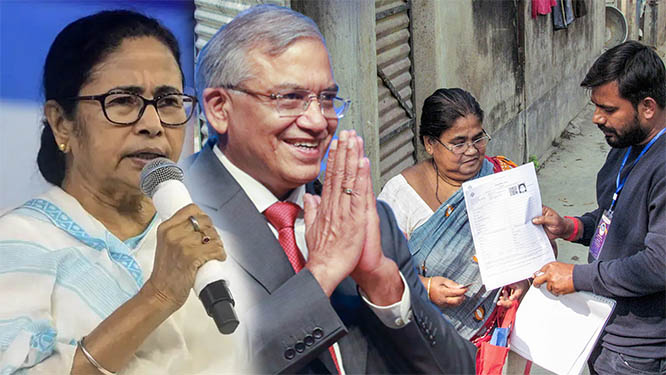
The deletion of over 58 lakh names from West Bengal’s draft electoral rolls following a Special Intensive Revision (SIR) has sparked widespread concern and is likely to deepen political tensions in the poll-bound state.

According to the Election Commission, the revision exercise has identified 24 lakh voters as deceased, 19 lakh as relocated, 12 lakh as missing, and 1.3 lakh as duplicate entries. The draft list, published after the completion of the first phase of SIR, aims to remove errors and duplication from the electoral rolls.

However, the scale of deletions has raised fears that a large number of eligible voters may have been wrongly excluded. The Election Commission has said that individuals whose names are missing can file objections and seek corrections. The final voter list is scheduled to be published in February next year, after which the Assembly election announcement is expected. Notably, the last Special Intensive Revision in Bengal was conducted in 2002.

The development has intensified the political row over the SIR process. Chief Minister Mamata Banerjee and her Trinamool Congress have strongly opposed the exercise, accusing the Centre and the Election Commission of attempting to disenfranchise lakhs of voters ahead of the elections.

Addressing a rally in Krishnanagar earlier this month, Banerjee urged people to protest if their names were removed from the voter list, alleging intimidation during elections and warning of serious consequences if voting rights were taken away.

The BJP, meanwhile, has defended the revision and accused the Trinamool Congress of politicising the issue to protect what it claims is an illegal voter base. Leader of the Opposition Suvendu Adhikari alleged that the ruling party fears losing power due to the removal of deceased, fake, and illegal voters.

The controversy comes amid earlier allegations by the Trinamool Congress that excessive work pressure during the SIR led to the deaths by suicide of some Booth Level Officers (BLOs), for which the party blamed the Election Commission. With the draft list now out, another round of political confrontation appears imminent.

As objections begin to be filed, the focus will be on whether the correction mechanism is accessible, transparent, and timely—critical factors in ensuring that no eligible voter is denied their democratic right ahead of a crucial election.

Comments

Add new comment

  • Coastaldigest.com reserves the right to delete or block any comments.
  • Coastaldigset.com is not responsible for its readers’ comments.
  • Comments that are abusive, incendiary or irrelevant are strictly prohibited.
  • Please use a genuine email ID and provide your name to avoid reject.