



Kolkata, Oct 13: India’s powerful Hindutva group wants minority Muslims and Christians to accept that India is a nation of Hindus, and is pushing some of them to convert. An election in the volatile state of West Bengal has become a prime target in its game plan.
The game plan of Modi’s Bharatiya Janata Party (BJP), which is in the minority in the upper house, is to govern 20 of India’s 31 regional legislative assemblies over the next four years, top party sources said. It currently controls or shares power in 11.
Interviews with more than two dozen RSS and BJP officials and rare access to closed RSS meetings reveal a two-stage strategy – electoral victory at the national level, which has been achieved in the lower house of Parliament, followed by similar success at the state level.
“We would want the BJP to win all the state elections because only then can significant social, political and cultural changes take place in this country,” RSS Joint General Secretary Dattatreya Hosabale told Reuters. “The 2014 election victory should be seen as the starting point of a long term mission."
POLICY INFLUENCE
What also emerges is the impact the RSS is having on government rhetoric and decisions.
Once scorned as a right-wing fringe group, the RSS is the ideological parent of the BJP. The Modi government has appointed RSS sympathizers to prominent positions in recent months. This includes the chairman of the Film and Television Institute of India, the chairman of the Indian Council of Historical Research and a board member of the Securities and Exchange Board of India.
Most of the ministers in the federal cabinet had their political consciousness shaped by the RSS and its affiliates. Modi spent his formative years as a full-time volunteer in the group, which he credits for his work ethic, discipline and success. BJP President Amit Shah and seven members of Modi’s cabinet also joined the RSS in their youth. Home Minister Rajnath Singh, who was once an RSS official and went on to lead the BJP, is now pushing for a nationwide ban on cow slaughter.
The government has also taken up other issues dear to the RSS, like the search for the lost Saraswati River. Government archaeologists have been ordered to search for the river, mentioned in ancient Hindu texts. RSS members believe proof of its existence would bolster the group’s narrative of a Hindu-dominated golden age in India prior to invasions by Muslims and Christians.
A close aide to the Prime Minister affirmed Modi’s commitment to the group and its vision. The Prime Minister, he said, is “viewed as the RSS worker who will take bullets in the chest to protect the RSS. He believes that it is the finest institution, a think tank and an organisation that has the power to change India.”
INDIA'S GLORY DAYS
What is unfolding is a battle for the soul of India. Since independence in 1947, Indian politics has been dominated by the Congress party and its leftist offshoots. They have espoused a secular, multi-faith vision of the nation. Hindus are the majority, but roughly 14 percent of India’s 1.2 billion people are Muslim.
The RSS was founded in 1925 as an anti-colonial organisation. It promotes a fundamentally different vision that draws on a mix of Hindu legends and ancient Indian history, when the subcontinent was home to some of the world’s most advanced civilizations.
According to this narrative, India’s glory days ended after it was invaded – beginning in the 8th century – by Muslims and then Christians, who converted the Hindu inhabitants. The RSS believes that if all Indians were to acknowledge and accept that ancient Hindu identity as theirs, it would unify the country, offer the best defence against any future aggressors and head off separatist movements.
“Hindustan means land of Hindus,” RSS General Secretary Suresh “Bhaiyyaji” Joshi told Reuters, using the old Mughal Persian name for India. “So anyone living here is automatically a Hindu first.”
The RSS has been banned four times since its inception, once after a former member of the group assassinated Mahatma Gandhi in 1948. That attack came after the RSS accused Gandhi of appeasing Muslims at a time when Pakistan, an all-Muslim nation, was being carved out of India. The ban was later lifted in the absence of any evidence the group planned the attack.
NEW STRATEGY
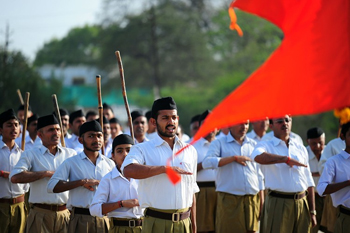
Until a few years ago, the RSS had focussed on achieving its vision of a Hindu nation from outside the electoral realm. RSS volunteers would meet weekly at thousands of shakhas, or branches, around the country to talk about Hinduism and civic duty, and practice martial exercises and discipline. Those interested in electoral politics traditionally migrated to the BJP and its predecessor, Jan Sangh, which shared much of the RSS’ ideology.
That changed in July 2013. At a meeting in Amravati in the western state of Maharashtra, RSS leaders decided it was time for the group to start using its network to more systematically help the BJP come to power, according to Ramapada Pal, the RSS chief preacher for West Bengal and Odisha states. His account was confirmed by several other RSS and BJP leaders who attended the meeting.
One speaker helped convince those resisting the change by acknowledging that politics was dirty, like a “toilet,” but that it was for the RSS to clean up the mess, Pal said.
After the Amravati meeting, BJP president Shah enlisted an army of RSS volunteers in Uttar Pradesh, India’s most populous state, to campaign for the BJP in the federal elections of 2014. The state is electorally important, accounting for 80 of 543 elected seats in the lower house of Parliament.
Each RSS volunteer was given a page from the electoral rolls containing about 100 names. The volunteers, called “panna prabharis”, or in-charge of a page, had to persuade voters who were vacillating to back the BJP, and then escort them to the polls.
The BJP won 71 parliamentary seats in Uttar Pradesh – a record for the party.
Now, the RSS and BJP are hoping to replicate the Uttar Pradesh playbook in state elections. Bihar, an impoverished eastern state that is currently governed by a coalition of BJP rivals, started voting in a state election on Monday. RSS volunteers have run a grassroots campaign in the state.
ACID TEST
But the acid test for the RSS-BJP alliance will be next year’s elections in West Bengal, a state where the BJP is traditionally weak and which for decades was ruled by an alliance headed by Communist parties.
RSS officials have met at least five times this year with BJP President Shah, who many credit as the architect of Modi’s election triumph, to coordinate political strategy in West Bengal, said a party official present at the meetings in New Delhi and Kolkata. The BJP did not win a single seat in the last election for the 290-seat state assembly in 2011.
Shah described West Bengal as a gateway to forging political control in India's northeastern states that border China, senior party official Sidharth Nath Singh quoted the BJP president as saying in a meeting. Shah also agreed to grant RSS leaders a say in the selection of senior members of the BJP's state organisation, Singh said.
Shah did not respond to requests for an interview and did not answer questions sent to his office. Modi’s office also did not respond to questions for this article.
In April, the RSS was deeply engaged in the municipal election campaign in West Bengal. For the first time, the BJP fielded candidates for every seat in the local elections. It more than quadrupled its seats in the vote, albeit from a low base – from 16 to 74 out of a total of 1,943.
When the leader of the party in West Bengal is chosen for the state elections, that person could be from the BJP or the RSS, said Kailash Vijayvargia, who was appointed in July to manage the BJP's political expansion in West Bengal. It needs to be someone who can fight against “appeasing Muslims” and against “allowing Islamic terror groups to flourish in our country,” he said.
RELIGIOUS RIOTING
Communal violence is never far from the surface in places like West Bengal. Some of the worst religious rioting in Indian history followed the partitioning of British India into predominantly Hindu West Bengal and Muslim East Bengal, which in 1971 became the new country of Bangladesh. More recently, Hindu-Muslim riots erupted in West Bengal in 2007, 2010 and 2013.
In the months after Modi’s victory, leaders of hardline Hindu groups launched a drive to have India officially declared a nation of Hindus. They also stepped up a campaign against what they called "Love Jihad" – a term used to describe what they claimed was an Islamist strategy to convert Hindu women through seduction, marriage and money. And they began a push to convert Muslims and Christians to Hinduism, through a purification ritual called “ghar vapsi”, or “homecoming”, a concept central to the RSS since its founding.
Cow slaughter, another touchstone issue for the RSS and the source of many lethal riots, has again shaken India in October after a Muslim man was lynched near Delhi on suspicion he had killed a cow, an animal holy to many Hindus. His death at the hands of a Hindu mob was deemed “an accident” by Modi’s culture minister.
Modi has been criticized for giving hardliners a free rein, but their zeal has also caused him headaches.
After meeting the Prime Minister in January in New Delhi, US President Barack Obama urged India not to stray from its constitutional commitment to allow people to freely "profess, practice and propagate" religion.
ECONOMIC REFORMS
In the upper house of Parliament, opposition lawmakers have tied up Modi’s economic proposals, including a tax overhaul and a land reform bill, in some cases with debates over the religious controversies.
Modi and the RSS share a long-term vision of making India the world’s leading power but they don’t always see eye-to-eye on how to get there.
Modi has at times asked lawmakers from his party and RSS members to stop promoting controversial issues such as religious conversions. He wants to keep the focus on economic reforms.
There are some signs that Modi would like to be less dependent on the RSS at the ballot box. The BJP has launched its own online membership drive, aiming to enroll 5 million new members, which would lessen its dependence on the RSS at election time. Every evening, Shah checks the membership numbers. Even when he is travelling, one party official is expected to text him the number by 6:30 pm, a close aide told Reuters.
At an early September meeting in New Delhi organised by the RSS and attended by Modi, however, relations appeared harmonious. Senior government ministers presented their plans and were quizzed about the steps they were taking in their respective ministries, according to two federal ministers who were both present.
Two long-awaited government plans were discussed that had strong RSS backing – the launch of a sovereign gold bond and improved pension rights for retired army personnel.
Shortly afterwards, the government publicly unveiled them.


Comments
Add new comment