



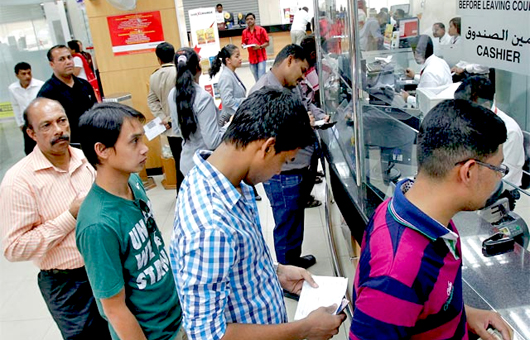
Rupee weakness triggers spike in NRI remittances

January 3, 2015

NRI remittances

Dubai, Jan 3: Encouraged by the low cost of remitting money to India and the current strength of the UAE dirham over the Indian rupee, wealthier non-resident Indians (NRIs) are remitting big amounts for investment back home, according to a recent white paper commissioned by Friends Provident International (FPI) and published by the Economist Intelligence Unit (EIU).

The white paper and documentary video released by FPI, titled'UAE Expatriates and the Bottom Line', reveal the hidden costs that expatriates living and working in Dubai and Abu Dhabi may face. The survey findings show how important financial planning is for expatriates if they want to reap the benefits of working in a tax-free environment, and avoid the pitfalls of hidden costs and high prices.

In stark contrast with other expatriate nationalities in the UAE, NRIs are one of the most financially prudent expatriate groups. Research published last year found that NRIs put aside an average of 70 per cent of their disposable income for investment and saving.

Marcus Gent, managing director, Middle East and rest of the world, FPI, said: œMuch has been said about the UAE's many spending temptations and the fact that expatriates are not saving enough for their retirement, or for other important events in their lives. We see that non-resident Indians, be they high or low-income earners, have incredible financial discipline and their culture of saving makes them a great case study, highlighting the value of careful financial planning. 

Much of the money remitted is used for family support. India's less developed pension system, compared with Europe or North America, for example, drives expatriates towards supporting their parents and children rather than starting a retirement plan for themselves. Over 80 per cent of Indians in the UAE have between two and five dependents to support, many of these back in India.

Culturally, Indians consider the education of their children and paying for their wedding as fundamental financial planning requirements. Some 90 per cent invest heavily in their children's education.

Remitting money from the UAE to India is less expensive than from other locations. Specialist money transfer firms such as UAE Exchange, Al Ansari, Emirates NBD and Western Union charge fixed fees as low as Dh15 on transfers to India and the Philippines.

For UK expatriates, the fee can be two or three times higher when remitting to their home country. While there is some variation ” fixed rates of up to Dh80 can apply for express payments ” the average cost of sending $200 to India from the UAE is about $5. Sending the same amount to India from Australia costs three times as much.

Gent added: œEarning in dirhams could translate favourably into a comfortable retirement, especially given the current weakness of the Indian rupee. For investment opportunities, India is an attractive prospect for the savvy, better-off white-collar Indian investor ” and remittance and investment flows from the UAE to India clearly confirm a continued and increasing appetite. 

œHowever, NRIs should consider carefully while planning their savings ” in particular the preference for investing in gold and property. While gold can be a good diversifier ” because it is negatively correlated to many mainstream asset classes ” it is important that any portfolio is diversified, both geographically and by asset class. That way it is more likely to generate a less volatile return,  he added.

Indians, by far, form the largest foreign-born community in the UAE, and an increasing number of professionals are relocating to the country. The Indian embassy in Abu Dhabi lists over 40 major Indian companies with offices in the UAE, the majority operating in highly skilled technology or finance sectors.


Comments

Add new comment

  • Coastaldigest.com reserves the right to delete or block any comments.
  • Coastaldigset.com is not responsible for its readers’ comments.
  • Comments that are abusive, incendiary or irrelevant are strictly prohibited.
  • Please use a genuine email ID and provide your name to avoid reject.
News Network
December 15,2025

Mangaluru, Dec 15: Air India Express has announced that it will resume direct flight services between Mangaluru and Muscat from March 2026, restoring an important international air link for passengers from the coastal region.

Airport authorities said the service will operate twice a week—on Sundays and Tuesdays—from March 1. The initial flights are scheduled on March 3, 8 and 10, followed by March 15 and 17, with the same operating pattern to continue thereafter. The flight duration is approximately three hours and 25 minutes.

The Mangaluru–Muscat route was earlier operated under the 2025 summer schedule, with services beginning on July 14. At that time, Air India Express had operated four flights a week before suspending the service.

Officials said the summer schedule will come into effect from March 29, after which changes in flight timings and departure schedules from Mangaluru are expected. Passengers have been advised to check the latest schedules while planning their travel.

The resumption of direct flights to Muscat is expected to significantly benefit expatriates, business travellers and others, further strengthening Mangaluru’s air connectivity with the Gulf region.

Comments

Add new comment

  • Coastaldigest.com reserves the right to delete or block any comments.
  • Coastaldigset.com is not responsible for its readers’ comments.
  • Comments that are abusive, incendiary or irrelevant are strictly prohibited.
  • Please use a genuine email ID and provide your name to avoid reject.
News Network
December 7,2025

SHRIMP.jpg

Mangaluru, Dec 7: A rare bamboo shrimp has been rediscovered on mainland India more than 70 years after it was last reported, confirming for the first time the presence of Atyopsis spinipes in the country. The find was made by researchers from the Centre for Climate Change Studies at Sathyabama Institute of Science and Technology, Chennai, during surveys in Karnataka and Odisha.

The team — shrimp expert Dr S Prakash, PhD scholar K Kunjulakshmi, and Mangaluru-based researcher Maclean Antony Santos — combined field surveys, ecological assessments and DNA analysis to identify the elusive species. Their findings, published in Zootaxa, resolve decades of taxonomic confusion stemming from a 1951 report that misidentified the species as Atyopsis moluccensis without strong evidence.

The shrimp has now been confirmed at two locations: the Mulki–Pavanje estuary near Mangaluru and the Kuakhai River in Bhubaneswar. Historical specimens from the Andaman Islands, previously labelled as A. moluccensis, were also found to be misidentified and actually belong to A. spinipes.

The rediscovery began after an aquarium hobbyist in Odisha spotted a shrimp in 2022, prompting systematic surveys across Udupi, Karwar and Mangaluru. Four female specimens were collected in Mulki and one in Odisha, all genetically matching.

Researchers warn the species may exist in very small, vulnerable populations as freshwater habitats face increasing pressure from pollution, sand mining and infrastructure development. All verified specimens have been deposited with the Zoological Survey of India for future reference.

Comments

Add new comment

  • Coastaldigest.com reserves the right to delete or block any comments.
  • Coastaldigset.com is not responsible for its readers’ comments.
  • Comments that are abusive, incendiary or irrelevant are strictly prohibited.
  • Please use a genuine email ID and provide your name to avoid reject.
News Network
December 7,2025

Mangaluru, Dec 7: A 34-year-old fruit and vegetable trader in Mangaluru has reportedly lost ₹33.1 lakh after falling victim to an online investment scam run through a fake mobile app.

Police said the scam began in September, when the victim received a link on Facebook. Clicking it connected him to a WhatsApp number, where an unidentified person introduced a high-return investment scheme and instructed him to download an app.

To build trust, the fraudster asked him to invest ₹30,000 on September 24. The trader soon received ₹34,000 as “profit,” convincing him the scheme was genuine. Over the next two months, he transferred money in multiple instalments via Google Pay and IMPS to different scanner codes and bank accounts shared by the scammers. Between September 24 and December 3, he ended up sending a total of ₹33.1 lakh.

When he later requested a refund of his investment and promised returns, the scammers demanded additional payments, claiming he needed to pay a “service tax” first. Even after he paid a small amount, no money was returned, and the scammers continued pressuring him for more.

A case has been registered at the CEN Crime Police Station.

Comments

Add new comment

  • Coastaldigest.com reserves the right to delete or block any comments.
  • Coastaldigset.com is not responsible for its readers’ comments.
  • Comments that are abusive, incendiary or irrelevant are strictly prohibited.
  • Please use a genuine email ID and provide your name to avoid reject.