Saudi Arabia decides to cut oil output as producers discuss price dip

Agencies
November 12, 2018

Nov 12: Saudi Arabia, the world's top crude exporter, said on Sunday it will cut oil output from next month, as major producers held a key meeting to discuss shoring up sliding prices. Saudi Energy Minister Khalid al-Falih announced the kingdom was cutting its supplies by 500,000 barrels per day from December.

But Falih said ahead of the meeting of OPEC and non-OPEC key producers that there was not yet consensus on a broader output cut.

Oil prices have shed a fifth of their value in just one month after surging to a four-year high in early October, driven by a combination of factors centred on higher supply and fears of sluggish demand.

The meeting of the Joint Ministerial Monitoring Committee in Abu Dhabi will not take decisions, ministers said, but will propose recommendations for a crucial ministerial meeting in Vienna early in December.

Among those attending were Russian Energy Minister Alexander Novak, Oman's Oil Minister Mohammed al-Rumhi and the energy minister of host UAE Suheil al-Mazroue.

Falih told reporters ahead of the meeting that Saudi Arabia's "crude exports for December will be 500,000 bpd lower than November".

The world's top oil exporter has been pumping 10.7 million bpd since October, he said.

The Saudi minister acknowledged that so far there was no fresh agreement on reducing production among OPEC and non-OPEC producers, who struck a deal in late 2016 to cut output by 1.8 million bpd to remedy an oversupply crisis.

"There is no consensus yet among oil producers about cutting production," Falih said at the gathering.

He insisted it was "premature to talk about a specific action", when asked about the possibility of an output cut.

"We have to study all the factors," Falih said.

Brent crude dropped below USD 70 a barrel on Friday for the first time since April while the New York's West Texas Intermediate (WTI) sank below USD 60 a barrel, a nine-month low.

In his speech at the start of the meeting Falih said the recent sharp drop in prices has "surprised us".

He said the market sentiment has shifted from one of fearing shortages to one worried about oversupply.

He also attributed the sharp drop in prices to "microeconomic uncertainties", and signs of a build-up in crude inventories.

The UAE's Mazrouei said that the goal of the OPEC and non-OPEC cooperation was to strike a balance in the market, adding that recommendations for possible action will be made to next month's ministerial conference.

The latest price slump comes as the United States has upped production of shale oil, while Saudi Arabia, Russia and others have raised supplies of crude amid signs of slowing demand.

There have also been signs of a softer-than-expected impact from US sanctions on Iranian oil exports.

"Prices have been falling amid a continued rise in crude supplies from big producers, such as Saudi Arabia, Russia and the US, more than compensating for lost Iranian barrels," Forex.com analyst Fawad Razaqzada told AFP.

"With the Iranian sanctions not being as severe as initially feared, officials from the OPEC and non-OPEC producers may discuss at the weekend the need to bring compliance back down... or risk another 2014-style slide in prices." Producers implemented large cuts starting at the beginning of 2017 and managed to push up oil prices from below USD 30 a barrel to over USD 85 in October, strongly improving their revenues.

But the producer nations eased the output cuts in June after signs of a tighter market and higher prices, allowing hundreds of thousands of extra barrels to hit the market.

Commerzbank, Germany's second-largest lender, said Friday oil producers must act to prevent a free fall of prices.

"If they fail to signal any intention to reverse the latest increase in production, oil prices threaten to slide further," the bank said in a note.

Comments

Add new comment

  • Coastaldigest.com reserves the right to delete or block any comments.
  • Coastaldigset.com is not responsible for its readers’ comments.
  • Comments that are abusive, incendiary or irrelevant are strictly prohibited.
  • Please use a genuine email ID and provide your name to avoid reject.
News Network
November 27,2025

DKSvokkaliga.jpg

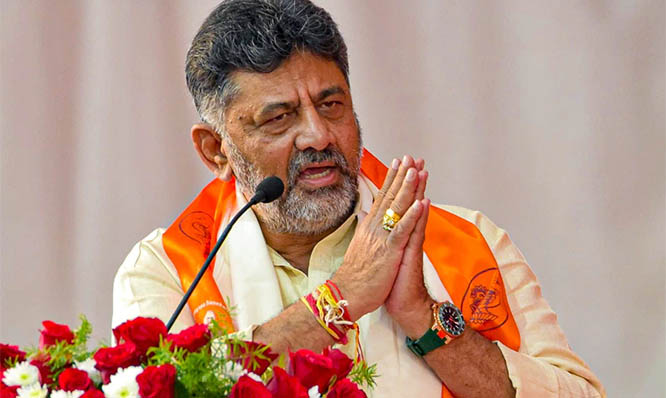
Bengaluru: The Vokkaligara Sangha on Thursday issued a stern warning to the Congress, saying the party could face serious electoral repercussions if Deputy Chief Minister D.K. Shivakumar is not appointed as Chief Minister.

The warning follows the public backing of Shivakumar’s chief ministerial ambition by top Vokkaliga pontiff Nirmalanandanatha Swami, who urged the Congress high command to honor his claim.

“The community supported Congress in the 2023 Assembly elections only because Shivakumar had a real chance to become CM. If he is cheated, we’ll teach the party a big lesson,” said newly elected Sangha president L. Srinivas. He added that Vokkaligas would organize protests under the guidance of community leaders.

General Secretary C.G. Gangadhar pointed out that Congress won more seats in the Vokkaliga-dominated Old Mysuru region due to Shivakumar’s influence, adding, “If Congress wants to retain power, Shivakumar should be made the CM.”

Outgoing president Kenchappa Gowda emphasized Shivakumar’s contribution to Congress’ victory. “Our community voted for Congress thinking he would become CM. Siddaramaiah has also served the party well, but Shivakumar should now be given a chance,” he said.

Former general-secretary Konappa Reddy appealed to Sonia and Rahul Gandhi to recognize Shivakumar’s loyalty and service, saying, “Congress is known to keep its promises. We hope it won’t break the promise made to him.”

Comments

Add new comment

  • Coastaldigest.com reserves the right to delete or block any comments.
  • Coastaldigset.com is not responsible for its readers’ comments.
  • Comments that are abusive, incendiary or irrelevant are strictly prohibited.
  • Please use a genuine email ID and provide your name to avoid reject.
News Network
November 24,2025

israelsyra.jpg

Israeli forces have pushed over the Syrian frontier, erecting a checkpoint and stopping vehicles in the southwestern city of Quneitra, in yet another breach of the Arab country’s sovereignty.

The violation took place on Sunday, when the troops made their way across the border, setting up the outpost near the Ain al-Bayda junction in northern Quneitra, Syrian outlets reported.

According to the al-Ikhbariya paper, an Israeli detachment positioned itself at the junction, halting cars and conducting searches.

The Syrian Arab News Agency (SANA) reported that three Israeli military vehicles then moved further into the northern countryside, deploying between the town of Jubata al-Khashab and the villages of Ofaniya and Ain al-Bayda. The agency added that a separate Israeli unit mounted a new incursion in the central region, approaching the villages of Umm Batina and al-Ajraf.

Residents said such activities have surged in recent months, pointing to Israeli advances onto farmland, leveling of extensive forested areas, arrests, and spread of mobile checkpoints.

The Israeli regime began markedly increasing its military aggression against Syria last year.

The escalation coincided with increasingly ferocious onslaughts throughout the country by the so-called Hay'at Tahrir al-Sham (HTS) Takfiri terrorist group, which the government of President Bashar al-Assad had confined to northwestern Syria. The HTS, however, managed to overthrow the government as the Israeli attacks would pummel the country’s civilian and defensive infrastructure.

Various reports have shown that, during the escalation, the regime conducted more than 1,000 airstrikes on the Syrian territory and over 400 ground raids into the south.

Following the collapse of the Assad government, Tel Aviv also widened its grip over the occupied Golan Heights by taking control of a demilitarized buffer zone, in defiance of a 1974 Disengagement Agreement. Earlier this month, senior Israeli officials, including Prime Minister Benjamin Netanyahu, visited the buffer zone, prompting expressions of alarm on the part of the United Nations.

The United States, the regime’s biggest ally, has, meanwhile, been fraternizing the HTS head Abu Mohammed al-Jolani amid the widely reported prospect of rapprochement with Tel Aviv.

Comments

Add new comment

  • Coastaldigest.com reserves the right to delete or block any comments.
  • Coastaldigset.com is not responsible for its readers’ comments.
  • Comments that are abusive, incendiary or irrelevant are strictly prohibited.
  • Please use a genuine email ID and provide your name to avoid reject.
News Network
November 24,2025

lebanon.jpg

Israel has launched a new act of aggression on a residential neighborhood in Lebanon's capital, Beirut, killing and injuring about two dozen civilians.

The Israeli regime's military said in a statement that its forces carried out a so-called precise strike in a residential apartment in Dahiyeh in the southern suburbs of Beirut on Sunday.

The aggression targeted residential areas, killing at least five people and injuring more than 28 people, Lebanon's Health Ministry said. 

Hezbollah announced the martyrdom of senior Hezbollah commander Haytham Ali Tabatabai and four resistance fighters.

Lebanese President Michel Aoun condemned the airstrike, calling it a clear demonstration of Tel Aviv’s disregard for repeated international calls to halt violations on Lebanese soil.

“Israel refuses to implement international resolutions and all efforts aimed at ending the escalation and restoring stability,” Aoun said, urging the international community to take action to prevent further aggression.

The Palestinian Islamic Jihad movement also condemned the attack, holding the international community accountable. 

“The international community bears responsibility and continues to provide cover for these attacks as long as it does not restrain the occupiers,” said Ali Abu Shahin, a member of the group’s political bureau.

Israeli prime minister Benjamin Netanyahu’s office announced that the Israeli army carried out a strike “in the heart of Beirut."

Netanyahu reportedly approved the operation following recommendations from top Israeli security officials.

Two senior US officials commented on the Israeli strike.

The first official said that Israel did not notify Americans in advance about the attack. "We were informed immediately after the strike was carried out."

The second senior official said that the "US knew for several days that Israel was planning to escalate its strikes in Lebanon, but did not know in advance the timing, location, or target of the strike."

Speaking from the site of the Israeli strike, Lebanese MP Ali Ammar condemned the attack as part of a broader campaign of aggression that has targeted "all of Lebanon since the Washington-sponsored ceasefire."

He stated that "any attack on Lebanon is a violation of red lines; this aggression is part and parcel of the entity that targets Lebanon's dignity, sovereignty, and security of citizens."

Ammar went on to say the resistance is responding with "utmost wisdom, patience, and will confront the enemy at the appropriate time."

"Unfortunately, the enemy is emboldened to commit its aggression by voices within Lebanon that have turned themselves into tools that support its aggression," he added.

The Israeli attack on the southern suburbs of the Lebanese capital is the latest blatant violation of the ceasefire Israel signed with Hezbollah in November 2024, which was intended to end hostilities that had escalated into full-scale war.

An Israeli strike on the Ain al-Hilweh camp near Sidon in southern Lebanon late Tuesday killed at least 14 people. It wounded several others, including young students, according to the Lebanese health ministry.

The military claimed the attack targeted “a Hamas training compound” used to plan and carry out attacks against the regime -- a claim that has frequently been made without evidence.

Hamas rejected the allegations as “a blatant lie aimed at justifying the massacre,” stating it had “no military installations in the Palestinian camps in Lebanon” and that the targeted site was merely “an open sports field.”

According to Lebanese authorities, Israeli attacks have killed approximately 4,000 people and displaced more than 1.2 million residents across the country since October 2023.

Comments

Add new comment

  • Coastaldigest.com reserves the right to delete or block any comments.
  • Coastaldigset.com is not responsible for its readers’ comments.
  • Comments that are abusive, incendiary or irrelevant are strictly prohibited.
  • Please use a genuine email ID and provide your name to avoid reject.