



Saudi Arabia vows retaliation if punished over ‘missing’ journalist

Agencies
October 14, 2018

Dubai, Oct 14:  Saudi Arabia warned on Sunday it would retaliate against any sanctions imposed on the oil-rich kingdom over the disappearance of journalist Jamal Khashoggi, as the Riyadh stock market suffered its worst plunge in years.

From tech tycoons to media giants, a host of Western companies are now distancing themselves from the Gulf state, imperilling Crown Prince Mohammed bin Salman's much-hyped economic reform drive.

US President Donald Trump threatened ally Saudi Arabia on Saturday with "severe punishment" if Khashoggi, who has been critical of Prince Mohammed, was killed inside its Istanbul mission.

But Riyadh vowed to hit back against any action against it.

"The kingdom affirms its total rejection of any threats or attempts to undermine it whether through threats to impose economic sanctions or the use of political pressure," an official source said, quoted by state news agency SPA.

He said Riyadh would "respond to any action with a bigger one", pointing out that the oil superpower "plays an effective and vital role in the world economy".

As investors took fright, Saudi stocks tumbled by around seven percent at one point on Sunday, wiping out their gains for 2018.

Business barons including British billionaire Richard Branson and Uber CEO Dara Khosrowshahi, as well as media powerhouses like Bloomberg and CNN, have pulled out of next week's Future Investment Initiative (FII) in Riyadh, dubbed "Davos in the desert".

Khashoggi, a Washington Post contributor, vanished after entering the consulate on October 2 to obtain official documents for his upcoming marriage.

Turkey on Saturday stepped up pressure on Saudi Arabia by accusing the kingdom of failing to cooperate with a probe into the journalist's disappearance.

Turkish officials have said they believe Khashoggi was killed inside the mission and claims have been leaked to media that he was tortured and even dismembered.

Saudi Arabia insists Khashoggi left the building safely and dismissed accusations that authorities had ordered his murder by a hit squad as "lies and baseless allegations".

The kingdom's Tadawul All-Shares Index (TASI) lost more than 500 points in the first two hours after trading resumed after the weekend, in panic selling similar reminiscent of the days after the global financial crisis in 2008.

It clawed back some losses by mid-session but was still down by 5.0 percent, the worst single-day drop in about three years, trading at a 10-month low of 7,167 points.

The index had already dropped 3.0 percent on Thursday, following a rout on world stock markets fuelled by worries about higher interest rates and US President Donald Trump's attacks on the Federal Reserve.

Mohammed Zidan, market strategist at Thinkmarket in Dubai, said the drop in Saudi stocks was the result of panic selling because of several political and economic factors.

"There has been a kind of uncertainty surrounding the situation of the disappearance of Khashoggi which has caused the market to fall," Zidan told AFP.

"The withdrawal of top participants from the Riyadh investment conference has also negatively impacted traders' sentiment," he said.

The pullouts have cast a pall on the annual summit at which Prince Mohammed wowed investors last year with talking robots and blueprints for a futuristic mega city.

The withdrawal of Uber's Khosrowshahi from the event is particularly symbolic as the kingdom's vast Public Investment Fund (PIF) has invested $3.5 billion in the ride-hailing app.

Branson, who dropped two directorships linked to Saudi tourism projects around the Red Sea, said claims about Khashoggi's disappearance would "change the ability of any of us in the West to do business with the Saudi government".

Global multinational corporations "see potential in a developing market like Saudi Arabia, but for many the reputational risk of being associated with FII outweighs the potential gains from the Saudi economy," said Michael Stephens, a Middle East expert at the Royal United Services Institute.

Washington lobbying firm Harbour group which represented the Saudi government, has also terminated its $80,000 per month contract.

"We (have) ended the relationship," Richard Mintz, managing director of the firm, told AFP.

The Saudi leadership faces "an acute public relations crisis" over Khashoggi's disappearance, said consultancy group Eurasia.

"The leadership will now have to manage a more serious threat to its economic liberalisation strategy," Eurasia said.

"At this point, Saudi Arabia will find it incredibly challenging to contain the emerging crisis."

Comments

Add new comment

  • Coastaldigest.com reserves the right to delete or block any comments.
  • Coastaldigset.com is not responsible for its readers’ comments.
  • Comments that are abusive, incendiary or irrelevant are strictly prohibited.
  • Please use a genuine email ID and provide your name to avoid reject.
News Network
January 20,2026

iran.jpg

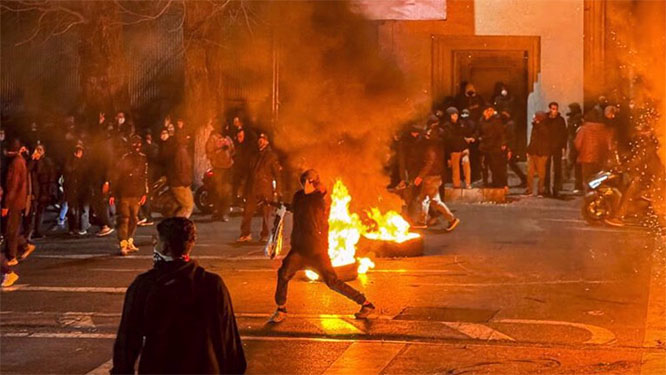
Iranian security and intelligence forces have captured more than 470 individuals in three provinces, identified as key figures behind the recent wave of violent unrest and terrorist activities linked to foreign-backed networks.

The Intelligence Ministry's provincial office in Khorasan Razavi announced on Monday the arrest of 192 armed terrorists, identified as the main agents behind recent riots in the region. 

According to an official statement, the detainees were involved in the killing of several security personnel and civilians, setting fire to mosques, public service facilities, and buses, as well as attacks on military and law enforcement centers.

The seized items from the group include several bulletproof vests, Kalashnikov rifles, hunting weapons, Winchester rifles, and various cold weapons such as daggers, swords, brass knuckles, tactical knives, crossbows, and chains.

Evidence indicates that some of the individuals were tied to hostile movements and terrorist organizations, with links overseas. Others were identified as members of violent criminal gangs, actively taking part in the unrest alongside their associates.

Simultaneously, in the western province of Lorestan, the IRGC announced the arrest of 134 individuals as the main leaders and influential field agents of a US-Israeli terrorist network.

The IRGC statement stated that these individuals formed terrorist cells during the recent unrest, committing "Daesh-like" acts.

They wounded security forces with firearms and cold weapons, and burned and destroyed public and private properties, including mosques, shops, banks, and private and public vehicles.

In the northwestern province of Zanjan, the police reported detaining 150 people identified as principal leaders and agents behind recent riots.

Authorities noted that these individuals were responsible for destroying public and private property and intentionally setting fire to vehicles in the province's squares.

Their crimes include shedding the blood of innocent people, destroying public and private property, attempting to enter military sites, disrupting public order, and spreading terror among citizens.

A variety of cold weapons were reportedly seized from the detainees.

What began late last month as peaceful protests over economic hardship across Iran turned violent after public statements by US and Israeli regime figures encouraged vandalism and disorder.

During the unrest, foreign-backed mercenaries rampaged through cities, killing security forces and civilians and damaging public property.

Comments

Add new comment

  • Coastaldigest.com reserves the right to delete or block any comments.
  • Coastaldigset.com is not responsible for its readers’ comments.
  • Comments that are abusive, incendiary or irrelevant are strictly prohibited.
  • Please use a genuine email ID and provide your name to avoid reject.
News Network
February 1,2026

Bengaluru, Feb 1: For travelers landing at Kempegowda International Airport (KIA), the sleek, wood-paneled curves of Terminal 2 promise a world-class welcome. But the famed “Garden City” charm quickly withers at the curb. As India’s aviation sector swells to record numbers—handling over 43 million passengers in Bengaluru alone this past year—the “last mile” has turned into a marathon of frustration.

The Bengaluru Logjam: Rules vs Reality

While the city awaits the 2027 completion of the Namma Metro Blue Line, the interim has been chaotic. Recent “decongestion” rules at Terminal 1 have pushed app-based cab pickups to distant parking zones, forcing weary passengers into a 20-minute walk with luggage.

“I landed after ten months away and felt like a stranger in my own city,” says Ruchitha Jain, a Koramangala resident. “My driver couldn’t find me, staff couldn’t guide me, and the so-called ‘Premium’ lane is just a fancy tax on convenience.”

•    The Cost of Distance: A 40-km cab ride can now easily cross ₹1,500, driven by demand pricing and airport surcharges.

•    The Bus Gap: While Vayu Vajra remains a lifeline, its ₹300–₹400 fare is often cited as the most expensive airport bus service in the country.

A National Pattern of Disconnect

The struggle is not unique to Karnataka. From Chennai’s coast to Hyderabad’s plateau, India’s airports tell a familiar story: brilliant runways, broken exits.

City:    Primary Issue   |    Recent Development

Bengaluru:    Cab pickup restrictions & distance  |    App-based taxis shifted to far parking zones; long walks and fare spikes reported

Chennai:    Multi-Level Parking (MLCP) hike  |    Passengers report 40-minute walks to reach cab pickup points

Hyderabad:    “Taxi mafia” & touting  |    Over 440 touting cases reported; security presence intensified

Mumbai:    Fare scams  |     Tourists charged ₹18,000 for just 400 metres, triggering police action

In Hyderabad, travelers continue to battle entrenched local groups that intimidate Uber and Ola drivers, pushing passengers toward overpriced private taxis. Chennai flyers, meanwhile, complain that reaching the designated pickup zones now takes longer than short-haul flights from cities like Coimbatore.

The ‘Budget Day’ Hope

As Finance Minister Nirmala Sitharaman presents the Union Budget 2026 today, the aviation sector is watching closely. With the government’s renewed emphasis on multimodal integration, there is cautious hope for funding toward seamless airport-metro-bus hubs.

The vision is clear: a future where planes, trains, and metros speak the same language. Until then, passengers at KIA—and airports across India—will continue to discover that the hardest part of flying isn’t the thousands of kilometres in the air, but the last few on the ground.

Comments

Add new comment

  • Coastaldigest.com reserves the right to delete or block any comments.
  • Coastaldigset.com is not responsible for its readers’ comments.
  • Comments that are abusive, incendiary or irrelevant are strictly prohibited.
  • Please use a genuine email ID and provide your name to avoid reject.
News Network
February 1,2026

US President Donald Trump on Saturday claimed that the government of India led by Prime Minister Narendra Modi has made a deal to buy Venezuelan oil, as opposed to purchasing it from Iran.

"We've already made that deal, the concept of the deal," he told reporters on Air Force One.

Trump had imposed 25% tariffs on countries buying Venezuelan oil, including India, in March 2025. He had also hit India with tariffs for buying Russian oil, saying it was "funding" President Vladimir Putin's war against Ukraine.

Trump has said that the US has taken control of the oil-rich Venezuela after capturing former President Nicolas Maduro in January.

A fleet of 18 ships loaded with crude oil bound for refineries in Texas, Louisiana, and Mississippi in January, the most since December 2024, according to a report by the news agency Bloomberg.

Combined crude deliveries to the US will reach about 2,75,000 barrels a day, more than doubling volumes seen in December last year. Shipments to China, which averaged 4,00,000 barrels a day last year, fell to zero in January.

PM Modi, Venezuelan President Agree To Expand Ties

Prime Minister Narendra Modi and Venezuela's acting President Delcy Rodriguez spoke on Friday and agreed to take the bilateral relations to "new heights" in the years ahead.

It was the first phone call between the two leaders since the capture of Maduro and his wife by the US on January 3.

"Spoke with Acting President of Venezuela, Ms. Delcy Rodriguez. We agreed to further deepen and expand our bilateral partnership in all areas, with a shared vision of taking India-Venezuela relations to new heights in the years ahead," PM Modi said in a post on X.

A statement from Prime Minister Modi's office said the two leaders agreed to further expand and deepen the India-Venezuela partnership in all areas, including trade and investment, energy, digital technology, health, agriculture, and people-to-people ties.

They exchanged views on various regional and global issues of mutual interest and underscored the importance of their close cooperation for the Global South, the statement said.

Rodriguez also said that they discussed partnerships in the fields of agriculture, science and technology, mining, and tourism, as well as the pharmaceutical and automotive industries.

Comments

Add new comment

  • Coastaldigest.com reserves the right to delete or block any comments.
  • Coastaldigset.com is not responsible for its readers’ comments.
  • Comments that are abusive, incendiary or irrelevant are strictly prohibited.
  • Please use a genuine email ID and provide your name to avoid reject.