



Saudi wants US to launch 'surgical strike' on Iran

Agencies
May 17, 2019

Dubai, May 17: Saudi Arabia accused Tehran of being behind a drone strike that shut down a key oil pipeline in the kingdom, and a newspaper close to the palace called for Washington to launch “surgical” strikes on Iran, raising the spectre of escalating tensions as the US boosts its military presence in the Persian Gulf.

Concerns about the possible conflict have flared after the US dispatched warships and bombers to the region to counter an alleged but unspecified threat from Iran. There also have been allegations that four oil tankers were sabotaged on Sunday off the coast of the United Arab Emirates, and Iran-aligned rebels in Yemen claimed responsibility for Tuesday’s attack on the Saudi pipeline.

Fears have grown out of President Donald Trump’s decision last year to withdraw the US from the 2015 nuclear accord between Iran and world powers and impose wide-reaching sanctions — the latest levied as recently as last week — that have crippled Iran’s economy.

But Trump took a soft tone Thursday, a day after tweeting that he expected Iran to look for talks. Asked if the US might be on a path to war with the Iranians, the president answered, “I hope not.”

Saudi prince Khalid bin Salman, who is King Salman’s son and the country’s deputy defence minister, tweeted that the drone attack on two Saudi Aramco pumping stations running along the East-West pipeline were “ordered by the regime in Tehran, and carried out by the Houthis” — a reference to the Yemeni rebel group.

A state-aligned Saudi newspaper went further, running an editorial calling for “surgical” US strikes on Iran in retaliation. Iran has been accused by the US and the UN of supplying ballistic missile technology and arms to the Houthis, which Tehran denies.

The front-page editorial in the Arab News, published in English, said it’s “clear that (US) sanctions are not sending the right message” and that “they must be hit hard,” without elaborating on specific targets. It said the Trump administration had already set a precedent with airstrikes in Syria, when the government there was suspected of using chemical weapons.

Ali Shihabi, who runs the Saudi-leaning Arabia Foundation in Washington, said there’s a sense that if the Iranians can get away with targeting Saudi oil infrastructure, then “the whole security infrastructure in the Gulf will be called into question and security premiums on oil will rise.”

He said it would seem that Riyadh would like to coordinate with Washington how it responds to Iran, but “eventually what may happen is that just Saudi Arabia and the UAE may have to do something.”

“Nobody is going to start a war with them (Iran), but I think they should be defanged and, you know, things like their naval capabilities, things like their missile capabilities should be downgraded at least to make their capacity to inflict such dangerous activity more painful, more costly,” Shihabi said.

Saudi crown prince Mohammed bin Salman, who also is defence minister and controls major levers of power in the Sunni kingdom, has not commented publicly on this week’s incidents. In a Saudi TV interview in 2017, he said the kingdom knows it is a main target of Shiite Iran and there is no room for dialogue with Tehran.

A top Emirati diplomat said late Wednesday the Saudi-led coalition fighting the Houthis in Yemen would “retaliate hard” for attacks on civilian targets, without elaborating. However, Anwar Gargash also said the UAE is “very committed to de-escalation” after the alleged sabotage of the tankers off the country’s coast. He declined to blame Iran directly, although he repeatedly criticised Tehran.

In response to the oil pipeline attack, the coalition said it launched airstrikes on Houthi targets in the rebel-held capital, Sanaa, killing at least six people, including four children. At least 40 other people were wounded, according to Yemen’s Health Ministry.

Residents of Sanaa scrambled to pull wounded people from the rubble of a building hit by the airstrikes. Fawaz Ahmed told The Associated Press he saw three bodies — a man, a woman and a child, all buried together.

The coalition, which includes the UAE, has been at war with the Houthis since 2015, carrying out near-daily airstrikes. The pipeline attack marked one of the rebels’ deepest and most significant drone strikes inside Saudi territory since the conflict began.

Washington already has warned shipping companies that “Iran or its proxies” could be targeting maritime traffic in the Persian Gulf region and said it deployed an aircraft carrier strike group and B-52 bombers there to counter the threat.

Last week, US officials said they had detected signs of Iranian preparations for potential attacks on US forces and interests in the Middle East but did not provide any evidence to back up the claims.

The US State Department has ordered all nonessential government staff to leave its embassy and consulate in Iraq. Germany and the Netherlands both suspended their military assistance programs in the country in the latest sign of tensions.

Iraq is home to powerful pro-Iranian militias, while also hosting more than 5,000 US troops. The US military’s Central Command said its troops were on high alert, without elaborating.

European nations have urged the US and Iran to show restraint. Also, a senior British officer in the US-backed coalition fighting the Islamic State group, Maj Gen. Chris Ghika, said earlier this week that there had been no increased threat from Iranian-backed forces in Iraq and Syria. His comments exposed international skepticism over the US military buildup.

Iranian Foreign Minister Mohammad Javad Zarif said during a visit to Tokyo that Iran has the right to respond to the “unacceptable” US sanctions, but has exercised “maximum restraint.” Speaking about Iran’s nuclear deal with world powers, Zarif was quoted as also saying: “A multilateral deal cannot be treated unilaterally.”

Iran recently said it would resume enriching uranium at higher levels if a new nuclear deal is not reached by 7 July. That would potentially bring it closer to being able to develop a nuclear weapon, something Iran insists it has never sought.

Comments

Add new comment

  • Coastaldigest.com reserves the right to delete or block any comments.
  • Coastaldigset.com is not responsible for its readers’ comments.
  • Comments that are abusive, incendiary or irrelevant are strictly prohibited.
  • Please use a genuine email ID and provide your name to avoid reject.
News Network
November 28,2025

ministerPM.jpg

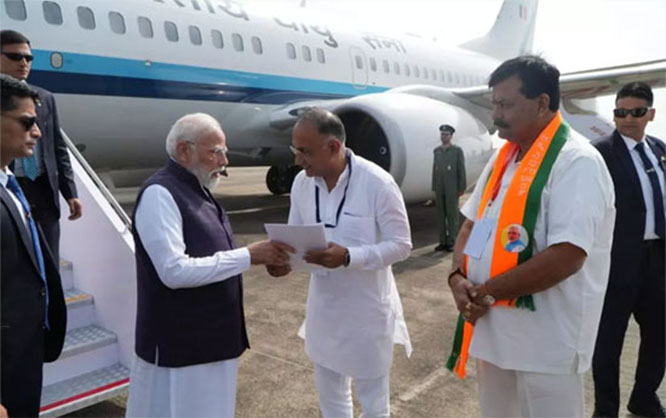
Mangaluru, Nov 28: Karnataka Health Minister and Dakshina Kannada district in-charge minister Dinesh Gundu Rao on Friday handed over Chief Minister Siddaramaiah’s letter to Prime Minister Narendra Modi, highlighting the severe distress faced by farmers due to crashing crop prices.

PM Modi arrived at the Mangaluru International Airport en route to Udupi, where Gundu Rao welcomed him and submitted the letter. The chief minister’s message stressed that farmers are suffering heavy losses because maize and green gram are being bought far below the Minimum Support Price (MSP). The state urged the Centre to immediately begin procurement at MSP.

According to the letter, Karnataka has a bumper harvest this year—over 54.74 lakh metric tons of maize and 1.98 lakh metric tons of green gram—yet farmers are unable to secure fair prices. Against the MSP of ₹2,400/MT for maize and ₹8,768/MT for green gram, market rates have plunged to ₹1,600–₹1,800 and ₹5,400 respectively.

The chief minister has requested the Centre to:

• Direct NAFED, FCI and NCCF to start MSP procurement immediately.
• Ensure ethanol units purchase maize directly from farmers or FPOs.
• Increase Karnataka’s ethanol allocation, citing high production capacity.
• Stop maize imports, which have depressed domestic prices.
• Relax quality norms for green gram, allowing up to 10% discoloration due to rains.

The letter stresses that MSP is crucial for farmer dignity and income stability and calls for swift central intervention to prevent a deepening crisis.

Comments

Add new comment

  • Coastaldigest.com reserves the right to delete or block any comments.
  • Coastaldigset.com is not responsible for its readers’ comments.
  • Comments that are abusive, incendiary or irrelevant are strictly prohibited.
  • Please use a genuine email ID and provide your name to avoid reject.
News Network
December 2,2025

A major upgrade in safety and monitoring is planned for Haj 2026, with every Indian pilgrim set to receive a Haj Suvidha smart wristband linked to the official Haj Suvidha mobile app. The initiative aims to support pilgrims—especially senior citizens—who may struggle with smartphones during the 45-day journey.

What the Smart Wristband Will Do

Officials said the device will come with:
•    Location tracking
•    Pedometer
•    SOS emergency button
•    Qibla compass
•    Prayer timings
•    Basic health monitoring

SP Tiwari, secretary of the UP State Haj Committee, said the goal is to make the pilgrimage safer and more comfortable.

“Most Hajis are elderly and not comfortable with mobile apps,” he said. “The smartwatch will help locate pilgrims who forget their way or cannot communicate their location.”

The wristbands will be monitored by the Consulate General of India in Saudi Arabia, similar to mobile tracking via the Haj Suvidha App.

Free Distribution and Training

•    Smart wristbands will be given free of cost.
•    Training for pilgrims will be conducted between January and February 2026.
•    Sample units will reach state Haj committees soon.
•    Final devices will be distributed as pilgrims begin their journey.

New Rules for Accommodation

Two major decisions have also been finalised for Haj 2026:
1.    Separate rooms for men and women – including married couples. They may stay on the same floor but must occupy different rooms, following stricter Saudi guidelines.
2.    Cooking banned – gas cylinders will not be allowed; all meals will be provided through official catering services arranged by the Haj Committee of India.

These decisions were finalised during a meeting of the Haj Committee of India and state representatives in Mumbai.

Haj Suvidha App Launched Earlier

The government launched the Haj Suvidha App in 2024, offering:

•    Training modules
•    Accommodation and flight details
•    Baggage information
•    SOS and translation tools
•    Grievance redressal

Haj 2026 Quota and Key States

•    India’s total Haj quota for 2026: 1,75,025 pilgrims
•    70% (1,25,000) allotted to the Haj Committee of India
•    30% (around 50,000) reserved for Haj Group Organisers

Uttar Pradesh has the largest allocation (around 30,000 seats), though approximately 18,000 pilgrims are expected to go this year. States with high pilgrim numbers include Kerala, Maharashtra and Gujarat.

Dates of Haj 2026

The pilgrimage is scheduled to take place from 24 May to 29 May, 2026 (tentative).
Haj is one of the five pillars of Islam and is mandatory for Muslims who meet the required conditions.

Comments

Add new comment

  • Coastaldigest.com reserves the right to delete or block any comments.
  • Coastaldigset.com is not responsible for its readers’ comments.
  • Comments that are abusive, incendiary or irrelevant are strictly prohibited.
  • Please use a genuine email ID and provide your name to avoid reject.
News Network
November 26,2025

students.jpg

Bengaluru, Nov 26: Karnataka is taking its first concrete steps towards lifting a three-decade-old ban on student elections in colleges and universities. Deputy Chief Minister D.K. Shivakumar announced Wednesday that the state government will form a small committee to study the reintroduction of campus polls, a practice halted in 1989 following incidents of violence.

Speaking at a 'Constitution Day' event organised by the Karnataka Congress, Mr. Shivakumar underscored the move's aim: nurturing new political leadership from the grassroots.

"Recently, (Leader of the Opposition in Lok Sabha) Rahul Gandhi wrote a letter to me and Chief Minister (Siddaramaiah) asking us to think about restarting student elections," Shivakumar stated. "I'm announcing today that we'll form a small committee and seek a report on this."

Student elections were banned in Karnataka in 1989, largely due to concerns over violence and the infiltration of political party affiliates into campus life. The ban effectively extinguished vibrant student bodies and the pipeline of young leaders they often produced.

Mr. Shivakumar, who also serves as the Karnataka Congress president, said that former student leaders will be consulted to "study the pros and cons" of the re-introduction.

Acknowledging the history of the ban, he added, "There were many criminal activities taking place back then. We’ll see how we can conduct (student) elections by regulating such criminal activities."

The Deputy CM reminisced about his own journey, which began on campus. He recalled his political activism at Sri Jagadguru Renukacharya College leading to his first Assembly ticket in 1985 at the age of 23. "That's how student leadership was at the time. Such leadership has gone today. College elections have stopped," he lamented, adding that for many, college elections were "like a big movement" where leaders were forged.

The move, driven by the Congress high command's push to cultivate young talent, will face scrutiny from academics and university authorities who have, in the past, expressed concern that the return of polls could disrupt the peaceful academic environment and turn campuses into political battlegrounds.

Comments

Add new comment

  • Coastaldigest.com reserves the right to delete or block any comments.
  • Coastaldigset.com is not responsible for its readers’ comments.
  • Comments that are abusive, incendiary or irrelevant are strictly prohibited.
  • Please use a genuine email ID and provide your name to avoid reject.