SC suspends triple talaq for 6 months, asks Parliament to make a law

Agencies
August 22, 2017

New Delhi, Aug 22: In a landmark judgment, the Supreme Court on Tuesday suspended the triple talaq verdict for the next six months with immediate effect. The top court also asked the Parliament to bring in the new law to govern the issue. Three out of five judges hearing the case have declared triple talaq as 'arbitary' and 'unconstitutional'.

A five-judge bench comprising of Chief Justice Jagdish Singh Khehar, Justice Kurian Joseph, Justice Rohinton Fali Nariman, Justice Uday Umesh Lalit and Justice S Abdul Nazeer – all from different religious communities including Sikh, Christian, Parsi, Hindu and Muslim – heard seven pleas, including five separate petitions, filed by Muslim women challenging the prevalent practice of triple talaq in the community.

Uttarakhand-based Shayara Bano was the first to file a petition in the Supreme Court of India challenging the constitutional validity of Triple talaq.

Expressing happiness on the judgement, Bano told Zee News, “I know the law of triple talaq cannot end. But the Supreme Court has ended the practice. It's a great judgment for Muslim women across the country and for our future generation.”

She further added, “There is no mention of teen talaq in Quraon. It's a fabrication of the society.”

“I have not even seen my children in the last two-three years. I don't know what's happening to them. I hope no one goes through such tremendous mental pressure. Because of triple talaq, children are suffering physical and mental harassment,” said Bano.

“Triple Talaq is a violation to equlity and the dignity of a woman,” said Monika Arora, Supreme Court advocate.

The judges had reserved its verdict on May 18 after a six-day marathon hearing during the summer vacation.

The Chief Justice of India (CJI) J S Khehar, while reading the judgement, said that "talaq-e-biddat is not in violation of articles 14,15, 21 and 25 of the Constitution."

He further said the talaq-e-biddat is an integral part of Sunni community, which is being practiced for the last 1000 years.

During the hearing, the top court observed that the practice of triple talaq was the "worst" and "not a desirable" form of dissolution of marriage among Muslims, even though there were schools of thought which called it "legal".

The Centre had told the bench that it introduce a new law to regulate the instant divorce practice among Muslims, if triple talaq is held invalid and unconstitutional by the top court.

The government had termed all the three forms of divorce among the Muslim community - talaq-e-biddat, talaq hasan and talaq ahsan, as "unilateral" and "extra-judicial"

As the Centre sought to flag the issue of gender equality of Muslim women vis-a-vis women in other religions and in Islamic countries, the All India Muslim Personal Law Board (AIMPLB) asked it to bring a law taking recourse to Article 25 (2)(b) of the Constitution that permits enactment of law invoking social reforms.

However, AIMPLB had cautioned the constitution bench that "testing the validity of customs and practices was a slippery slope" and cautioned the bench that "testing the validity of customs and practices was a slippery slope".

In the course of the hearing, the AIMPLB issued an advisory to telling the qazis to give an option to Muslim women to opt out of instant triple talaq before giving consent for nikah.

Senior advocate Kapil Sibal, appearing for All India Muslim Personal Law Board (AIMPLB), had equated the issue of triple talaq with the belief that Lord Rama was born in Ayodhya and these were matters of faith which cannot be tested on grounds of constitutional morality.

Comments

Close your eyes and think who created this, when i was close my eyes i can`t see anything and ask your creator to guide me in Right path , Don't blame Islam , blame yourself that you can`t identify your  creator.

Sangeeth
 - 
Tuesday, 22 Aug 2017

Dear Saleem, If you want to live in India, then you should follow Indian laws and rules. Any country like that only. I cant live in Saudi without following their rules. Modiji is doing right thing in that way...

Sandesh
 - 
Tuesday, 22 Aug 2017

True mr. unknown. "Islam not just a religion its a lifestlye for peaceful life BY DIVORCING WIFE VERBALLY JUST SAYING TALAQ"

Unknown
 - 
Tuesday, 22 Aug 2017

Islam not just a religion its a lifestlye for peaceful life

Saleem
 - 
Tuesday, 22 Aug 2017

SC cant decide our laws

Rakesh
 - 
Tuesday, 22 Aug 2017

Contradiction is in the case of PM

Add new comment

  • Coastaldigest.com reserves the right to delete or block any comments.
  • Coastaldigset.com is not responsible for its readers’ comments.
  • Comments that are abusive, incendiary or irrelevant are strictly prohibited.
  • Please use a genuine email ID and provide your name to avoid reject.
News Network
December 5,2025

Mangaluru: In a significant step to curb online hate and intimidation, Mangaluru City Police have registered a suo motu case against multiple Instagram accounts accused of circulating alleged provocative and threatening content.

While monitoring social media activity on Tuesday, Kankanady Town PSI Anitha Nikkam identified the Instagram handle ‘team_targetttt_900’ for posting a hate message alongside images of lethal weapons. Another account, ‘team_nagara_900’, allegedly shared a threatening post targeting activist Bharath Kumdelu, tagging additional pages such as KARAVALI-OFFICIAL.

Several other accounts — including ‘immu_bhai.fan’, ‘target_boy_900’, ‘kings_of_manglore’, ‘team_target_boys.900’, ‘arshad_mangalore’, ‘target_ka19_ullal’, ‘team_target__’, ‘troll_tigersz_900’, ‘tr_group_900’, and ‘team_target_900’ — are also under scrutiny for spreading similar inflammatory material, police said.

Authorities have urged citizens, especially young social media users, to report suspicious pages and avoid engaging with groups that glorify violence or threaten individuals. Online hate can quickly escalate into real-world harm, and police stress that sharing or promoting such content can attract legal consequences.

Comments

Add new comment

  • Coastaldigest.com reserves the right to delete or block any comments.
  • Coastaldigset.com is not responsible for its readers’ comments.
  • Comments that are abusive, incendiary or irrelevant are strictly prohibited.
  • Please use a genuine email ID and provide your name to avoid reject.
News Network
December 17,2025

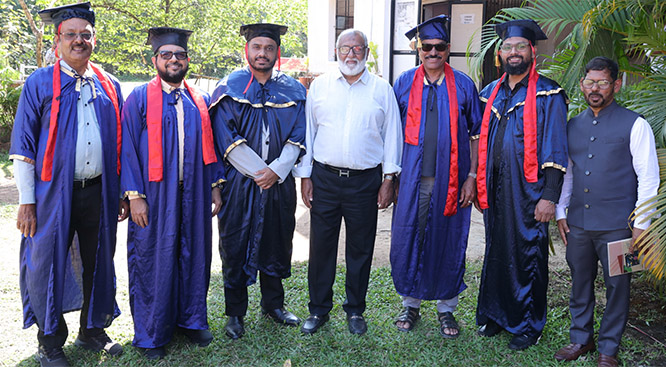
melkar1.jpg

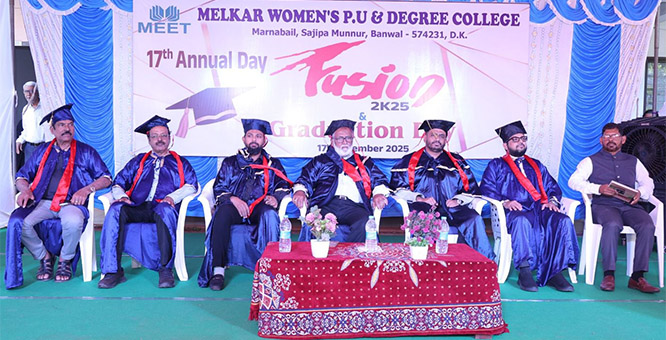
Melkar, Dec 17: The 17th Annual Day and Graduation Ceremony of Melkar Women’s PU and Degree College, themed “Fusion-2K25,” was celebrated with dignity and enthusiasm, marking a significant milestone in the institution’s academic journey. The programme reflected the college’s steadfast commitment to academic excellence, character building, and the holistic development of students.

The event was inaugurated by Mr. Asif Mohammed, whose presence greatly enriched the occasion. The celebration was further graced by the chief guests Mr. P. B. Ahmed Mudassir and Mr. Nissar Fakeer Mohammed, along with the distinguished guests of honour Mr. B. A. Nazeer and Mr. Ibrahim Gadiyar. In their inspiring addresses, the guests encouraged the graduating students and appreciated the dedicated efforts of the management, faculty, and students.

The annual report was presented by the Principal, Mr. Abdul Majeed S, highlighting the institution’s academic progress, notable achievements, and extracurricular accomplishments during the academic year.

The presidential address was delivered by the esteemed Chairman of Melkar Women’s PU and Degree College, Dr. Haji S. M. Rasheed, who emphasized the vital role of education in empowering women and shaping responsible citizens. He also stressed the importance of discipline, dedication, and perseverance in achieving success.

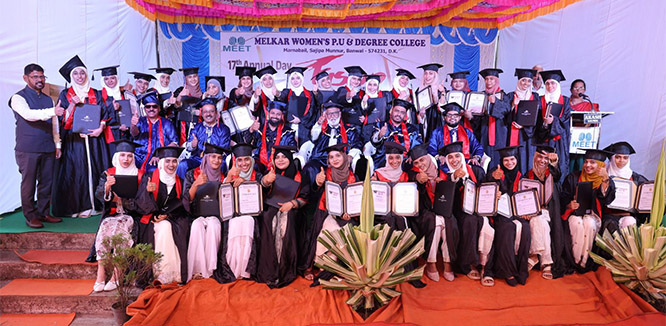
Cultural programmes and academic recognitions formed an integral part of the celebration, showcasing the talents and achievements of the students. The graduation ceremony was a proud moment for the outgoing students as they were formally conferred degrees and wished success in their future endeavours.

Ms. Mashmooma Fathima served as the Master of Ceremonies. The welcome address was delivered by Ms. Fathima Nida, and the programme concluded with a vote of thanks proposed by Ms. Ayisha Suhana.

The event successfully achieved its objectives and was highly appreciated by the guests and attendees.

melkar3.jpg

melkar2.jpg

Comments

Add new comment

  • Coastaldigest.com reserves the right to delete or block any comments.
  • Coastaldigset.com is not responsible for its readers’ comments.
  • Comments that are abusive, incendiary or irrelevant are strictly prohibited.
  • Please use a genuine email ID and provide your name to avoid reject.
News Network
December 13,2025

New Delhi: School-going children are picking up drug and smoking habits and engaging in consumption of alcohol, with the average age of introduction to such harmful substances found to be around 13 years, suggesting a need for earlier interventions as early as primary school, a multi-city survey by AIIMS-Delhi said.

The findings also showed substance use increased in higher grades, with grade XI/XII students two times more likely to report use of substances when compared with grade VIII students. This emphasised the importance of continued prevention and intervention through middle and high school.

The study led by Dr Anju Dhawan of AIIMS's National Drug Dependence Treatment Centre, published in the National Medical Journal of India this month, looks at adolescent substance use across diverse regions.

The survey included 5,920 students from classes 8, 9, 11 and 12 in urban government, private and rural schools across 10 cities -- Bengaluru, Chandigarh, Delhi, Dibrugarh, Hyderabad, Imphal, Jammu, Lucknow, Mumbai, and Ranchi. The data were collected between May 2018 and June 2019.

The average age of initiation for any substance was 12.9 (2.8) years. It was lowest for inhalants (11.3 years) followed by heroin (12.3 years) and opioid pharmaceuticals (without prescription; 12.5 years).

Overall, 15.1 per cent of participants reported lifetime use, 10.3 per cent reported past year use, and 7.2 per cent reported use in the past month of any substance, the study found.

The most common substances used in the past year, after tobacco (4 per cent) and alcohol (3.8 per cent), were opioids (2.8 per cent), followed by cannabis (2 per cent) and inhalants (1.9 per cent). Use of non-prescribed pharmaceutical opioids was most common among opioid users (90.2 per cent).

On being asked, 'Do you think this substance is easily available for a person of your age' separately for each substance category, nearly half the students (46.3 per cent) endorsed that tobacco products and more than one-third of the students (36.5 per cent) agreed that a person of their age can easily procure alcohol products.

Similarly, for Bhang (21.9 per cent), ganja/charas (16.1 per cent), inhalants (15.2 per cent), sedatives (13.7 per cent), opium and heroin (10 per cent each), the students endorsed that these can be easily procured.

About 95 per cent of the children, irrespective of their grade, agreed with the statement that 'drug use is harmful'.

The rates of substance use (any) among boys were significantly higher than those of girls for substance use (ever), use in the past year and use in the past 30 days. Compared to grade VIII students, grade IX students were more likely, and grade XI/XII students were twice as likely to have used any substance (ever).

The likelihood of past-year use of any substance was also higher for grade IX students and for grade XI/XII students as compared to grade VIII students.

About 40 per cent of students mentioned that they had a family member who used tobacco or alcohol each. The use of cannabis (any product) and opioid (any product) by a family member was reported by 8.2 per cent and 3.9 per cent of students, respectively, while the use of other substances, such as inhalants/sedatives by family was 2-3 per cent, the study found.

A relatively smaller percentage of students reported use of tobacco or alcohol among peers as compared to among family members, while a higher percentage reported inhalants, sedatives, cannabis or opioid use among peers.

Children using substances (past year) compared to non-users reported significantly higher any substance use by their family members and peers.

There were 25.7 per cent students who replied 'yes' to the question 'conflicts/fights often occur in your family'. Most students also replied affirmatively to 'family members are aware of how their time is being spent' and 'damily members are aware of with whom they spend their time'.

Comments

Add new comment

  • Coastaldigest.com reserves the right to delete or block any comments.
  • Coastaldigset.com is not responsible for its readers’ comments.
  • Comments that are abusive, incendiary or irrelevant are strictly prohibited.
  • Please use a genuine email ID and provide your name to avoid reject.