



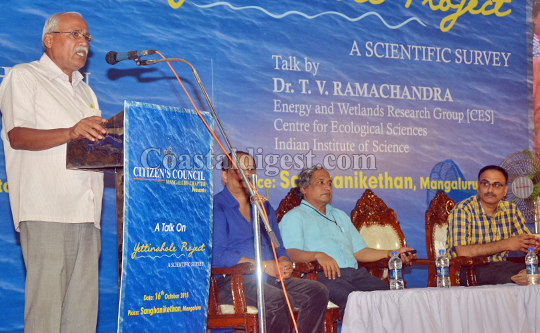
Mangaluru, Oct 17: T.V. Ramachandra, co-ordinator, Energy and Wetlands Research Group, Centre for Ecological Sciences, Indian Institute of Science (IISc), Bengaluru, said here on Friday that the Yettinahole diversion project is meant to benefit a “bunch of bureaucrats and contractors”.
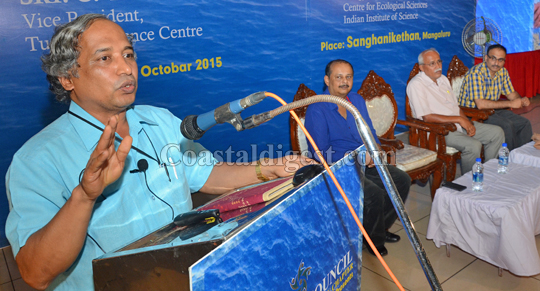
Speaking on the project at a function organised by Citizens’ Council, he called the detailed project report submitted by Karnataka Neeravari Nigam Ltd. (KNNL) as a “document for the pro-rich based on assumptions”.
Mr. Ramachandra, a scientist at the IISc and a fellow, National Institute of Hydrology, warned that if the project was implemented, it would meet the same fate as the Telugu Ganga Project.
The Telugu Ganga project, also known as the Krishna Water Supply Project, was one of the major projects that was executed during 1977-2006. The objective of the project was to utilise water from the Krishna and the Pennar rivers to provide 15 tmcft (later amended to 12 tmcft) of water to Chennai and irrigate 2,32,702 hectares of drought-prone areas in Kurnool, Chittoor and Cuddapah districts and the uplands in Nellore district in undivided Andhra Pradesh.
Water was diverted from the Srisailam reservoir, Andhra Pradesh, to Poondi reservoir, Tamil Nadu, for a distance of 406 km through a series of interlinked lined canals and reservoirs, namely Srisailam, Velugondu, Somasila, Kandaleru and Poondi reservoir.
The maximum quantity water supply to Chennai in 2006 was 3.7 tmcft. The government records showed that the highest water released since 1996 was six tmcft in 2000-2001.
Nellore farmers can now grow only one crop compared to three crops per year earlier. The Krishna river basin itself was facing severe scarcity in rainfall and lower catchment yield due to land cover changes, he said.
Mr. Ramachandra reiterated that the report, titled “Environmental Flow Assessment in Yettinahole, Where is 24 tmcft to divert?”, by the IISc was based on scientific studies and facts. Water yield in the Yettinahole catchment would be only 9.55 tmcft, he reiterated.
He said that the annual yield of water from rainfall in Kolar district would be 52 tmcft and in Chkkaballapur district, it would be 61 tmcft.
Mr. Ramachandra suggested decentralised water harvesting through tanks, ponds, lakes, restoration of water sources, increasing the green cover, re-charging groundwater as solutions to mitigate water scarcity in the parched districts.
Also Read: ‘Govt is misleading, dividing people over Yettinahole project’

Comments
Add new comment