Singh brothers resign after HC upholds Rs 3,500 cr arbitral award to Japanese pharma

Agencies
February 9, 2018

Fortis Healthcare promoters Malvinder Mohan Singh and Shivinder Mohan Singh have resigned as directors from the company’s board following the Delhi High Court order upholding the ₹3,500 crore arbitral award in favour of Daiichi Sankyo.

The Singh brothers have jointly tendered their resignation to the Board of Fortis Healthcare, which will discuss it in the meeting on 13 February, the company said in a filing to the BSE.

“Malvinder Mohan Singh, Executive Chairman and Shivinder Mohan Singh, Non-Executive Vice Chairman have tendered their resignation from the directorships of the company,” Fortis Healthcare said.

The resignation is intended to free the organisation from any encumbrances that may be linked to the promoters, the letter said.

“In light of the recent High Court judgement upholding the plea of Daiichi Sankyo to enforce the arbitration award, we believe this is in the interest of propriety and good governance,” it said.

The Delhi High Court had on 31 January upheld an international arbitral award of ₹3,500 crore passed in favour of Japanese pharma major Daiichi Sankyo, which has alleged that the former promoters of India’s Ranbaxy Laboratories had concealed information about proceedings against them by American food and drug department.

A tribunal in Singapore had passed the verdict in favour of Daiichi holding that the former Ranbaxy promoters and brothers, Malvinder Singh and Shivinder Singh, had concealed information that the Indian company was facing probe by the US Food and Drug Administration and the Department of Justice, while selling its shares.

With the resignation of the promoters, the board will be “better enabled and empowered to guide the future direction of the organisation without anyway being hampered by the Daiichi Sankyo judgement and our association at the Board,” the letter said.

“The members of the board are also requested to look into all inter-group transactions and distance the promoter group from Fortis Healthcare Ltd in a manner that enables continuity of the operations of the organisation and deliver on its mission of enriching and saving lives,” the Singh brothers wrote in the letter.

The High Court order paved the way for enforcement of the 2016 arbitral award passed by the Singapore tribunal against the Singh brothers who had sold their shares in Ranbaxy to Daiichi in 2008 for ₹9,576.1 crore. Sun Pharmaceuticals Ltd later acquired the company from Daiichi.

Daiichi had approached the High Court in 2016 to seek the enforcement of a ₹2,562 crore Singapore arbitral award passed in April 2016, along with an additional claim of interest and lawyers’ fees incurred in connection with the proceedings.

The tribunal’s award had come after the Japanese company invoked arbitration clause against Singhs alleging that they concealed important information while selling Ranbaxy in 2008.

Daiichi had entered into a settlement agreement with the US Department of Justice, agreeing to pay USD 500 million penalty to resolve potential, civil and criminal liability.

The company had then sold its stake in Ranbaxy to Sun Pharmaceuticals for ₹22,679 crore in 2015.

Comments

Add new comment

  • Coastaldigest.com reserves the right to delete or block any comments.
  • Coastaldigset.com is not responsible for its readers’ comments.
  • Comments that are abusive, incendiary or irrelevant are strictly prohibited.
  • Please use a genuine email ID and provide your name to avoid reject.
News Network
December 6,2025

pilot.jpg

New Delhi: IndiGo, India’s largest airline, faced major operational turbulence this week after failing to prepare for new pilot-fatigue regulations issued by the Directorate General of Civil Aviation (DGCA). The stricter rules—designed to improve flight safety—took effect in phases through 2024, with the latest implementation on November 1. IndiGo has acknowledged that inadequate roster planning led to widespread cancellations and delays.

Below are the key DGCA rules that affected IndiGo’s operations:

1. Longer Mandatory Weekly Rest

Weekly rest for pilots has been increased from 36 hours to 48 hours.

The government says the extended break is essential to curb cumulative fatigue. This rule remains in force despite the current crisis.

2. Cap on Night Landings

Pilots can now perform only two night landings per week—a steep reduction from the earlier limit of six.

Night hours, defined as midnight to early morning, are considered the least alert period for pilots.

Given the disruptions, this rule has been temporarily relaxed for IndiGo until February 10.

3. Reduced Maximum Night Flight Duty

Flight duty that stretches into the night is now capped at 10 hours.

This measure has also been kept on hold for IndiGo until February 10 to stabilize operations.

4. Weekly Rest Cannot Be Replaced With Personal Leave

Airlines can no longer count a pilot’s personal leave as part of the mandatory 48-hour rest.

Pilots say this closes a loophole that previously reduced actual rest time.

Currently, all airlines are exempt from this rule to normalise travel.

5. Mandatory Fatigue Monitoring

Airlines must submit quarterly fatigue reports along with corrective actions to DGCA.

This system aims to create a transparent fatigue-tracking framework across the industry.

The DGCA has stressed that these rules were crafted to strengthen flight safety and align India with global fatigue-management standards. The temporary relaxations are expected to remain until February 2025, giving IndiGo time to stabilise its schedules and restore normal air travel.

Comments

Add new comment

  • Coastaldigest.com reserves the right to delete or block any comments.
  • Coastaldigset.com is not responsible for its readers’ comments.
  • Comments that are abusive, incendiary or irrelevant are strictly prohibited.
  • Please use a genuine email ID and provide your name to avoid reject.
News Network
November 28,2025

ministerPM.jpg

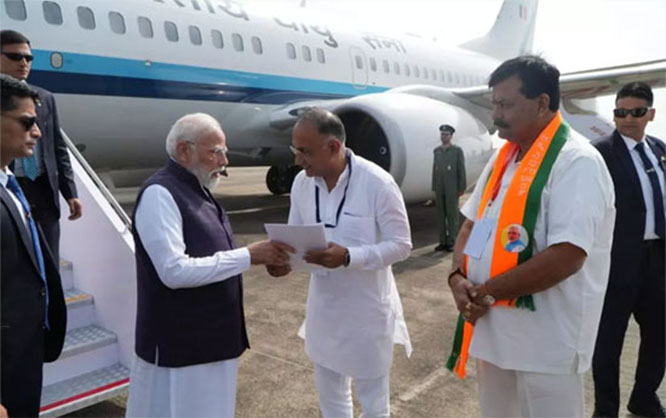
Mangaluru, Nov 28: Karnataka Health Minister and Dakshina Kannada district in-charge minister Dinesh Gundu Rao on Friday handed over Chief Minister Siddaramaiah’s letter to Prime Minister Narendra Modi, highlighting the severe distress faced by farmers due to crashing crop prices.

PM Modi arrived at the Mangaluru International Airport en route to Udupi, where Gundu Rao welcomed him and submitted the letter. The chief minister’s message stressed that farmers are suffering heavy losses because maize and green gram are being bought far below the Minimum Support Price (MSP). The state urged the Centre to immediately begin procurement at MSP.

According to the letter, Karnataka has a bumper harvest this year—over 54.74 lakh metric tons of maize and 1.98 lakh metric tons of green gram—yet farmers are unable to secure fair prices. Against the MSP of ₹2,400/MT for maize and ₹8,768/MT for green gram, market rates have plunged to ₹1,600–₹1,800 and ₹5,400 respectively.

The chief minister has requested the Centre to:

• Direct NAFED, FCI and NCCF to start MSP procurement immediately.
• Ensure ethanol units purchase maize directly from farmers or FPOs.
• Increase Karnataka’s ethanol allocation, citing high production capacity.
• Stop maize imports, which have depressed domestic prices.
• Relax quality norms for green gram, allowing up to 10% discoloration due to rains.

The letter stresses that MSP is crucial for farmer dignity and income stability and calls for swift central intervention to prevent a deepening crisis.

Comments

Add new comment

  • Coastaldigest.com reserves the right to delete or block any comments.
  • Coastaldigset.com is not responsible for its readers’ comments.
  • Comments that are abusive, incendiary or irrelevant are strictly prohibited.
  • Please use a genuine email ID and provide your name to avoid reject.
News Network
November 27,2025

Bengaluru, Nov 27: Karnataka Chief Minister Siddaramaiah’s camp is reportedly on alert as the Congress leadership tussle in the state intensifies, particularly amid speculation over the potential promotion of Deputy Chief Minister D.K. Shivakumar. Siddaramaiah is said to be in a “wait-and-watch” mode after admitting to “confusion” earlier this week and urging the party to “put a full stop” to it.

Sources say his supporters are ready to act if senior leaders — including party chief Mallikarjun Kharge, Sonia Gandhi, and Rahul Gandhi — give any indication of backing Shivakumar. If the party insists on a leadership change, Siddaramaiah’s camp has a list of alternatives, underscoring the deep rift between the two leaders. One possible candidate is Home Minister G. Parameshwara, a Siddaramaiah loyalist and influential Dalit leader.

The strategy was reportedly finalized at a meeting led by PWD Minister Satish Jarkiholi, another Siddaramaiah supporter, who stressed that Delhi leaders need to resolve the issue. Kharge and the Gandhis are expected to meet soon, after which Siddaramaiah and Shivakumar may be summoned to Delhi.

Shivakumar has largely stayed non-confrontational, publicly endorsing Siddaramaiah and downplaying speculation about his own ambitions. However, he has made pointed comments emphasizing the importance of honoring promises, directed at Siddaramaiah.

The feud traces back to the 2023 state election, when Siddaramaiah was chosen as Chief Minister while Shivakumar, who led the party’s campaign, was made Deputy CM and state party chief — a departure from the Congress’ usual “one post per person” rule.

There were also hints of a prior understanding that Siddaramaiah would step down midway through the term. As the halfway mark passed last week, Shivakumar-aligned lawmakers have ramped up pressure on the party for a leadership change, with Shivakumar himself hinting at stepping down as state party chief to pursue the top job.

Comments

Add new comment

  • Coastaldigest.com reserves the right to delete or block any comments.
  • Coastaldigset.com is not responsible for its readers’ comments.
  • Comments that are abusive, incendiary or irrelevant are strictly prohibited.
  • Please use a genuine email ID and provide your name to avoid reject.