



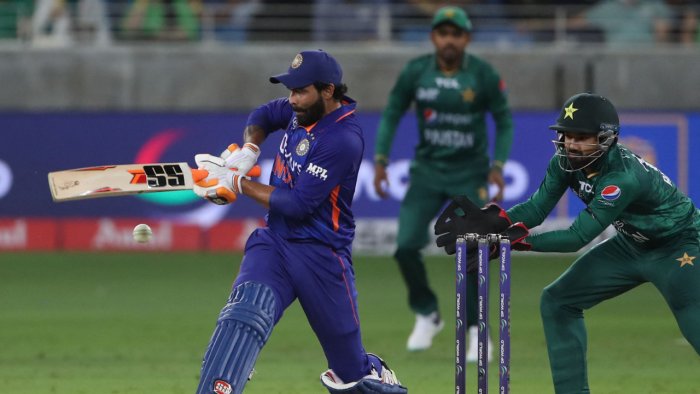
Asia Cup 2022: India beat Pakistan by 5 wickets in a thriller

News Network
August 28, 2022

jadeja.jpg

Dubai, Aug 29: Hardik Pandya produced a special all-round effort as India held nerves to pull off an exciting five-wicket win over arch-rivals Pakistan in their Asia Cup opener here on Sunday.

Hardik (3/25 in 4 overs) showed his high value under extreme pressure as his well-directed short balls helped India bowl out Pakistan for 147.

It should have been straight forward chase but India's experienced top-three faltered, putting extra pressure on the middle order.

Hardik (33 not out off 17) and Ravindra Jadeja (35 off 29) then shared a 52-run stand to take India on the cusp of of a famous win. The star all-rounder's three fours off Haris Rauf off the 19th over effectively sealed the game for India.

With the team needing 6 off three balls, Hardik finished the game with a six off left-arm spinner Mohammad Nawaz.

The focus was on India's top three going into the tournament and all three -- K L Rahul (0), Rohit Sharma (12 off 18) and Virat Kohli (35 off 34) -- did not have the best of times in the middle.

Rahul was out first ball with a tentative away from the body stroke off Naseem Shah that saw him playing on to his stumps.

Virat, who did hit a couple of confident pull shots in his innings, was dropped in the first over. He also played and missed a few times and also got lucky when a mistimed pull went all the way for six.

With luck going his way, it seemed Kohli will finally get a much awaited big score but he was caught at long off off Nawaz. In his previous over, Rohit was too dismissed in a similar fashion as he attempted to clear the long off fielder.

With Pakistani pacers led by debutant Naseem troubling the Indian batters with extra pace and spinners keeping it tidy, 86 runs off the last 10 overs seemed a tough task.

When Shah returned to rattle Suryakumar Yadav's stumps, India were reduced to 89 for four with a lot riding on incoming battter Hardik and Jadeja.

The equation was brought down to 32 off 18 balls with Pakistan forced to bring one extra fielder inside the circle due to an over rate penalty. Pakistan pacers especially Shah struggling with cramps made the Indians task a tad easier.

Earlier, Rohit Sharma decided to chase after winning the toss and the bowlers, led by Hardik, set up the game nicely for India.

Bhuvneshwar Kumar (4/26) was at his skilful best and his four wicket haul included the prized scalp of Babar Azam (10). However, Hardik's envious figures of 3 for 25 in four overs, during the middle phase, triggered a Pakistani batting collapse.

Young seamer Arshdeep Singh also returned decent figures of 2 fo 33 in his first ever appearance in an Indo-Pak clash as all 10 wickets were snapped by speed merchants, a first for India in shortest version.

The first over of the game bowled by Bhuvneshwar was a rather eventful one as it included two DRS calls going in favour of Mohammad Rizwan (43 off 42) and a straight drive from Babar.

There was not much movement around for both Bhuvneshwar and Arshdeep Singh as they managed to keep things tight in their two over opening spell.

Babar straight drove Arshdeep in the second over, showing the sublime touch he has been in over the past 12 months.

Bhuvneshwar, however, surprised the Pakistan skipper with a bouncer in his second over and he went for the pull only to top edge to Arshdeep at short fine leg.

India went in with Avesh Khan as the third pace option and he struck in his opening over after Rizwan smashed him for a six and four towards the midwicket region.

His fifth ball of the over was faced by left-handed Fakhar Zaman who decided to walk after edging a short and wide ball to wicketkeeper Dinesh Karthik who was picked ahead of Rishabh Pant for the big game.

With the crowd making a lot of noise, the Indians did not hear the edge but Zaman decided to walk, leaving Pakistan at 43 for two in six overs.

Rizwan then shared a 45-run stand for the third wicket with Iftikhar Ahmed (28 off 22) to give the innings some momentum.

However, Hardik changed the course of the game removing the well set Iftikhar and Rizwan with well directed short balls --- the former edged it to Karthik and latter, not sure of what he was doing, ended up giving a regulation catch to third man.

Soon after, Hardik removed Khushdil Shah with another short ball to leave Pakistan at 97 for five in the 15th over.

Number 11 Shahnawaz Dahani hammered two big sixes in the death overs to take Pakistan closer to 150. 

Comments

Add new comment

  • Coastaldigest.com reserves the right to delete or block any comments.
  • Coastaldigset.com is not responsible for its readers’ comments.
  • Comments that are abusive, incendiary or irrelevant are strictly prohibited.
  • Please use a genuine email ID and provide your name to avoid reject.
News Network
January 23,2026

Mangaluru: The Karnataka Government Polytechnic (KPT), Mangaluru, has achieved autonomous status from the All India Council for Technical Education (AICTE), becoming the first government polytechnic in the country to receive such recognition in its 78-year history. The status was granted by AICTE, New Delhi, and subsequently approved by the Karnataka Board of Technical Education in October last year.

Officials said the autonomy was conferred a few months ago. Until recently, AICTE extended autonomous status only to engineering colleges, excluding diploma institutions. However, with a renewed national focus on skill development, several government polytechnics across India have now been granted autonomy.

KPT, the second-largest polytechnic in Karnataka, was established in 1946 with four branches and has since expanded to offer eight diploma programmes, including computer science and polymer technology. The institution is spread across a 19-acre campus.

Ravindra M Keni, the first dean of the institution, told The Times of India that AICTE had proposed autonomous status for polytechnic institutions that are over 25 years old. “Many colleges applied. In the first round, 100 institutions were shortlisted, which was further narrowed down to 15 in the second round. We have already completed one semester after becoming an autonomous institution,” he said. He added that nearly 500 students are admitted annually across eight three-year diploma courses.

Explaining the factors that helped KPT secure autonomy, Keni said the institution has consistently recorded 100 per cent admissions and placements for its graduates. He also noted its strong performance in sports, with the college emerging champions for 12 consecutive years, along with active student participation in NCC and NSS activities.

Autonomous status allows KPT to design industry-oriented curricula, conduct examinations, prepare question papers, and manage academic documentation independently. The institution can also directly collaborate with industries and receive priority funding from AICTE or the Ministry of Education. While academic autonomy has been granted, financial control will continue to rest with the state government.

“There will be separate committees for examinations, question paper setting, boards of studies, and boards of examiners. The institution will now have the freedom to conduct admissions without government notifications and issue its own marks cards,” Keni said, adding that new academic initiatives would be planned after a year of functioning under the autonomous framework.

Comments

Add new comment

  • Coastaldigest.com reserves the right to delete or block any comments.
  • Coastaldigset.com is not responsible for its readers’ comments.
  • Comments that are abusive, incendiary or irrelevant are strictly prohibited.
  • Please use a genuine email ID and provide your name to avoid reject.
News Network
January 23,2026

Karnataka Governor Thaawarchand Gehlot read only three lines from the 122-paragraph address prepared by the Congress-led state government while addressing the joint session of the Legislature on Thursday, effectively bypassing large sections critical of the BJP-led Union government.

The omitted portions of the customary Governor’s address outlined what the state government described as a “suppressive situation in economic and policy matters” under India’s federal framework. The speech also sharply criticised the Centre’s move to replace the Mahatma Gandhi National Rural Employment Guarantee Act (MGNREGA) with the Viksit Bharat–Guarantee for Rozgar and Ajeevika Mission (Gramin) Act, commonly referred to as the VB-GRAM (G) Act.

Governor Gehlot had earlier conveyed his objection to several paragraphs that were explicitly critical of the Union government. On Thursday, he confined himself to the opening lines — “I extend a warm welcome to all of you to the joint session of the State legislature. I am extremely pleased to address this august House” — before jumping directly to the concluding sentence of the final paragraph.

He ended the address by reading the last line of paragraph 122: “Overall, my government is firmly committed to doubling the pace of the State’s economic, social and physical development. Jai Hind — Jai Karnataka.”

According to the prepared speech, the Karnataka government demanded the scrapping of the VB-GRAM (G) Act, describing it as “contractor-centric” and detrimental to rural livelihoods, and called for the full restoration of MGNREGA. The state government argued that the new law undermines decentralisation, weakens labour protections, and centralises decision-making in violation of constitutional norms.

Key points from the unread sections of the speech:

•    Karnataka facing a “suppressive” economic and policy environment within the federal system

•    Repeal of MGNREGA described as a blow to rural livelihoods

•    VB-GRAM (G) Act accused of protecting corporate and contractor interests

•    New law alleged to weaken decentralised governance

•    Decision-making said to be imposed by the Centre without consulting states

•    Rights of Adivasis, women, backward classes and agrarian communities curtailed

•    Labourers allegedly placed under contractor control

•    States facing mounting fiscal stress due to central policies

•    VB-GRAM (G) Act accused of enabling large-scale corruption

Comments

Add new comment

  • Coastaldigest.com reserves the right to delete or block any comments.
  • Coastaldigset.com is not responsible for its readers’ comments.
  • Comments that are abusive, incendiary or irrelevant are strictly prohibited.
  • Please use a genuine email ID and provide your name to avoid reject.
News Network
January 31,2026

Roy.jpg

Bengaluru: The shooting incident involving CJ Roy, founder of the Confident Group, has once again put the spotlight on a businessman whose life has swung between flamboyant global success and persistent controversy at home.

Though Roy’s business interests extended across continents, his roots lay firmly in Karnataka. An alumnus of Christ School in Bengaluru, he later moved to Tumakuru to pursue an engineering degree. Those familiar with his early years describe him as intensely ambitious, beginning his career as a salesman at a small electronics firm dealing in computers.

Roy’s entry into large-scale real estate came through the Crystal Group, where he worked closely with Latha Namboothiri and rose from manager to director. However, the launch of the Confident Group in 2005 was clouded by industry speculation. Insiders speak of a fallout involving alleged “benami” properties and claims of deception that ultimately led to his independent venture—an episode Roy spent years trying to distance himself from, according to associates.

A tale of two cities

Roy’s professional trajectory diverged sharply across geographies.

In Dubai, he built a reputation as a bold and efficient developer, completing massive luxury residential projects in record time—some reportedly within 11 months. His rapid project delivery and lavish lifestyle in the Emirates earned him admiration and visibility in the real estate sector.

In Bengaluru, however, his image remained far more fractured. Sources say Roy stayed away from the city for several years amid disputes over unpaid dues to vendors and suppliers. Several projects were allegedly stalled, with accusations of unfulfilled commitments to cement and steel suppliers continuing to follow him.

Roy’s return to Bengaluru’s business and social circles began around 2018, marked by a conscious attempt at rebranding. His appointment as Honorary Consul of the Slovak Republic added diplomatic legitimacy, which he complemented with visible CSR initiatives, including ambulance donations and high-profile charity events.

Heavy police presence in Langford Town

Following the incident, police personnel from the Central division were deployed outside the Confident Group building in Langford Town, which also houses the Slovak Honorary Consulate in Bengaluru.

The otherwise busy premises near Hosur Road wore a deserted look on Friday, reflecting the shock and uncertainty that followed the tragedy.

Comments

Add new comment

  • Coastaldigest.com reserves the right to delete or block any comments.
  • Coastaldigset.com is not responsible for its readers’ comments.
  • Comments that are abusive, incendiary or irrelevant are strictly prohibited.
  • Please use a genuine email ID and provide your name to avoid reject.
