



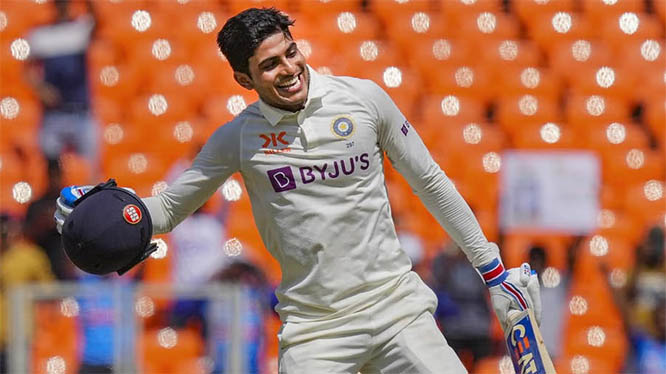
Here’s why Shubman Gill is India’s new Test captain—and what it means for the team’s future

News Network
May 24, 2025

shubhmanG.jpg

Mumbai, May 24: In a significant shift that marks the beginning of a new era in Indian Test cricket, Shubman Gill has been named the new captain of the Indian Test team. Rishabh Pant, making a remarkable comeback, has been appointed vice-captain. The announcement comes ahead of India’s challenging five-match Test series in England.

This leadership transition was widely anticipated following the retirement of senior players Rohit Sharma and Virat Kohli from the longest format of the game. With this move, the selectors have clearly signaled a generational change in the team's direction.

“Over the last year or so, we have been looking at Shubman for leadership. We are hopeful he’s the one to take the team forward. It’s a high-pressure job, but he’s a terrific player. We wish him all the best,” said chief selector Ajit Agarkar at the press conference.

Why Shubman Gill?

At just 24, Gill has already proven himself as one of the most technically sound and mentally composed young batters in international cricket. With a Test average above 45, overseas centuries, and strong domestic credentials, he represents the calm yet assertive leadership style the team needs in the post-Kohli-Rohit era.

Key Inclusions and Comebacks

•    B. Sai Sudharsan has earned his maiden Test call-up, after consistent domestic performances.

•    Karun Nair, who once scored a historic triple century in Tests, has made a surprise return after seven years.

•    Abhimanyu Easwaran and Nitish Reddy also find places in the squad, adding depth to the batting unit.
Notable Absences

•    Veteran pacer Mohammed Shami has been ruled out due to fitness concerns. “His workload is not where it needs to be. We were hoping he would be available, but it’s unfortunate,” Agarkar noted.

•    Rising talents Harshit Rana and Sarfaraz Khan, both part of the previous Test squad in Australia, have been dropped.

India’s Test Squad for England Tour:

Shubman Gill (Captain), Rishabh Pant (Vice-Captain), Yashasvi Jaiswal, K. L. Rahul, Sai Sudharsan, Abhimanyu Easwaran, Karun Nair, Nitish Reddy, Ravindra Jadeja, Dhruv Jurel, Washington Sundar, Shardul Thakur, Jasprit Bumrah, Mohammed Siraj, Prasidh Krishna, Akash Deep, Arshdeep Singh, Kuldeep Yadav

With Gill at the helm and a mix of fresh and returning talent in the squad, India’s tour of England promises not only thrilling cricket but also a glimpse into the future of Indian Test leadership.

Comments

Add new comment

  • Coastaldigest.com reserves the right to delete or block any comments.
  • Coastaldigset.com is not responsible for its readers’ comments.
  • Comments that are abusive, incendiary or irrelevant are strictly prohibited.
  • Please use a genuine email ID and provide your name to avoid reject.
News Network
January 23,2026

Karnataka Governor Thaawarchand Gehlot read only three lines from the 122-paragraph address prepared by the Congress-led state government while addressing the joint session of the Legislature on Thursday, effectively bypassing large sections critical of the BJP-led Union government.

The omitted portions of the customary Governor’s address outlined what the state government described as a “suppressive situation in economic and policy matters” under India’s federal framework. The speech also sharply criticised the Centre’s move to replace the Mahatma Gandhi National Rural Employment Guarantee Act (MGNREGA) with the Viksit Bharat–Guarantee for Rozgar and Ajeevika Mission (Gramin) Act, commonly referred to as the VB-GRAM (G) Act.

Governor Gehlot had earlier conveyed his objection to several paragraphs that were explicitly critical of the Union government. On Thursday, he confined himself to the opening lines — “I extend a warm welcome to all of you to the joint session of the State legislature. I am extremely pleased to address this august House” — before jumping directly to the concluding sentence of the final paragraph.

He ended the address by reading the last line of paragraph 122: “Overall, my government is firmly committed to doubling the pace of the State’s economic, social and physical development. Jai Hind — Jai Karnataka.”

According to the prepared speech, the Karnataka government demanded the scrapping of the VB-GRAM (G) Act, describing it as “contractor-centric” and detrimental to rural livelihoods, and called for the full restoration of MGNREGA. The state government argued that the new law undermines decentralisation, weakens labour protections, and centralises decision-making in violation of constitutional norms.

Key points from the unread sections of the speech:

•    Karnataka facing a “suppressive” economic and policy environment within the federal system

•    Repeal of MGNREGA described as a blow to rural livelihoods

•    VB-GRAM (G) Act accused of protecting corporate and contractor interests

•    New law alleged to weaken decentralised governance

•    Decision-making said to be imposed by the Centre without consulting states

•    Rights of Adivasis, women, backward classes and agrarian communities curtailed

•    Labourers allegedly placed under contractor control

•    States facing mounting fiscal stress due to central policies

•    VB-GRAM (G) Act accused of enabling large-scale corruption

Comments

Add new comment

  • Coastaldigest.com reserves the right to delete or block any comments.
  • Coastaldigset.com is not responsible for its readers’ comments.
  • Comments that are abusive, incendiary or irrelevant are strictly prohibited.
  • Please use a genuine email ID and provide your name to avoid reject.
News Network
January 23,2026

Mangaluru: The Karnataka Government Polytechnic (KPT), Mangaluru, has achieved autonomous status from the All India Council for Technical Education (AICTE), becoming the first government polytechnic in the country to receive such recognition in its 78-year history. The status was granted by AICTE, New Delhi, and subsequently approved by the Karnataka Board of Technical Education in October last year.

Officials said the autonomy was conferred a few months ago. Until recently, AICTE extended autonomous status only to engineering colleges, excluding diploma institutions. However, with a renewed national focus on skill development, several government polytechnics across India have now been granted autonomy.

KPT, the second-largest polytechnic in Karnataka, was established in 1946 with four branches and has since expanded to offer eight diploma programmes, including computer science and polymer technology. The institution is spread across a 19-acre campus.

Ravindra M Keni, the first dean of the institution, told The Times of India that AICTE had proposed autonomous status for polytechnic institutions that are over 25 years old. “Many colleges applied. In the first round, 100 institutions were shortlisted, which was further narrowed down to 15 in the second round. We have already completed one semester after becoming an autonomous institution,” he said. He added that nearly 500 students are admitted annually across eight three-year diploma courses.

Explaining the factors that helped KPT secure autonomy, Keni said the institution has consistently recorded 100 per cent admissions and placements for its graduates. He also noted its strong performance in sports, with the college emerging champions for 12 consecutive years, along with active student participation in NCC and NSS activities.

Autonomous status allows KPT to design industry-oriented curricula, conduct examinations, prepare question papers, and manage academic documentation independently. The institution can also directly collaborate with industries and receive priority funding from AICTE or the Ministry of Education. While academic autonomy has been granted, financial control will continue to rest with the state government.

“There will be separate committees for examinations, question paper setting, boards of studies, and boards of examiners. The institution will now have the freedom to conduct admissions without government notifications and issue its own marks cards,” Keni said, adding that new academic initiatives would be planned after a year of functioning under the autonomous framework.

Comments

Add new comment

  • Coastaldigest.com reserves the right to delete or block any comments.
  • Coastaldigset.com is not responsible for its readers’ comments.
  • Comments that are abusive, incendiary or irrelevant are strictly prohibited.
  • Please use a genuine email ID and provide your name to avoid reject.