India in semis of Olympics men’s hockey after 49 years

News Network
August 1, 2021

hokyk.jpg

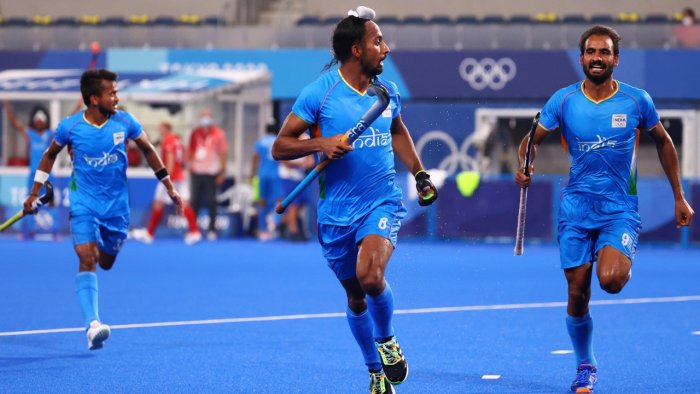
Tokyo, Aug 1: A determined Indian men's hockey team advanced to the Olympic semifinals for the first time in 49 years, beating Great Britain 3-1 in the quarterfinals on Sunday, a triumph which leaves the side within touching distance of a medal that has proved elusive for over four decades.

The eight-time former Olympic champions scored three field goals through Dilpreet Singh (7th minute), Gurjant Singh (16th) and Hardik Singh (57th) to seal the win.

Great Britain's lone goal was scored by Sam Ward from a penalty corner in the 45th minute.

India will take on world champions Belgium in the semifinal on Tuesday.

India's last of the eight Olympic gold medals came way back in the 1980 Moscow Games but there were no semifinals in that edition as only six teams participated in the event.

For a country that gave the world stalwarts like Major Dhyan Chand and Balbir Singh Senior among others, it has been especially painful to watch the hockey teams' Olympic debacles before this edition.

The last time India featured in the semifinals of the Olympics was in 1972 Munich Games where they lost 0-2 to arch-rivals Pakistan.

It was the edition in which American swimming legend Mark Spitz won seven gold medals, a feat which was overshadowed by the massacre of 11 Israeli athletes and coaches by Palestinian terrorists at the Olympic Village.

Belgium defeated Spain 3-1 in another quarterfinal to seal their place in the last four round.

The other semifinal of the men's hockey competition will be played between Australia and Germany.

By virtue of this win, India now have a 5-4 win-loss record over Great Britain in the Olympic Games.

In Sunday's tie, Great Britain enjoyed the early share of exchanges, earning their first penalty corner as early as in the third minute but India defended well to keep the danger away.

The Indians got their footing into the match as time went by and took the lead in the seventh minute through Dilpreet, who pushed the ball past Great Britain goalkeeper after being fed by Simranjeet Singh.

It was Simranjeet who created the chance after he stole the ball from a Great Britain defender just outside the latter's circle.

Two minutes from the first quarter, India custodian PR Sreejesh made fine reflex saves to deny Great Britain.

The Indians didn't let their rivals settle down and doubled their lead seconds into the second quarter through Gurjant.

It was Hardik who created the opportunity by intercepting a pass just outside the Great Britain 'D' and then sent the ball to an unmarked Gurjant, who kept a calm head to put the ball into the net through the legs of opposition goalkeeper Oliver Payne.

In the 35th minute, Gurjant had another chance to extend the lead but his reverse hit from a tight angle was easily saved by Payne.

Thereafter, it was all Great Britain as they pressed numbers in front in search of goals.

Leading by two goals, the Indians dropped back and tried to defend the lead but the move proved costly as minutes from the end of the third quarter Great Britain secured four back-to-back penalty corners the last of which was put into the back of the net by Ward.

With 15 more minutes remaining and just a goal behind, Great Britain went on the offensive in the final quarter, throwing numbers into their attacks as the Indians struggled to control the onslaught.

Great Britain succeeded in their efforts as they earned three more penalty corners in the match but their doubtable Sreejesh rose to the occasion and pulled off saves after saves to keep his side ahead.

India extended their lead against the run of play in the 57th minute when Hardik scored with a rebound from a counter-attack after his initial shot was saved by Great Britain goalkeeper Payne.

That goal sealed the tie in India's favour as down by two goals and with just three minutes remaining, Great Britain players' shoulders dropped down.

Once the hooter went off to declare the match's end, Indian players had tears of joy as they hugged and congratulated each other.


Comments

Add new comment

  • Coastaldigest.com reserves the right to delete or block any comments.
  • Coastaldigset.com is not responsible for its readers’ comments.
  • Comments that are abusive, incendiary or irrelevant are strictly prohibited.
  • Please use a genuine email ID and provide your name to avoid reject.
News Network
December 6,2025

pilot.jpg

New Delhi: IndiGo, India’s largest airline, faced major operational turbulence this week after failing to prepare for new pilot-fatigue regulations issued by the Directorate General of Civil Aviation (DGCA). The stricter rules—designed to improve flight safety—took effect in phases through 2024, with the latest implementation on November 1. IndiGo has acknowledged that inadequate roster planning led to widespread cancellations and delays.

Below are the key DGCA rules that affected IndiGo’s operations:

1. Longer Mandatory Weekly Rest

Weekly rest for pilots has been increased from 36 hours to 48 hours.

The government says the extended break is essential to curb cumulative fatigue. This rule remains in force despite the current crisis.

2. Cap on Night Landings

Pilots can now perform only two night landings per week—a steep reduction from the earlier limit of six.

Night hours, defined as midnight to early morning, are considered the least alert period for pilots.

Given the disruptions, this rule has been temporarily relaxed for IndiGo until February 10.

3. Reduced Maximum Night Flight Duty

Flight duty that stretches into the night is now capped at 10 hours.

This measure has also been kept on hold for IndiGo until February 10 to stabilize operations.

4. Weekly Rest Cannot Be Replaced With Personal Leave

Airlines can no longer count a pilot’s personal leave as part of the mandatory 48-hour rest.

Pilots say this closes a loophole that previously reduced actual rest time.

Currently, all airlines are exempt from this rule to normalise travel.

5. Mandatory Fatigue Monitoring

Airlines must submit quarterly fatigue reports along with corrective actions to DGCA.

This system aims to create a transparent fatigue-tracking framework across the industry.

The DGCA has stressed that these rules were crafted to strengthen flight safety and align India with global fatigue-management standards. The temporary relaxations are expected to remain until February 2025, giving IndiGo time to stabilise its schedules and restore normal air travel.

Comments

Add new comment

  • Coastaldigest.com reserves the right to delete or block any comments.
  • Coastaldigset.com is not responsible for its readers’ comments.
  • Comments that are abusive, incendiary or irrelevant are strictly prohibited.
  • Please use a genuine email ID and provide your name to avoid reject.
News Network
November 29,2025

DKSsiddu.jpg

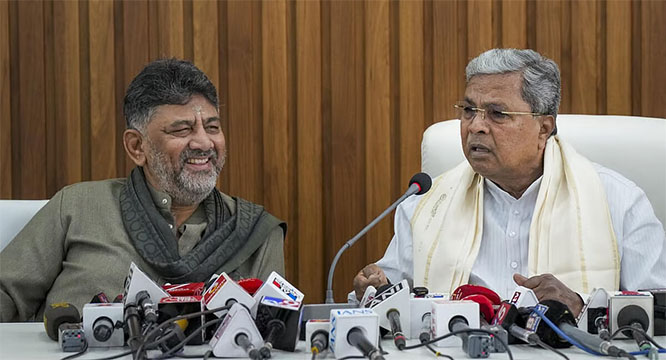
New Delhi: Karnataka chief minister Siddaramaiah and deputy CM DK Shivakumar on Saturday put up a dramatic display of unity at a closely watched joint press briefing, firmly dismissing weeks of speculation about a power-sharing tussle within the Congress. With the high command nudging both leaders to sit together and settle the dust, the meeting became a political spectacle, ending with the duo declaring that there was “no confusion, no differences.”

Calling the reports of a rift “manufactured confusion,” Siddaramaiah said the talks had gone smoothly, even joking about their breakfast. “Breakfast was very good. All three of us enjoyed it,” he said. “We want to end this confusion once and for all. For local elections and for 2028, our mission is clear — Congress must return to power. There is no difference between me and DKS, not now, not before.”

He blamed the media for fuelling rumours and reiterated absolute adherence to the party leadership. “From tomorrow, let there be no confusion. What the high command says, we will follow.”

Siddaramaiah also assured that the Assembly session starting December 8 would run smoothly and vowed that Congress would take on the BJP and JD(S) “together.”

Shivakumar echoed the chief minister word for word, stressing loyalty and discipline. “People have given us a massive mandate. It is our duty to deliver,” he said. “This government was formed under Siddaramaiah’s leadership. We both have complete trust in the high command. If they tell me to wait, I will wait.”

He added that the two leaders had discussed strategy for the 2028 Assembly elections. “Whatever the CM says, I agree. We are loyal soldiers of the party. The party may be facing challenges nationally, but we will keep it strong in Karnataka.”

Shivakumar also said Siddaramaiah would soon visit his home for lunch or dinner — another symbolic gesture meant to underline their unity.

Both leaders later posted on social media describing the breakfast meeting as “productive” and focused on “Karnataka’s priorities.”

The BJP, however, rejected the show of camaraderie as “pure bunkum,” accusing Congress of trying to paper over an internal power struggle. But Siddaramaiah and Shivakumar insisted their united front would continue — and that there was “no confusion” within the state leadership.

Comments

Add new comment

  • Coastaldigest.com reserves the right to delete or block any comments.
  • Coastaldigset.com is not responsible for its readers’ comments.
  • Comments that are abusive, incendiary or irrelevant are strictly prohibited.
  • Please use a genuine email ID and provide your name to avoid reject.
coastaldigest.com news network
November 28,2025

roadshow.jpg

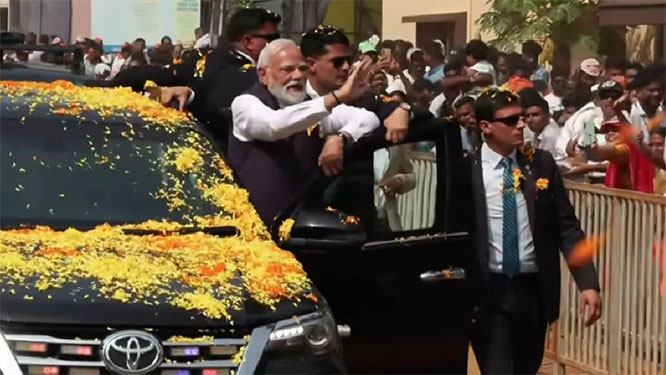
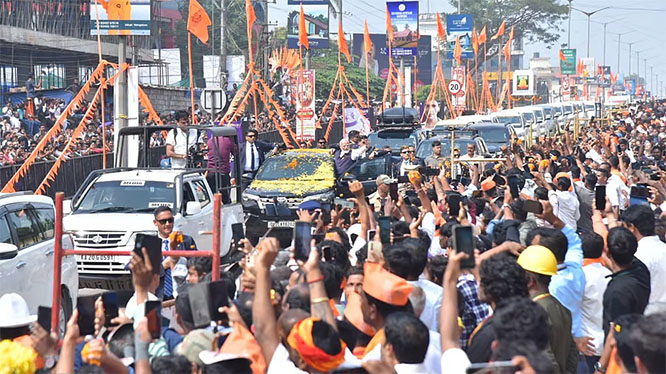
Udupi district transformed into a sea of saffron and celebration on Friday, November 28, as Prime Minister Narendra Modi’s roadshow swept through the coastal temple town. Thousands of residents lined the streets, turning the event into a vibrant public spectacle filled with cheers, flags, and festive energy.

The procession route—from the helipad to the historic Sri Krishna Math—was decked with buntings, saffron flags, and multilayered security barricades. One of the district’s largest-ever security deployments was put in place for the high-profile visit, with over 3,000 police personnel on duty. The arrangement included ten SPs, 27 DSPs, 49 inspectors, 127 sub-inspectors, 232 assistant sub-inspectors, 1,608 constables, and 39 women staff.

Six platoons of the Karnataka State Reserve Police, six Quick Response Teams, bomb detection units, and dog squads were stationed across Udupi. Enhanced surveillance covered Adi Udupi, Bannanje bus stand, and the Sri Krishna Math parking zone, with combing operations carried out along the roadshow corridor.

At the 800-year-old Sri Krishna Math, preparations reached a ceremonial peak. Paryaya Puttige Math seer Sugunendra Teertha Swamiji said the Prime Minister would take part in the Laksha Kantha Geetha Parayana, a mass chanting of the Bhagavad Gita by one lakh devotees, and inaugurate the new Suvarna Teertha Mantapa.

“He will first offer floral tributes to saint-poet Kanakadasa and then unveil the golden covering over the Kanakana Kindi,” the seer said.

The Prime Minister will also receive a Poorna Kumbha welcome and have darshan of Lord Sri Krishna, Mukhyaprana Devaru, and the Suvarna Paduke. Union Minister Pralhad Joshi, Karnataka Governor Thaawarchand Gehlot, Minister Bairathi Suresh, Dharmadhikari D. Veerendra Heggade, and seers from the Ashta Maths are expected to join the ceremony.

Ahead of his arrival, the Prime Minister posted on X that he felt “honoured” to attend the spiritually significant gathering. “This is a special occasion that brings together people from different sections of society for a recital of the Gita. This Matha has a very special significance in our cultural life,” he wrote, noting the institution’s long-standing legacy rooted in the teachings of Sri Madhvacharya.

roadshow2.jpg

Comments

Add new comment

  • Coastaldigest.com reserves the right to delete or block any comments.
  • Coastaldigset.com is not responsible for its readers’ comments.
  • Comments that are abusive, incendiary or irrelevant are strictly prohibited.
  • Please use a genuine email ID and provide your name to avoid reject.