Subrata Roy's get-out-of-jail deal is mired in mystery

February 5, 2015

Mumbai, Feb 5: Subrata Roy, the boss of the Sahara conglomerate, is in a New Delhi prison on contempt-of-court charges and needs to post $1.6 billion in bail to get out. To help raise the money, Sahara is in talks to refinance its overseas hotels, including New York's Plaza.
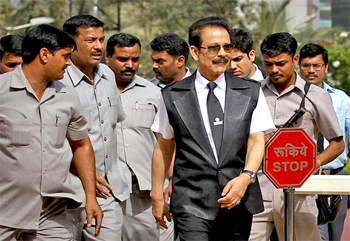
Subrata Roy

The only problem: It's unclear if the man who's orchestrating the deal, a 34-year-old former broker named Saransh Sharma, has the money to pull it off.

Sahara's head of corporate finance, Sandeep Wadhwa, said Sahara's lawyers had verified with Bank of America that Sharma has deposited just over $1 billion in an account at the bank that is "earmarked for the said transaction."

That account, however, doesn't appear to exist. A manager at the bank told Reuters that he didn't write a crucial document attributed to him: an email, sent in his name to Sahara, which purported to verify the account's existence.

After Reuters asked the bank to look into the account, spokeswoman Jumana Bauwens issued a statement saying: "Bank of America isn't involved in the transaction."

What's more, Sharma, who lives in San Jose, California, has admitted to stealing a database from a former employer. There are also two pending lawsuits against him alleging he forged a letter and produced fake documents to obtain a loan.

Bank of America's assertion that it has nothing to do with the deal, as well as details about Sharma's past, could throw a wrench into Sahara's efforts to free Roy in a case that has made headlines in India for almost a year.

Roy is being held at Tihar jail, the largest in India, on contempt charges for failing to comply with a court order to repay investors in a bond scheme later ruled to be illegal. The bail amount, the largest ever in India, reflects the cost of the illegal scheme, estimated by Indian regulators to be as much as $7 billion.

A lawyer working for Sahara, speaking on the condition of anonymity, said the company's lawyers had not separately checked with Bank of America to see whether Sharma had a billion-dollar account with the bank. Instead, the lawyer said, Sahara relied on a letter from the bank saying the funds were there. Sahara declined to comment on the lawyer's assertion.

Sharma told Reuters he is backed by a group of U.S. and U.K. investors for the refinancing and that the funds in the account have come from them. Both he and Sahara declined to identify the investors.

Sharma, who spoke with Reuters on Jan. 23 and sent a subsequent email on Jan. 28, said in an emailed statement on Wednesday that Mirach had faced "a number of challenges in closing this transaction" and that he wouldn't disclose "sensitive details" about the deal until it closes.

Under the proposed deal, which Sharma said he reached with Sahara in December, Sharma's investor group would help pay off about $880 million of a Bank of China loan for the hotels. Besides the Plaza, which Sahara bought for about $570 million in 2012, the properties also include the Dream Hotel in downtown New York and the Grosvenor House in London.

Sharma and the investor group also agreed to lend $650 million to Sahara and make a $450 million investment in the conglomerate's properties in India. Sahara and Sharma have said they expect to finalize the deal by Feb. 20.

It is unclear how paying off the Bank of China loan, or obtaining the loan and investment, would help Sahara pay Roy's bail and refund money to the bond investors.

Sahara's businesses range from financial services to media, retail and real estate. The company used to sponsor the Indian cricket team, which helped to make it a household name in the country. During his heyday, Roy, 66, socialized with presidents and film stars. Seen as a maverick among India's conservative business elite, his self-appointed title is "Managing Worker," and he's known in the company as "Saharasri," or "Mr. Sahara."

Sahara's troubles started in 2011 when it was found by the Securities and Exchange Board of India (SEBI), the market regulator, to have illegally sold billions of dollars of bonds to investors. After a legal battle that reached the Indian Supreme Court, Sahara was ordered to refund investors the money.

The Supreme Court threw Roy in jail last March after he failed to appear at a contempt hearing related to the dispute with the regulator and set his $1.6 billion bail. Sahara has said that it has repaid most investors, a claim SEBI has disputed.

Since Roy's imprisonment, Sahara has been trying to raise cash. It has been reporting its progress to the court and regulators, and needs approvals from them to do these transactions.

Sahara told the Supreme Court last month that it is in talks with Mirach Capital, the company Sharma set up to do the deal with Sahara. Sahara has shown the court a Jan. 5 letter from Bank of America, saying it is holding $1.05 billion in funds in an account on behalf of Mirach Capital for Sahara, according to a court filing. Sahara and Sharma declined to show Reuters a copy of the letter.

BANK MANAGER

Reuters has seen an email, dated Dec. 17, sent in the name of Nuno Marques, a Bank of America banking center manager in Wellington, Florida, to Sahara finance executive Wadhwa. In the email, the writer attests that Mirach "has sufficient liquidity with Bank of America to undertake the said transactions" with Sahara. The email does not specify the amount of funds Mirach has, but says the money would be put into escrow after anti-money laundering-related checks.

Marques, contacted by Reuters for comment on Feb. 3 at his office in Florida, denied having written the Dec. 17 e-mail. He said he had been called by another Bank of America employee to verify whether there were Mirach Capital funds on deposit and that he told her he couldn't do so.

Sahara declined to comment further, saying it was bound by "strict confidentiality provisions" as part of the talks with Mirach.

Shekhar Naphade, an independent lawyer advising the Indian Supreme Court on the case against Roy, said he had "no concrete details about the Bank of America escrow account" beyond the letter submitted by Sahara. Naphade said he didn't have the means to independently verify the claim made by Sharma about the bank account.

Sources familiar with the Reserve Bank of India's investigations into Sahara said the regulator had not received a request from the Supreme Court to probe whether the money is in the Bank of America account, but was making some initial checks of its own.

Sources familiar with SEBI said if the hotel deal does not go through, Indian government officials would seize and sell Sahara assets, including its hotels and properties, to raise cash.

FORMER BROKER

Sharma has spent the past decade working on and off for small independent brokerages in the United States, a Reuters review of U.S. regulatory filings shows.

He said in an interview that he had experience "transacting several multibillion dollar deals." He declined to give details, however, and said he had not successfully completed such deals before.

In 2013, Sharma sued a U.S. hedge fund for alleged breach of contract. In a Dec. 15, 2013, deposition in a New York federal civil court case, Sharma admitted to fabricating an email; to selling for $10,000 a database of contacts he stole from a previous employer, the investment bank AllianceBernstein; and to lying about the sources of funds he had obtained. A spokesman for AllianceBernstein declined to comment.

Sharma's case was dismissed. Sharma confirmed his statements made in the deposition, but said he had learned from his past mistakes.

He also has two other civil lawsuits pending against him in California courts.

A lawsuit filed by private equity firm Disruptive Technology Associates in August 2013 alleges Sharma forged a letter from the Bank of the West, saying that he had $400,000 in an account with the San Francisco based lender. A spokeswoman for Bank of the West declined to comment.

Another lawsuit filed by hedge fund Midwest Energy Resources in November 2013 alleges that he produced fake documents showing he owned pre-IPO shares in Twitter Inc that he planned to use as collateral for a loan. Sharma denies that allegation.

Sharma said the lawsuits have no bearing on the Sahara talks and that the suits were filed by people who are after his family's money. He told Reuters his family lived in Oman where his father was a doctor for the royal family.

Sharma said that he first connected Sahara's Wadhwa through business networking site LinkedIn. A Sahara spokesman confirmed on Wadhwa's behalf that Sharma had first approached the Sahara executive through LinkedIn.

Sharma told Reuters that he would bear the transaction costs for the deal and get a finder's fee, but is not investing in the deal. He said he was working with Paul Hastings lawyer Rick Kirkbride on the transaction.

Kirkbride referred calls to Paul Hastings spokeswoman Arielle Lapiano, who declined to comment.

Comments

Add new comment

  • Coastaldigest.com reserves the right to delete or block any comments.
  • Coastaldigset.com is not responsible for its readers’ comments.
  • Comments that are abusive, incendiary or irrelevant are strictly prohibited.
  • Please use a genuine email ID and provide your name to avoid reject.
News Network
December 5,2025

indigoCEO.jpg

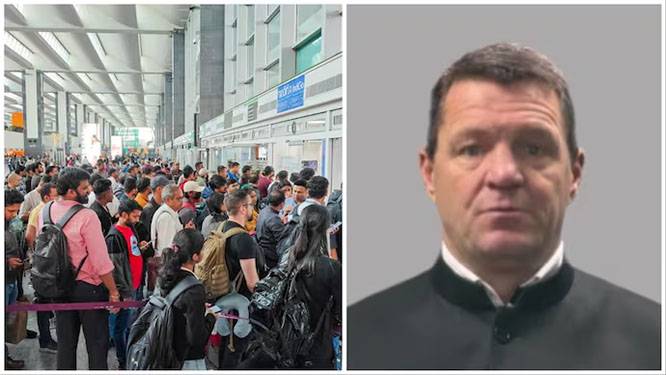
New Delhi, Dec 5: IndiGo CEO Pieter Elbers issued a public apology this evening after more than a thousand flights were cancelled today, making it the "most severely impacted day" in terms of cancellations. The biggest airline of the country cancelled "more than half" of its daily number of flights on Friday, said Elbers. He also said that even though the crisis will persist on Saturday, the airline anticipates fewer than 1,000 flight cancellations.

"Full normalisation is expected between December 10 and 15, though IndiGo cautions that recovery will take time due to the scale of operations," the IndiGo CEO said. 

IndiGo operates around 2,300 domestic and international flights daily.

Pieter Elbers, while apologising for the major inconvenience due to delays and cancellations, said the situation is a result of various causes.

The crisis at IndiGo stems from new regulations that boost pilots' weekly rest requirements by 12 hours to 48 and allow only two night-time landings per week, down from six. IndiGo has attributed the mass cancellations to "misjudgment and planning gaps".

Elbers also listed three lines of action that the airline will adopt to address the issue.

"Firstly, customer communication and addressing your needs, for this, messages have been sent on social media. And just now, a more detailed communication with information, refunds, cancellations and other customer support measures was sent," he said.

The airline has also stepped up its call centre capacity.

"Secondly, due to yesterday's situation, we had customers stranded mostly at the nation's largest airports. Our focus was for all of them to be able to travel today itself, which will be achieved. For this, we also ask customers whose flights are cancelled not to come to the airports as notifications are sent," the CEO said.

"Thirdly, cancellations were made for today to align our crew and planes to be where they need to start tomorrow morning afresh. Earlier measures of the last few days, regrettable, have proven not to be enough, but we have decided today to reboot all our systems and schedules, resulting in the highest numbers of cancellations so far, but imperative for progressive improvements starting from tomorrow," he added.

As airports witnessed chaotic scenes, the Directorate General of Civil Aviation (DGCA) stepped in to grant IndiGo a temporary exemption from stricter night duty rules for pilots. It also allowed substitution of leaves with a weekly rest period. 

Civil Aviation Minister Ram Mohan Naidu has said a high-level inquiry will be ordered and accountability will be fixed.

Comments

Add new comment

  • Coastaldigest.com reserves the right to delete or block any comments.
  • Coastaldigset.com is not responsible for its readers’ comments.
  • Comments that are abusive, incendiary or irrelevant are strictly prohibited.
  • Please use a genuine email ID and provide your name to avoid reject.
News Network
December 6,2025

indigoticket.jpg

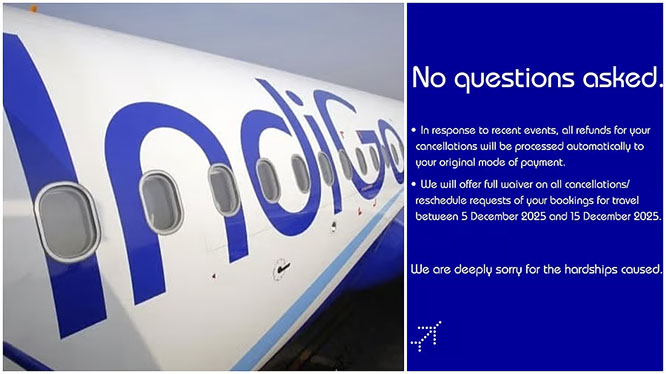
With IndiGo flight disruptions impacting thousands of passengers, the airline on Saturday said that it will offer full waiver on all cancellations/reschedule requests for travel bookings between December 5, 2025 and December 15, 2025.

Earlier in the day, the civil aviation ministry had directed the airline to complete the ticket refund process for the cancelled flights by Sunday evening, as well as ensure baggage separated from the travellers are delivered in the next two days.

In a post on X, titled 'No questions asked', IndiGo wrote, "In response to recent events, all refunds for your cancellations will be processed automatically to your original mode of payment."

"We are deeply sorry for the hardships caused," it further added.

Several passengers, however, complained of not getting full refund as promised by the airline.

Netizens have shared screenchots of getting charged for airline cancellation fee and convenience fee.

"Please tell me why u have did this airline cancellation charges when u say full amount will be refunded (sic)," a user wrote sharing a screenshot of the refund page.

"Well, but you have still debited the convenience charges," wrote another.

Passengers have also raised concerns about the "cancel" option being disabled on the IndiGo app. "First enable the 'Cancel' button on your App & offer full refund on tickets cancelled by customers between the said dates," wrote a user.

A day after the country's largest airline, IndiGo, cancelled more than 1,000 flights and caused disruptions for the fifth day on Saturday, the ministry said that any delay or non-compliance in refund processing will invite immediate regulatory action.

The refund process for all cancelled or disrupted flights must be completed by 8 pm on Sunday, the ministry said in a statement.

"Airlines have also been instructed not to levy any rescheduling charges for passengers whose travel plans were affected by cancellations," it said.

On Saturday, more than 400 flights were cancelled at various airports.

IndiGo has also been instructed to set up dedicated passenger support and refund facilitation cells.

Comments

Add new comment

  • Coastaldigest.com reserves the right to delete or block any comments.
  • Coastaldigset.com is not responsible for its readers’ comments.
  • Comments that are abusive, incendiary or irrelevant are strictly prohibited.
  • Please use a genuine email ID and provide your name to avoid reject.
News Network
December 13,2025

New Delhi: School-going children are picking up drug and smoking habits and engaging in consumption of alcohol, with the average age of introduction to such harmful substances found to be around 13 years, suggesting a need for earlier interventions as early as primary school, a multi-city survey by AIIMS-Delhi said.

The findings also showed substance use increased in higher grades, with grade XI/XII students two times more likely to report use of substances when compared with grade VIII students. This emphasised the importance of continued prevention and intervention through middle and high school.

The study led by Dr Anju Dhawan of AIIMS's National Drug Dependence Treatment Centre, published in the National Medical Journal of India this month, looks at adolescent substance use across diverse regions.

The survey included 5,920 students from classes 8, 9, 11 and 12 in urban government, private and rural schools across 10 cities -- Bengaluru, Chandigarh, Delhi, Dibrugarh, Hyderabad, Imphal, Jammu, Lucknow, Mumbai, and Ranchi. The data were collected between May 2018 and June 2019.

The average age of initiation for any substance was 12.9 (2.8) years. It was lowest for inhalants (11.3 years) followed by heroin (12.3 years) and opioid pharmaceuticals (without prescription; 12.5 years).

Overall, 15.1 per cent of participants reported lifetime use, 10.3 per cent reported past year use, and 7.2 per cent reported use in the past month of any substance, the study found.

The most common substances used in the past year, after tobacco (4 per cent) and alcohol (3.8 per cent), were opioids (2.8 per cent), followed by cannabis (2 per cent) and inhalants (1.9 per cent). Use of non-prescribed pharmaceutical opioids was most common among opioid users (90.2 per cent).

On being asked, 'Do you think this substance is easily available for a person of your age' separately for each substance category, nearly half the students (46.3 per cent) endorsed that tobacco products and more than one-third of the students (36.5 per cent) agreed that a person of their age can easily procure alcohol products.

Similarly, for Bhang (21.9 per cent), ganja/charas (16.1 per cent), inhalants (15.2 per cent), sedatives (13.7 per cent), opium and heroin (10 per cent each), the students endorsed that these can be easily procured.

About 95 per cent of the children, irrespective of their grade, agreed with the statement that 'drug use is harmful'.

The rates of substance use (any) among boys were significantly higher than those of girls for substance use (ever), use in the past year and use in the past 30 days. Compared to grade VIII students, grade IX students were more likely, and grade XI/XII students were twice as likely to have used any substance (ever).

The likelihood of past-year use of any substance was also higher for grade IX students and for grade XI/XII students as compared to grade VIII students.

About 40 per cent of students mentioned that they had a family member who used tobacco or alcohol each. The use of cannabis (any product) and opioid (any product) by a family member was reported by 8.2 per cent and 3.9 per cent of students, respectively, while the use of other substances, such as inhalants/sedatives by family was 2-3 per cent, the study found.

A relatively smaller percentage of students reported use of tobacco or alcohol among peers as compared to among family members, while a higher percentage reported inhalants, sedatives, cannabis or opioid use among peers.

Children using substances (past year) compared to non-users reported significantly higher any substance use by their family members and peers.

There were 25.7 per cent students who replied 'yes' to the question 'conflicts/fights often occur in your family'. Most students also replied affirmatively to 'family members are aware of how their time is being spent' and 'damily members are aware of with whom they spend their time'.

Comments

Add new comment

  • Coastaldigest.com reserves the right to delete or block any comments.
  • Coastaldigset.com is not responsible for its readers’ comments.
  • Comments that are abusive, incendiary or irrelevant are strictly prohibited.
  • Please use a genuine email ID and provide your name to avoid reject.