Tabassum Hasan first Muslim MP from UP in 16th Lok Sabha

Agencies
June 1, 2018

Lucknow, Jun 1: Tabassum Hasan, whose victory in Kairana has given strength to opposition unity in Uttar Pradesh ahead of the 2019 general election, today became the first Muslim MP from the most populous state in the 16th Lok Sabha.

Hasan (48) defeated her nearest BJP rival Mriganka Singh by a huge margin of 44,600 votes as the Rashtriya Lok Dal candidate supported by the Samajwadi Party, the Congress and the Bahujan Samaj Party.

The opposition also won the Noorpur assembly seat, where SP's Naimul Hasan defeated the BJP candidate.

Uttar Pradesh, which has Muslim population of about 20 per cent, elected no Muslim MP in the 2014 Lok Sabha elections.

Out of 80 Lok Sabha seats, the BJP and its ally Apna Dal won 73 in the 2014 elections. The SP got five seats and the Congress just two.

"My success is the victory of people of the state who have shown that they have stood up against the four-year-old misrule of the BJP," Tabassum Hasan said after her resounding victory.

"Had there be no EVM problem, my victory margin would have been more," she said referring to the complaints against electronic voting machines.

"I was confident of my victory as I had faith in the people," she said.

Hasan claimed Prime Minister Narendra Modi will have no impact in next year's Lok Sabha polls.

"The BJP's arrogant people say there is no alternative to Modi, but the Almighty always finds a way out and the alliance of opposition parties will come out triumphant against the BJP in 2019.

"My victory has proved that the path of the united opposition is clear in 2019," she said.

Hasan took a plunge into politics in the 2009 Lok Sabha election on a BSP ticket, months after the death of her husband Munawwar Hasan in a car crash in Haryana and defeated BJP candidate Hukum Singh.

In 2014, her son Nahid Hasan fought the election on a SP ticket against Hukum Singh but was defeated.

Nahid won the UP assembly polls in 2017 against Hukum Singh's daughter Mriganka.

Kairana LS constituency has 16 lakh voters of whom Muslims account for a major chunk of five lakh voters. Dalits and Jats have two lakh voters each. Another major chunk is that of Gurjars who constitute one lakh voters.

The Kairana seat fell vacant after the death of BJP MP Hukum Singh, whose daughter Mriganka was the party candidate this time.

In Kairana, the opposition consolidated the anti-BJP vote and repeated its success in Gorakhpur and Phulpur bye-elections earlier this year when the ruling party suffered humiliating defeats.

Bye-elections were held for Gorakhpur and Phulpur in March as the seats fell vacant when UP Chief Minister Yogi Adityanath and his deputy Keshav Prasad Maurya resigned after entering the UP legislative council.

The ruling BJP had campaigned hard in Kairana with Chief Minister Yogi Adityanath himself wooing voters. SP chief Akhilesh Yadav and BSP supremo Mayawati stayed away from the campaigning.

Prime Minister Narendra Modi visited a neighbouring district, Baghpat, where he talked about development of western UP and also inaugurated the Eastern Peripheral Expressway, but voters appeared to have already made up their mind to back the opposition.

"The victory has sent a strong message to voters and party workers. The anti-people policies of the BJP stand exposed and voters are looking for an alternative," SP MLC Rajpal Kashyap said.

RLD national spokesman Anil Dubey said, "This victory is not of our party alone, but of the united opposition. With this victory we succeeded in uniting the society which the BJP attempted to fragment with its divisive politics."

Deputy Chief Minister Dinesh Sharma said the BJP does not dabble in the politics of victory or defeat.

"We believe in working for development and we don't want to contest elections on communal or caste lines," he said, accusing the opposition of spreading the venom of communalism and casteism to win elections by hook or by crook.

The Kairana election is the fourth Lok Sabha bye-election in the state since 2014.

Apart from Gorakhpur and Phulpur, a bye-election was also held in Mainpuri in 2014.

SP patriarch Mulayam Singh Yadav had resigned from Mainpuri after deciding to represent Azamgarh, the second constituency from which he won in 2014.

SP's Tej Pratap Singh Yadav, who is related to him, defeated the BJP there in that bye-election, retaining the seat for his party.


Comments

Add new comment

  • Coastaldigest.com reserves the right to delete or block any comments.
  • Coastaldigset.com is not responsible for its readers’ comments.
  • Comments that are abusive, incendiary or irrelevant are strictly prohibited.
  • Please use a genuine email ID and provide your name to avoid reject.
News Network
December 16,2025

bengal.jpg

The deletion of over 58 lakh names from West Bengal’s draft electoral rolls following a Special Intensive Revision (SIR) has sparked widespread concern and is likely to deepen political tensions in the poll-bound state.

According to the Election Commission, the revision exercise has identified 24 lakh voters as deceased, 19 lakh as relocated, 12 lakh as missing, and 1.3 lakh as duplicate entries. The draft list, published after the completion of the first phase of SIR, aims to remove errors and duplication from the electoral rolls.

However, the scale of deletions has raised fears that a large number of eligible voters may have been wrongly excluded. The Election Commission has said that individuals whose names are missing can file objections and seek corrections. The final voter list is scheduled to be published in February next year, after which the Assembly election announcement is expected. Notably, the last Special Intensive Revision in Bengal was conducted in 2002.

The development has intensified the political row over the SIR process. Chief Minister Mamata Banerjee and her Trinamool Congress have strongly opposed the exercise, accusing the Centre and the Election Commission of attempting to disenfranchise lakhs of voters ahead of the elections.

Addressing a rally in Krishnanagar earlier this month, Banerjee urged people to protest if their names were removed from the voter list, alleging intimidation during elections and warning of serious consequences if voting rights were taken away.

The BJP, meanwhile, has defended the revision and accused the Trinamool Congress of politicising the issue to protect what it claims is an illegal voter base. Leader of the Opposition Suvendu Adhikari alleged that the ruling party fears losing power due to the removal of deceased, fake, and illegal voters.

The controversy comes amid earlier allegations by the Trinamool Congress that excessive work pressure during the SIR led to the deaths by suicide of some Booth Level Officers (BLOs), for which the party blamed the Election Commission. With the draft list now out, another round of political confrontation appears imminent.

As objections begin to be filed, the focus will be on whether the correction mechanism is accessible, transparent, and timely—critical factors in ensuring that no eligible voter is denied their democratic right ahead of a crucial election.

Comments

Add new comment

  • Coastaldigest.com reserves the right to delete or block any comments.
  • Coastaldigset.com is not responsible for its readers’ comments.
  • Comments that are abusive, incendiary or irrelevant are strictly prohibited.
  • Please use a genuine email ID and provide your name to avoid reject.
News Network
December 13,2025

New Delhi: School-going children are picking up drug and smoking habits and engaging in consumption of alcohol, with the average age of introduction to such harmful substances found to be around 13 years, suggesting a need for earlier interventions as early as primary school, a multi-city survey by AIIMS-Delhi said.

The findings also showed substance use increased in higher grades, with grade XI/XII students two times more likely to report use of substances when compared with grade VIII students. This emphasised the importance of continued prevention and intervention through middle and high school.

The study led by Dr Anju Dhawan of AIIMS's National Drug Dependence Treatment Centre, published in the National Medical Journal of India this month, looks at adolescent substance use across diverse regions.

The survey included 5,920 students from classes 8, 9, 11 and 12 in urban government, private and rural schools across 10 cities -- Bengaluru, Chandigarh, Delhi, Dibrugarh, Hyderabad, Imphal, Jammu, Lucknow, Mumbai, and Ranchi. The data were collected between May 2018 and June 2019.

The average age of initiation for any substance was 12.9 (2.8) years. It was lowest for inhalants (11.3 years) followed by heroin (12.3 years) and opioid pharmaceuticals (without prescription; 12.5 years).

Overall, 15.1 per cent of participants reported lifetime use, 10.3 per cent reported past year use, and 7.2 per cent reported use in the past month of any substance, the study found.

The most common substances used in the past year, after tobacco (4 per cent) and alcohol (3.8 per cent), were opioids (2.8 per cent), followed by cannabis (2 per cent) and inhalants (1.9 per cent). Use of non-prescribed pharmaceutical opioids was most common among opioid users (90.2 per cent).

On being asked, 'Do you think this substance is easily available for a person of your age' separately for each substance category, nearly half the students (46.3 per cent) endorsed that tobacco products and more than one-third of the students (36.5 per cent) agreed that a person of their age can easily procure alcohol products.

Similarly, for Bhang (21.9 per cent), ganja/charas (16.1 per cent), inhalants (15.2 per cent), sedatives (13.7 per cent), opium and heroin (10 per cent each), the students endorsed that these can be easily procured.

About 95 per cent of the children, irrespective of their grade, agreed with the statement that 'drug use is harmful'.

The rates of substance use (any) among boys were significantly higher than those of girls for substance use (ever), use in the past year and use in the past 30 days. Compared to grade VIII students, grade IX students were more likely, and grade XI/XII students were twice as likely to have used any substance (ever).

The likelihood of past-year use of any substance was also higher for grade IX students and for grade XI/XII students as compared to grade VIII students.

About 40 per cent of students mentioned that they had a family member who used tobacco or alcohol each. The use of cannabis (any product) and opioid (any product) by a family member was reported by 8.2 per cent and 3.9 per cent of students, respectively, while the use of other substances, such as inhalants/sedatives by family was 2-3 per cent, the study found.

A relatively smaller percentage of students reported use of tobacco or alcohol among peers as compared to among family members, while a higher percentage reported inhalants, sedatives, cannabis or opioid use among peers.

Children using substances (past year) compared to non-users reported significantly higher any substance use by their family members and peers.

There were 25.7 per cent students who replied 'yes' to the question 'conflicts/fights often occur in your family'. Most students also replied affirmatively to 'family members are aware of how their time is being spent' and 'damily members are aware of with whom they spend their time'.

Comments

Add new comment

  • Coastaldigest.com reserves the right to delete or block any comments.
  • Coastaldigset.com is not responsible for its readers’ comments.
  • Comments that are abusive, incendiary or irrelevant are strictly prohibited.
  • Please use a genuine email ID and provide your name to avoid reject.
News Network
December 17,2025

melkar1.jpg

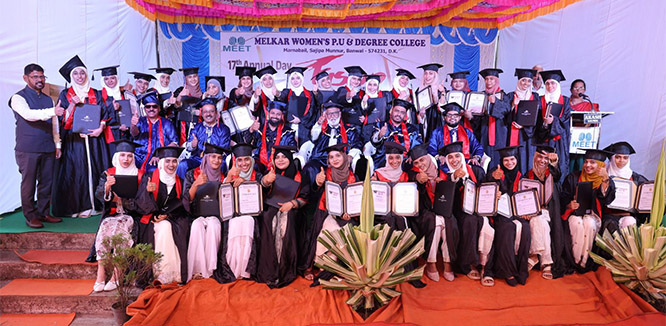
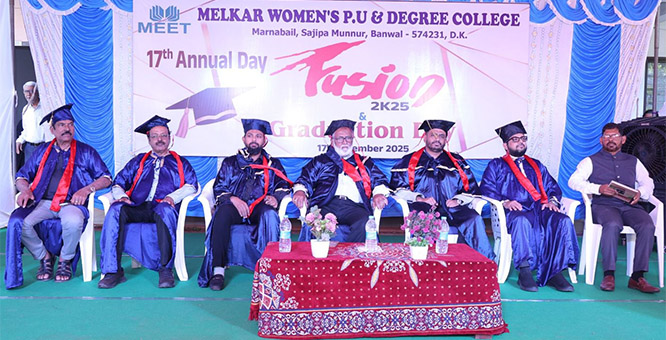
Melkar, Dec 17: The 17th Annual Day and Graduation Ceremony of Melkar Women’s PU and Degree College, themed “Fusion-2K25,” was celebrated with dignity and enthusiasm, marking a significant milestone in the institution’s academic journey. The programme reflected the college’s steadfast commitment to academic excellence, character building, and the holistic development of students.

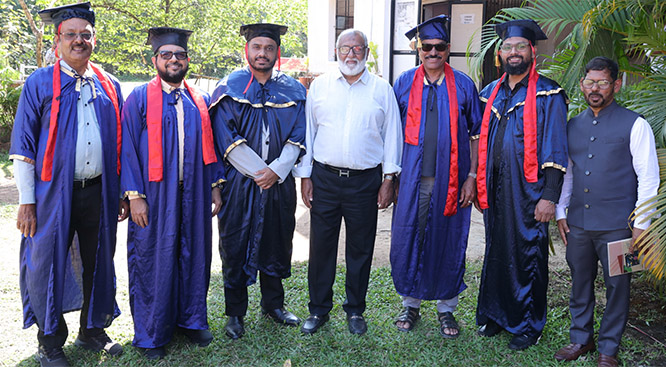
The event was inaugurated by Mr. Asif Mohammed, whose presence greatly enriched the occasion. The celebration was further graced by the chief guests Mr. P. B. Ahmed Mudassir and Mr. Nissar Fakeer Mohammed, along with the distinguished guests of honour Mr. B. A. Nazeer and Mr. Ibrahim Gadiyar. In their inspiring addresses, the guests encouraged the graduating students and appreciated the dedicated efforts of the management, faculty, and students.

The annual report was presented by the Principal, Mr. Abdul Majeed S, highlighting the institution’s academic progress, notable achievements, and extracurricular accomplishments during the academic year.

The presidential address was delivered by the esteemed Chairman of Melkar Women’s PU and Degree College, Dr. Haji S. M. Rasheed, who emphasized the vital role of education in empowering women and shaping responsible citizens. He also stressed the importance of discipline, dedication, and perseverance in achieving success.

Cultural programmes and academic recognitions formed an integral part of the celebration, showcasing the talents and achievements of the students. The graduation ceremony was a proud moment for the outgoing students as they were formally conferred degrees and wished success in their future endeavours.

Ms. Mashmooma Fathima served as the Master of Ceremonies. The welcome address was delivered by Ms. Fathima Nida, and the programme concluded with a vote of thanks proposed by Ms. Ayisha Suhana.

The event successfully achieved its objectives and was highly appreciated by the guests and attendees.

melkar3.jpg

melkar2.jpg

Comments

Add new comment

  • Coastaldigest.com reserves the right to delete or block any comments.
  • Coastaldigset.com is not responsible for its readers’ comments.
  • Comments that are abusive, incendiary or irrelevant are strictly prohibited.
  • Please use a genuine email ID and provide your name to avoid reject.