



Telangana set to become 29th state of India

February 20, 2014

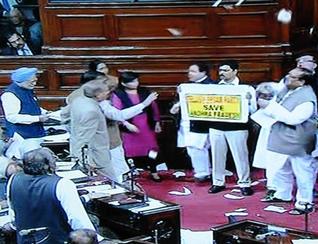
New Delhi, Feb 20: Telangana was all set to become 29th state of the Union with Parliament tonight approving a historic bill to carve it out of Andhra Pradesh amid vociferous protests by members from Seemandhra region as also from Trinamool Congress and Shiv Sena.
telangana
The suspense over the passage of the Andhra Pradesh Reorganisation Bill, 2014 came to an end with BJP backing the government on it despite raising several concerns.

Apparently responding to demands from Seemandhra MPs as well as from BJP for "justice" to the region, Prime Minister Manmohan Singh announced a six-point development package for successor states of Andhra Pradesh including grant of special category status including tax incentives to Seemandhra.

Congress President Sonia Gandhi's request to the Prime Minister to give a special category status to Seemandhra for five years seems to have apparently clinched the issue and BJP came on board.

"I hope these additional announcements will demonstrate our steadfast commitment to not just the creation of Telangana but also to the continued prosperity and welfare of Seemandhra," Singh noted.

A protective cordon was thrown around Singh as well as Home Minister Sushilkumar Shinde by Congress members as members from Seemandhra region as also those from TMC and Shiv Sena stormed the Well with TMC members even tearing papers and throwing them on the floor.

CPI-M members walked out in protest.

The House looked like a virtual battle-ground during the five-hour proceedings, which saw seven adjournments as members resorted to slogan shouting and tore papers describing the bill passed by the Lok Sabha on Tuesday as illegal.

The debate also saw the government facing an awkward situation when Union Minister Chiranjeevi, who hails from Seemandhra region, opposed the decision on Telangna inviting ridicule from BJP, which wondered whether a member of the Council of Minister can oppose a decision taken by his own government without resigning from it.

As the bill appeared set to be a reality with most of the amendments moved by the BJP either negatived or withdrawn, CPI-M and Trinamool Congress alleged "nexus" between the ruling party and the main Opposition.

Minister Jairam Ramesh, who was a key person in the Telangana decision process as a member of the GoM on the issue, repeatedly made brief intervention to assuage the concerns of members on diverse issues.

Law Minister Kapil Sibal said time has come to create Telangana. "Time has come to take this historic decision...it is very difficult to satisfy all people of both the regions."

Deputy Chairman P J Kurien rejected demands for division taking the plea that there was no order in the House.

Unlike Lok Sabha, where the bill was passed after a very brief discussion, Rajya Sabha saw a threadbare debate spanning around three hours despite unprecedented protest with anti-Telangana members storming the well with huge placards sometimes even overshadowing the Chair.

Similarly, unlike the television black out that was witnessed during the proceedings in Lok Sabha, there was no such "technical glitch" on the Rajya Sabha TV, which telecast the proceedings live.

Commotion and high drama continued throughout the proceedings with Congress member K V P Ramchandra Rao staging a sit in into the Well and Trinamool members shouting "tear and throw away".

There was no suspension of any member from the House of the Elders today unlike what happened in Lok Sabha, where as many as 16 Seemandhra members belonging to various parties faced action.

BJP, which supported the bill also demanded that Seemandhra region got justice and a "defective" legislation was not passed.

The principal Opposition party also deplored government for badly handling the passage of the bill without taking the stakeholders on board.

"Telangana and Andhra Pradesh are both brothers and are Telugu speaking. Telangana people want Telangana, we are saying yes...We are not dividing the country, we are only dividing a state for speedy development," Naidu said.

Naidu blamed Congress for delaying creation of Telangana and playing "vote-bank" and "opportunistic" politics on the issue and said it is the "real culprit" in this whole process.

He also sought amendments to give special category status to Seemandhra and adequate financial package to address the revenue loss of the region.

Supporting his colleague, Leader of the Opposition Arun Jaitley said, "We are in favour of creation of Telangana. But we want a lawful and legally sustainable bill be passed."

"I am deeply disappointed the way the UPA government has done the creation exercise," he said, highlighting expulsion of members in the other House, the state assembly rejecting the proposal and others.

Replying to Naidu's concerns regarding the resource gap arising between the notified date and appointed date for creation of Telangana, both Shinde and Ramesh assured him that Government will take care of that and quoted the Prime Minister's statement in this regard.

In his statement, the Prime Minister noted that the resource gap arising in the successor state of Andhra Pradesh in the very first year will be compensated in the Regular Union Budget for 2014-15.

This gap may arise during the period between the appointed day and the acceptance of the 14th Finance Commission recommendations by the Government of India.

Concerns were also raised during the debate over Polavaram project, which Ramesh sought to explain.

Sitaram Yechury (CPI-M) said, "There is match-fixing between the ruling party and the Opposition" adding that the Chair should not get into such match fixing.

Trinamool Congress members kept shouting "Congress-BJP bhai, bhai".

Trinamool Congress is concerned about the fall out of the Telangana decision on Gorakhaland issue. The hilly region of West Bengal is seeking separate statehood for long.

Similarly in Maharashtra, Shiv Sena has been staunchly opposed to any division of the state, where demands for creation of Vidarbha are raised occasionally.


Comments

Add new comment

  • Coastaldigest.com reserves the right to delete or block any comments.
  • Coastaldigset.com is not responsible for its readers’ comments.
  • Comments that are abusive, incendiary or irrelevant are strictly prohibited.
  • Please use a genuine email ID and provide your name to avoid reject.
News Network
December 6,2025

pilot.jpg

New Delhi: IndiGo, India’s largest airline, faced major operational turbulence this week after failing to prepare for new pilot-fatigue regulations issued by the Directorate General of Civil Aviation (DGCA). The stricter rules—designed to improve flight safety—took effect in phases through 2024, with the latest implementation on November 1. IndiGo has acknowledged that inadequate roster planning led to widespread cancellations and delays.

Below are the key DGCA rules that affected IndiGo’s operations:

1. Longer Mandatory Weekly Rest

Weekly rest for pilots has been increased from 36 hours to 48 hours.

The government says the extended break is essential to curb cumulative fatigue. This rule remains in force despite the current crisis.

2. Cap on Night Landings

Pilots can now perform only two night landings per week—a steep reduction from the earlier limit of six.

Night hours, defined as midnight to early morning, are considered the least alert period for pilots.

Given the disruptions, this rule has been temporarily relaxed for IndiGo until February 10.

3. Reduced Maximum Night Flight Duty

Flight duty that stretches into the night is now capped at 10 hours.

This measure has also been kept on hold for IndiGo until February 10 to stabilize operations.

4. Weekly Rest Cannot Be Replaced With Personal Leave

Airlines can no longer count a pilot’s personal leave as part of the mandatory 48-hour rest.

Pilots say this closes a loophole that previously reduced actual rest time.

Currently, all airlines are exempt from this rule to normalise travel.

5. Mandatory Fatigue Monitoring

Airlines must submit quarterly fatigue reports along with corrective actions to DGCA.

This system aims to create a transparent fatigue-tracking framework across the industry.

The DGCA has stressed that these rules were crafted to strengthen flight safety and align India with global fatigue-management standards. The temporary relaxations are expected to remain until February 2025, giving IndiGo time to stabilise its schedules and restore normal air travel.

Comments

Add new comment

  • Coastaldigest.com reserves the right to delete or block any comments.
  • Coastaldigset.com is not responsible for its readers’ comments.
  • Comments that are abusive, incendiary or irrelevant are strictly prohibited.
  • Please use a genuine email ID and provide your name to avoid reject.
News Network
December 13,2025

New Delhi: School-going children are picking up drug and smoking habits and engaging in consumption of alcohol, with the average age of introduction to such harmful substances found to be around 13 years, suggesting a need for earlier interventions as early as primary school, a multi-city survey by AIIMS-Delhi said.

The findings also showed substance use increased in higher grades, with grade XI/XII students two times more likely to report use of substances when compared with grade VIII students. This emphasised the importance of continued prevention and intervention through middle and high school.

The study led by Dr Anju Dhawan of AIIMS's National Drug Dependence Treatment Centre, published in the National Medical Journal of India this month, looks at adolescent substance use across diverse regions.

The survey included 5,920 students from classes 8, 9, 11 and 12 in urban government, private and rural schools across 10 cities -- Bengaluru, Chandigarh, Delhi, Dibrugarh, Hyderabad, Imphal, Jammu, Lucknow, Mumbai, and Ranchi. The data were collected between May 2018 and June 2019.

The average age of initiation for any substance was 12.9 (2.8) years. It was lowest for inhalants (11.3 years) followed by heroin (12.3 years) and opioid pharmaceuticals (without prescription; 12.5 years).

Overall, 15.1 per cent of participants reported lifetime use, 10.3 per cent reported past year use, and 7.2 per cent reported use in the past month of any substance, the study found.

The most common substances used in the past year, after tobacco (4 per cent) and alcohol (3.8 per cent), were opioids (2.8 per cent), followed by cannabis (2 per cent) and inhalants (1.9 per cent). Use of non-prescribed pharmaceutical opioids was most common among opioid users (90.2 per cent).

On being asked, 'Do you think this substance is easily available for a person of your age' separately for each substance category, nearly half the students (46.3 per cent) endorsed that tobacco products and more than one-third of the students (36.5 per cent) agreed that a person of their age can easily procure alcohol products.

Similarly, for Bhang (21.9 per cent), ganja/charas (16.1 per cent), inhalants (15.2 per cent), sedatives (13.7 per cent), opium and heroin (10 per cent each), the students endorsed that these can be easily procured.

About 95 per cent of the children, irrespective of their grade, agreed with the statement that 'drug use is harmful'.

The rates of substance use (any) among boys were significantly higher than those of girls for substance use (ever), use in the past year and use in the past 30 days. Compared to grade VIII students, grade IX students were more likely, and grade XI/XII students were twice as likely to have used any substance (ever).

The likelihood of past-year use of any substance was also higher for grade IX students and for grade XI/XII students as compared to grade VIII students.

About 40 per cent of students mentioned that they had a family member who used tobacco or alcohol each. The use of cannabis (any product) and opioid (any product) by a family member was reported by 8.2 per cent and 3.9 per cent of students, respectively, while the use of other substances, such as inhalants/sedatives by family was 2-3 per cent, the study found.

A relatively smaller percentage of students reported use of tobacco or alcohol among peers as compared to among family members, while a higher percentage reported inhalants, sedatives, cannabis or opioid use among peers.

Children using substances (past year) compared to non-users reported significantly higher any substance use by their family members and peers.

There were 25.7 per cent students who replied 'yes' to the question 'conflicts/fights often occur in your family'. Most students also replied affirmatively to 'family members are aware of how their time is being spent' and 'damily members are aware of with whom they spend their time'.

Comments

Add new comment

  • Coastaldigest.com reserves the right to delete or block any comments.
  • Coastaldigset.com is not responsible for its readers’ comments.
  • Comments that are abusive, incendiary or irrelevant are strictly prohibited.
  • Please use a genuine email ID and provide your name to avoid reject.