Touching stories from quake epicentre

[email protected] (Thomas Fuller and Ellen Barry (INYT))
April 29, 2015

Kathmandu, Apr 29: Five hours by car from Kathmandu, then by foot for several miles past the spot where the road is blocked by boulders and mud, people from the villages near the epicentre of Nepal’s powerful earthquake – Saurpani – are burying their dead, despairing of help arriving anytime soon.

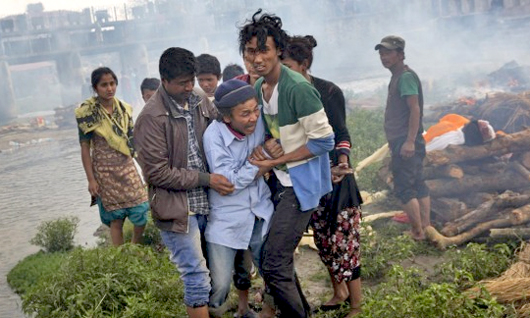
On Monday, Parbati Dhakal and several dozen of her neighbours walked two hours down a jungle path, carrying 11 bodies attached to bamboo poles. They stopped at a riverbank where they lowered the dead into holes. One of the villagers pointed to the people gathered there and identified them, one by one: “Father just buried; mother just buried; sister just buried.” Back in Saurpani, an ethnic Gurkha village at the epicentre of Saturday’s quake, Dhakal said, “we have no shelter, no food and all the bodies are scattered around.”
Kathmandu

Two days after Nepal’s worst earthquake in 80 years, the official death toll rose (the prime minister said it may cross 10,000), and humanitarian aid was starting to flow to the capital. Kathmandu’s airport had been so overloaded by aid and passenger planes that incoming flights sat for hours on the runway. Nepali expatriates were flying in, desperate to track down family members, and setting off down the airport access road on foot, rolling suitcases behind them.

But outside the capital, many of the worst-hit villages in the ridges around Kathmandu remain a black hole, surrounded by landslides that make them inaccessible even to the country’s armed forces. Nepali authorities have begun airdropping packages of tarpaulins, dry food and medicine into mountain villages, but an attempt to land helicopters was abandoned, said Brig Gen Jagadish Chandra Pokharel, an army spokesman.

The government is only gradually getting a grasp of the destruction in these isolated places. It is nearly impossible to identify which villages are most in need, and how many may be dead or injured, said Jeffrey Shannon, director of programmes for Mercy Corps in Nepal.

“Right now, what we’re hearing from everybody, including our own staff, is that we don’t know,” he said. “As people start to travel these roads, to reach these communities, you run into landslides. They’re simply inaccessible, the ones that need the most help.”

The chief bureaucrat in Gorkha district, Uddhav Timilsina, said rescue crews were unable even to distribute relief because they were confronting as many as 10 landslides between one village and its nearest neighbour. He said that 250 deaths had been reported so far but that it would take more time to get an accurate count. “Phone lines are down, electricity is out, roads are blocked, so what can we do?” he said.

In interviews, residents of hard-hit villages said their plight had not been in the foreground early in the crisis. Prakash Dhakal, a native of the village of Saurpani, was in Kathmandu when the earthquake struck, and he visited a government office Sunday to plead with an official to send help. “I asked them to send 25 young people to help bury our dead and search for the injured,” Dhakal said. “They told me, 'We can’t even rescue the injured in Kathmandu. How do you expect us to do anything for you now?'”

As assessments of the earthquake’s destruction proceeded, Irina Bokova, head of the United Nations Educational, Scientific and Cultural Organisation, said in New York that almost all the temples in Kathmandu’s Durbar Square had fallen. She added that one of Hinduism’s holiest sites, the Pashupati temple in the Kathmandu Valley, and Lumbini, a pilgrimage site in the southern plains believed to be Buddha’s birthplace, have been spared.

About 90 per cent of Nepal’s troops, who number 90,000, have been mobilised for disaster relief since Sunday, Pokharel said. Most of that force has been concentrated in Kathmandu, though, and the army had only 12 operational helicopters available at the time of the disaster.

India has since donated six more. Some 650 injured have been evacuated from villages to Kathmandu, he said. He added that most of the injured had been trapped in buildings and had head injuries and broken limbs. “We are trying to use our aviation assets so we would recover them alive,” Pokharel added.

In the past, Nepal’s government has made some attempt to consolidate thousands of tiny villages that dot its mountain ridges, some of them more than a day’s hike from the nearest road. Though the road system has expanded rapidly, attempts to attract mountain villagers to cities and towns where they could receive government services have mostly failed, Shannon said, perhaps because they lack the money to buy land elsewhere. The upshot, he said, is a population so cut off from the central government that most do not have Nepali citizenship cards. “All these people, they are just invisible,” he said.

Landscape of destruction

The residents of Saurpani, as they made their way down to the banks of the Daraudi River with the bodies of their relatives, described a landscape of destruction. There had been 1,300 houses in Saurpani, but one resident, Shankar Thapa, said, “All the houses collapsed.” Villagers said luck seemed to determine who lived and who died. Nar Bahadur Nepali, a 37-year-old farmer, said most of the structures in his village had collapsed, including his house.

“We survived because there was a wedding in the village, and we were out in an open area,” he said. At least 60 or 70 more people would have died had it not been for the wedding, he said. The earthquake that hit Saturday, shortly before noon, had a magnitude of 7.8, and early reports suggest that those villages that were damaged were nearly obliterated.

Sumzah Lama, who is from a village near the Tibetan border, was nursing her young daughter when the quake hit. Her pelvis was fractured on both sides, and she said she believed that her husband and three daughters died in the earthquake. “The hills all came down,” she said, from a hospital bed in Kathmandu.

Dawa Janba, who lives about two days’ walk from his home village of Langtang, said he looked down from a helicopter Sunday as he was being medically evacuated to Kathmandu and saw that “the whole valley has been destroyed.” He added that it seemed unlikely that more than a few of the 600 residents of Langtang would have survived. “There is nothing left to go back to, everything is destroyed,” said his wife, Karchon Tamang. “Everything was moving and smashed apart.”

Along the hills and valleys at the epicentre on Monday, relatives were making their way back home from Kathmandu, where they had been working when the earthquake struck. Dulbahadur Gurung, 27, walked two hours from where the bus dropped him off and was planning to walk another three hours to reach his village, Ranchok. Fifteen bodies had been recovered there, so far. Before the quake there were around 150 houses. “They told me there’s nothing left,” he said.


Comments

Add new comment

  • Coastaldigest.com reserves the right to delete or block any comments.
  • Coastaldigset.com is not responsible for its readers’ comments.
  • Comments that are abusive, incendiary or irrelevant are strictly prohibited.
  • Please use a genuine email ID and provide your name to avoid reject.
News Network
December 7,2025

SHRIMP.jpg

Mangaluru, Dec 7: A rare bamboo shrimp has been rediscovered on mainland India more than 70 years after it was last reported, confirming for the first time the presence of Atyopsis spinipes in the country. The find was made by researchers from the Centre for Climate Change Studies at Sathyabama Institute of Science and Technology, Chennai, during surveys in Karnataka and Odisha.

The team — shrimp expert Dr S Prakash, PhD scholar K Kunjulakshmi, and Mangaluru-based researcher Maclean Antony Santos — combined field surveys, ecological assessments and DNA analysis to identify the elusive species. Their findings, published in Zootaxa, resolve decades of taxonomic confusion stemming from a 1951 report that misidentified the species as Atyopsis moluccensis without strong evidence.

The shrimp has now been confirmed at two locations: the Mulki–Pavanje estuary near Mangaluru and the Kuakhai River in Bhubaneswar. Historical specimens from the Andaman Islands, previously labelled as A. moluccensis, were also found to be misidentified and actually belong to A. spinipes.

The rediscovery began after an aquarium hobbyist in Odisha spotted a shrimp in 2022, prompting systematic surveys across Udupi, Karwar and Mangaluru. Four female specimens were collected in Mulki and one in Odisha, all genetically matching.

Researchers warn the species may exist in very small, vulnerable populations as freshwater habitats face increasing pressure from pollution, sand mining and infrastructure development. All verified specimens have been deposited with the Zoological Survey of India for future reference.

Comments

Add new comment

  • Coastaldigest.com reserves the right to delete or block any comments.
  • Coastaldigset.com is not responsible for its readers’ comments.
  • Comments that are abusive, incendiary or irrelevant are strictly prohibited.
  • Please use a genuine email ID and provide your name to avoid reject.
News Network
December 3,2025

arrival.jpg

Mangaluru, Dec 3: A group of Congress workers gathered at the Mangaluru International Airport on Wednesday to welcome AICC general secretary K C Venugopal, but the reception quickly turned into a display of support for Deputy Chief Minister D K Shivakumar.

Venugopal arrived in the city to participate in the centenary commemoration of the historic dialogue between Mahatma Gandhi and Narayana Guru. The event, organised by the Sivagiri Mutt, Varkala, in association with the Mangalore University Sri Narayana Guru Study Chair, is being held on the university’s Konaje campus.

KPCC general secretary Mithun Rai and several party workers had assembled at the airport to receive Venugopal. However, the moment he stepped out, workers began raising slogans backing Shivakumar.

The university programme will be inaugurated by Chief Minister Siddaramaiah.

This show of support comes just a day after Siddaramaiah remarked that Shivakumar would lead the government “when the high command decides.” The chief minister made the comment after a breakfast meeting at Shivakumar’s residence—another public display of camaraderie between the two leaders amid ongoing attempts by the party high command to downplay their leadership rivalry.

Comments

Add new comment

  • Coastaldigest.com reserves the right to delete or block any comments.
  • Coastaldigset.com is not responsible for its readers’ comments.
  • Comments that are abusive, incendiary or irrelevant are strictly prohibited.
  • Please use a genuine email ID and provide your name to avoid reject.
News Network
December 16,2025

Mangaluru, Dec 16: The Mangaluru City police have significantly escalated their campaign against drug trafficking, arresting 25 individuals and booking 12 cases under the Narcotic Drugs and Psychotropic Substances (NDPS) Act between November 30 and December 13. The crackdown resulted in the seizure of a substantial quantity of illicit substances, including 685.6 grams of MDMA and 1.5 kg of ganja.

The success of this recent drive has been significantly boosted by the city’s innovative, QR code-based anonymous reporting system.

"The anonymous reporting system has received an encouraging response. Several recent arrests were made based on inputs received through this system, helping police tighten the noose around drug peddlers," said the City Police Commissioner.

The latest arrests contribute to a robust year-to-date record, underscoring the police's relentless commitment to combating the drug menace.

Up to December 14 this year, the police have registered a total of 107 cases of drug peddling, leading to the arrest of 219 peddlers. Furthermore, they have booked 562 cases of drug consumption, resulting in the arrest of 671 individuals.

The scale of the seizure for the year reflects the magnitude of the problem being tackled: police have seized 320.6 kg of ganja worth ₹88.7 lakh and 1.4 kg of MDMA valued at ₹1.2 crore. Other significant seizures include hydro-weed ganja worth ₹94.7 lakh and cocaine worth ₹1.9 lakh, among others.

The Commissioner emphasized a policy of rigorous enforcement: "We ensure that peddlers are caught red-handed so that they cannot later dispute the case or claim innocence."

To counter the rising trend of substance abuse among youth, the Mangaluru City police have rolled out uniform guidelines for random drug testing across educational institutions.

As part of the drive, tests were conducted in approximately 100 institutions, screening an estimated 5,500 to 6,000 students in the first phase. 20 students tested positive for drug consumption during the initial screening.

Students who tested positive have been provided counselling and are scheduled for re-testing in the second quarter. The testing will also be expanded to students not covered in the first phase. In a move to ensure strict implementation, police personnel were deployed in mufti in some institutions. Reiterating a zero-tolerance stance, the Commissioner confirmed that random testing will continue, and colleges have also been instructed to conduct drug tests at the time of admission to deter substance abuse from an early stage.

Comments

Add new comment

  • Coastaldigest.com reserves the right to delete or block any comments.
  • Coastaldigset.com is not responsible for its readers’ comments.
  • Comments that are abusive, incendiary or irrelevant are strictly prohibited.
  • Please use a genuine email ID and provide your name to avoid reject.