



Kathmandu, Apr 29: Five hours by car from Kathmandu, then by foot for several miles past the spot where the road is blocked by boulders and mud, people from the villages near the epicentre of Nepal’s powerful earthquake – Saurpani – are burying their dead, despairing of help arriving anytime soon.
On Monday, Parbati Dhakal and several dozen of her neighbours walked two hours down a jungle path, carrying 11 bodies attached to bamboo poles. They stopped at a riverbank where they lowered the dead into holes. One of the villagers pointed to the people gathered there and identified them, one by one: “Father just buried; mother just buried; sister just buried.” Back in Saurpani, an ethnic Gurkha village at the epicentre of Saturday’s quake, Dhakal said, “we have no shelter, no food and all the bodies are scattered around.”
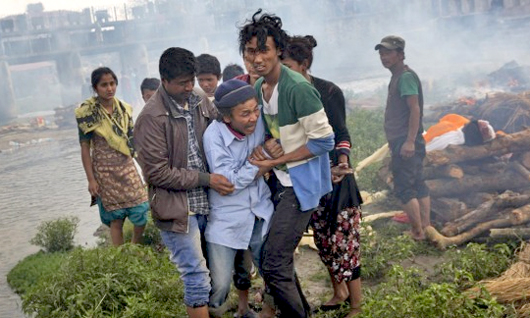
Two days after Nepal’s worst earthquake in 80 years, the official death toll rose (the prime minister said it may cross 10,000), and humanitarian aid was starting to flow to the capital. Kathmandu’s airport had been so overloaded by aid and passenger planes that incoming flights sat for hours on the runway. Nepali expatriates were flying in, desperate to track down family members, and setting off down the airport access road on foot, rolling suitcases behind them.
But outside the capital, many of the worst-hit villages in the ridges around Kathmandu remain a black hole, surrounded by landslides that make them inaccessible even to the country’s armed forces. Nepali authorities have begun airdropping packages of tarpaulins, dry food and medicine into mountain villages, but an attempt to land helicopters was abandoned, said Brig Gen Jagadish Chandra Pokharel, an army spokesman.
The government is only gradually getting a grasp of the destruction in these isolated places. It is nearly impossible to identify which villages are most in need, and how many may be dead or injured, said Jeffrey Shannon, director of programmes for Mercy Corps in Nepal.
“Right now, what we’re hearing from everybody, including our own staff, is that we don’t know,” he said. “As people start to travel these roads, to reach these communities, you run into landslides. They’re simply inaccessible, the ones that need the most help.”
The chief bureaucrat in Gorkha district, Uddhav Timilsina, said rescue crews were unable even to distribute relief because they were confronting as many as 10 landslides between one village and its nearest neighbour. He said that 250 deaths had been reported so far but that it would take more time to get an accurate count. “Phone lines are down, electricity is out, roads are blocked, so what can we do?” he said.
In interviews, residents of hard-hit villages said their plight had not been in the foreground early in the crisis. Prakash Dhakal, a native of the village of Saurpani, was in Kathmandu when the earthquake struck, and he visited a government office Sunday to plead with an official to send help. “I asked them to send 25 young people to help bury our dead and search for the injured,” Dhakal said. “They told me, 'We can’t even rescue the injured in Kathmandu. How do you expect us to do anything for you now?'”
As assessments of the earthquake’s destruction proceeded, Irina Bokova, head of the United Nations Educational, Scientific and Cultural Organisation, said in New York that almost all the temples in Kathmandu’s Durbar Square had fallen. She added that one of Hinduism’s holiest sites, the Pashupati temple in the Kathmandu Valley, and Lumbini, a pilgrimage site in the southern plains believed to be Buddha’s birthplace, have been spared.
About 90 per cent of Nepal’s troops, who number 90,000, have been mobilised for disaster relief since Sunday, Pokharel said. Most of that force has been concentrated in Kathmandu, though, and the army had only 12 operational helicopters available at the time of the disaster.
India has since donated six more. Some 650 injured have been evacuated from villages to Kathmandu, he said. He added that most of the injured had been trapped in buildings and had head injuries and broken limbs. “We are trying to use our aviation assets so we would recover them alive,” Pokharel added.
In the past, Nepal’s government has made some attempt to consolidate thousands of tiny villages that dot its mountain ridges, some of them more than a day’s hike from the nearest road. Though the road system has expanded rapidly, attempts to attract mountain villagers to cities and towns where they could receive government services have mostly failed, Shannon said, perhaps because they lack the money to buy land elsewhere. The upshot, he said, is a population so cut off from the central government that most do not have Nepali citizenship cards. “All these people, they are just invisible,” he said.
Landscape of destruction
The residents of Saurpani, as they made their way down to the banks of the Daraudi River with the bodies of their relatives, described a landscape of destruction. There had been 1,300 houses in Saurpani, but one resident, Shankar Thapa, said, “All the houses collapsed.” Villagers said luck seemed to determine who lived and who died. Nar Bahadur Nepali, a 37-year-old farmer, said most of the structures in his village had collapsed, including his house.
“We survived because there was a wedding in the village, and we were out in an open area,” he said. At least 60 or 70 more people would have died had it not been for the wedding, he said. The earthquake that hit Saturday, shortly before noon, had a magnitude of 7.8, and early reports suggest that those villages that were damaged were nearly obliterated.
Sumzah Lama, who is from a village near the Tibetan border, was nursing her young daughter when the quake hit. Her pelvis was fractured on both sides, and she said she believed that her husband and three daughters died in the earthquake. “The hills all came down,” she said, from a hospital bed in Kathmandu.
Dawa Janba, who lives about two days’ walk from his home village of Langtang, said he looked down from a helicopter Sunday as he was being medically evacuated to Kathmandu and saw that “the whole valley has been destroyed.” He added that it seemed unlikely that more than a few of the 600 residents of Langtang would have survived. “There is nothing left to go back to, everything is destroyed,” said his wife, Karchon Tamang. “Everything was moving and smashed apart.”
Along the hills and valleys at the epicentre on Monday, relatives were making their way back home from Kathmandu, where they had been working when the earthquake struck. Dulbahadur Gurung, 27, walked two hours from where the bus dropped him off and was planning to walk another three hours to reach his village, Ranchok. Fifteen bodies had been recovered there, so far. Before the quake there were around 150 houses. “They told me there’s nothing left,” he said.

Comments
Add new comment