Trouble for Modi govt: Coal strike stops output at over 60% mines; unions refuse to budge

January 7, 2015

Modi govt

Kolkata/New Delhi, Jan 7: Coal industry employees across the country yesterday went on a five-day strike, halting production at over 60 percent of state-run Coal India units that may also severely hit fuel supply to power plants, while talks failed late tonight to end the industrial action.

The government officials held hours-long negotiations with union representatives, but failed to convince them to call off the strike, which is being billed as the biggest industrial action since 1977.

Claiming that over 5 lakh coal industry workers across the country have gone off-work, the union leaders said they are open to negotiations at 'political' level, including with Prime Minister Narendra Modi and Coal Minister Piyush Goyal.

On its first day itself, the strike is estimated to have caused production losses to the tune of Rs 70 crore in first two shifts yesterday, officials said.

The strike call has been given by all five leading trade unions of the country, including the BJP-backed Bharatiya Mazdoor Sangh (BMS).

The industrial action is in protest against 'disinvestment and restructuring of state-run Coal India' and to press for demands including the roll-back of what they call as "process of denationalising of coal sector".

The Labour Ministry said in a statement that the strike has affected the working of CIL and its subsidiaries, as also the mines of Singareni Collieries Co Ltd.

The strike, joined by all five major trade unions - BMS, INTUC, AITUC, CITU and HMS -- is likely to affect production of up to 1.5 million tonnes (MT) of the dry-fuel per day besides fuel supply to power plants which are already grappling with fuel shortages.

Coming out of late-night talks, INTUC Secretary General S Q Zama said, "Negotiations at the secretary-level have failed, but we are open for discussions at political level, at the level of Prime Minister or Coal Minister.

"We did our best to arrive at an amicable solution, but the (Coal) Secretary has his own limitations. Around five lakh workers, including 3.5 lakh from CIL, are on strike."

CIL Chairman Sutirtha Bhattacharya, who assumed charge yesterday itself, said that he was hopeful that the situation would be resolved in an amicable manner.

According to a senior official, "Out of 438 units of CIL, 271 have been completely impacted by the strike. There is only partial production from 57 units. The PSU had suffered losses to the tune of Rs 35 crore in the first shift itself."

According to union leaders, the strike was being observed by almost all employees of CIL and around 70-80 percent of SCCL (Singareni Collieries Company Ltd) workers, while 5-10 percent of staff engaged in essential services like water supply were working at some CIL subsidiaries.

All India Coal Workers Federation leader Jibon Roy claimed that about 7 lakh workers have joined the strike.

CIL, which accounts for over 80 per cent of domestic coal production, itself has a workforce of about 3.5 lakh.

The trade unions had boycotted the earlier two meetings called by the government.

To face emergency situation, CIL has sought 20 additional rakes from Railways for supply of coal, while normally about 200 rakes are supplied a day on an average.

The company has stepped up supplies to power plants to tide over the likely disruption of supplies due to the strike.

All five major trade unions of the coal PSU had boycotted a meeting called by Coal Minister Piyush Goyal last week.

Meanwhile, electricity workers' union EEFI has also extended its support to the strike call.

Separately, employee unions had called for a one-day strike at public sector banks tomorrow, to be followed by another four-day strike later this month but deferred their action after talks between employee and management representatives earlier this evening.

Besides, petrol pump owners in Rajasthan will go on a single-day strike tomorrow to press for rollback of recent hike in VAT on petrol.

Comments

Add new comment

  • Coastaldigest.com reserves the right to delete or block any comments.
  • Coastaldigset.com is not responsible for its readers’ comments.
  • Comments that are abusive, incendiary or irrelevant are strictly prohibited.
  • Please use a genuine email ID and provide your name to avoid reject.
News Network
December 6,2025

indigoticket.jpg

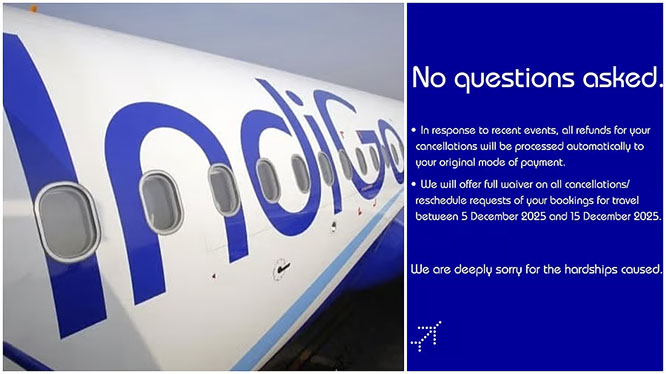
With IndiGo flight disruptions impacting thousands of passengers, the airline on Saturday said that it will offer full waiver on all cancellations/reschedule requests for travel bookings between December 5, 2025 and December 15, 2025.

Earlier in the day, the civil aviation ministry had directed the airline to complete the ticket refund process for the cancelled flights by Sunday evening, as well as ensure baggage separated from the travellers are delivered in the next two days.

In a post on X, titled 'No questions asked', IndiGo wrote, "In response to recent events, all refunds for your cancellations will be processed automatically to your original mode of payment."

"We are deeply sorry for the hardships caused," it further added.

Several passengers, however, complained of not getting full refund as promised by the airline.

Netizens have shared screenchots of getting charged for airline cancellation fee and convenience fee.

"Please tell me why u have did this airline cancellation charges when u say full amount will be refunded (sic)," a user wrote sharing a screenshot of the refund page.

"Well, but you have still debited the convenience charges," wrote another.

Passengers have also raised concerns about the "cancel" option being disabled on the IndiGo app. "First enable the 'Cancel' button on your App & offer full refund on tickets cancelled by customers between the said dates," wrote a user.

A day after the country's largest airline, IndiGo, cancelled more than 1,000 flights and caused disruptions for the fifth day on Saturday, the ministry said that any delay or non-compliance in refund processing will invite immediate regulatory action.

The refund process for all cancelled or disrupted flights must be completed by 8 pm on Sunday, the ministry said in a statement.

"Airlines have also been instructed not to levy any rescheduling charges for passengers whose travel plans were affected by cancellations," it said.

On Saturday, more than 400 flights were cancelled at various airports.

IndiGo has also been instructed to set up dedicated passenger support and refund facilitation cells.

Comments

Add new comment

  • Coastaldigest.com reserves the right to delete or block any comments.
  • Coastaldigset.com is not responsible for its readers’ comments.
  • Comments that are abusive, incendiary or irrelevant are strictly prohibited.
  • Please use a genuine email ID and provide your name to avoid reject.
News Network
December 6,2025

pilot.jpg

New Delhi: IndiGo, India’s largest airline, faced major operational turbulence this week after failing to prepare for new pilot-fatigue regulations issued by the Directorate General of Civil Aviation (DGCA). The stricter rules—designed to improve flight safety—took effect in phases through 2024, with the latest implementation on November 1. IndiGo has acknowledged that inadequate roster planning led to widespread cancellations and delays.

Below are the key DGCA rules that affected IndiGo’s operations:

1. Longer Mandatory Weekly Rest

Weekly rest for pilots has been increased from 36 hours to 48 hours.

The government says the extended break is essential to curb cumulative fatigue. This rule remains in force despite the current crisis.

2. Cap on Night Landings

Pilots can now perform only two night landings per week—a steep reduction from the earlier limit of six.

Night hours, defined as midnight to early morning, are considered the least alert period for pilots.

Given the disruptions, this rule has been temporarily relaxed for IndiGo until February 10.

3. Reduced Maximum Night Flight Duty

Flight duty that stretches into the night is now capped at 10 hours.

This measure has also been kept on hold for IndiGo until February 10 to stabilize operations.

4. Weekly Rest Cannot Be Replaced With Personal Leave

Airlines can no longer count a pilot’s personal leave as part of the mandatory 48-hour rest.

Pilots say this closes a loophole that previously reduced actual rest time.

Currently, all airlines are exempt from this rule to normalise travel.

5. Mandatory Fatigue Monitoring

Airlines must submit quarterly fatigue reports along with corrective actions to DGCA.

This system aims to create a transparent fatigue-tracking framework across the industry.

The DGCA has stressed that these rules were crafted to strengthen flight safety and align India with global fatigue-management standards. The temporary relaxations are expected to remain until February 2025, giving IndiGo time to stabilise its schedules and restore normal air travel.

Comments

Add new comment

  • Coastaldigest.com reserves the right to delete or block any comments.
  • Coastaldigset.com is not responsible for its readers’ comments.
  • Comments that are abusive, incendiary or irrelevant are strictly prohibited.
  • Please use a genuine email ID and provide your name to avoid reject.
News Network
December 5,2025

indigoCEO.jpg

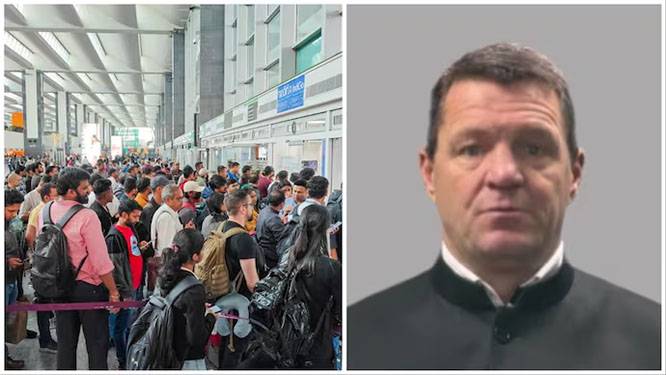
New Delhi, Dec 5: IndiGo CEO Pieter Elbers issued a public apology this evening after more than a thousand flights were cancelled today, making it the "most severely impacted day" in terms of cancellations. The biggest airline of the country cancelled "more than half" of its daily number of flights on Friday, said Elbers. He also said that even though the crisis will persist on Saturday, the airline anticipates fewer than 1,000 flight cancellations.

"Full normalisation is expected between December 10 and 15, though IndiGo cautions that recovery will take time due to the scale of operations," the IndiGo CEO said. 

IndiGo operates around 2,300 domestic and international flights daily.

Pieter Elbers, while apologising for the major inconvenience due to delays and cancellations, said the situation is a result of various causes.

The crisis at IndiGo stems from new regulations that boost pilots' weekly rest requirements by 12 hours to 48 and allow only two night-time landings per week, down from six. IndiGo has attributed the mass cancellations to "misjudgment and planning gaps".

Elbers also listed three lines of action that the airline will adopt to address the issue.

"Firstly, customer communication and addressing your needs, for this, messages have been sent on social media. And just now, a more detailed communication with information, refunds, cancellations and other customer support measures was sent," he said.

The airline has also stepped up its call centre capacity.

"Secondly, due to yesterday's situation, we had customers stranded mostly at the nation's largest airports. Our focus was for all of them to be able to travel today itself, which will be achieved. For this, we also ask customers whose flights are cancelled not to come to the airports as notifications are sent," the CEO said.

"Thirdly, cancellations were made for today to align our crew and planes to be where they need to start tomorrow morning afresh. Earlier measures of the last few days, regrettable, have proven not to be enough, but we have decided today to reboot all our systems and schedules, resulting in the highest numbers of cancellations so far, but imperative for progressive improvements starting from tomorrow," he added.

As airports witnessed chaotic scenes, the Directorate General of Civil Aviation (DGCA) stepped in to grant IndiGo a temporary exemption from stricter night duty rules for pilots. It also allowed substitution of leaves with a weekly rest period. 

Civil Aviation Minister Ram Mohan Naidu has said a high-level inquiry will be ordered and accountability will be fixed.

Comments

Add new comment

  • Coastaldigest.com reserves the right to delete or block any comments.
  • Coastaldigset.com is not responsible for its readers’ comments.
  • Comments that are abusive, incendiary or irrelevant are strictly prohibited.
  • Please use a genuine email ID and provide your name to avoid reject.