



Violent protests erupt across Lebanon as currency collapses

News Network
June 12, 2020

Beirut, Jun 12: Angry Lebanese protesters blocked roads across the country with burning tyres, debris and their vehicles, incensed over the local currency's depreciation by more than 25 percent in just two days.

The demonstrations from northern Akkar and Tripoli to central Zouk, the eastern Bekaa Valley, Beirut and southern Tyre and Nabatieh on Thursday were some of the most widespread in months of upheaval over a calamitous economic and financial crisis.

Protesters set ablaze a branch of the Central Bank, vandalised several private banks and clashed with security forces in several areas. At least 41 people were injured in Tripoli alone, according to the Lebanese Red Cross.

"I'm really pissed off, that's all. If politicians think they can burn our hearts like this the fire is going to reach them too," unemployed computer engineer Ali Qassem, 26, told Al Jazeera after pouring fuel onto smouldering tyres on a main Beirut thoroughfare.

Tens of thousands of Lebanese have lost jobs in the past six months and hundreds of businesses have shuttered as a dollar shortage led the Lebanese pound to slide from 1,500 to $1 last summer - where it was pegged for 23 years - to roughly 4,000 for each US dollar last month.

But the slide turned into a freefall between Wednesday and Thursday when the pound plummeted to roughly 5,000 to $1 on black markets, which have become a main source of hard currency. There was widespread speculation the rate hit 6,000 or even 7,000 pounds to the dollar, though most markets stopped trading.

Protesters began amassing on streets across the country before sunset and increased into the thousands across the country as the night fell.

Prime Minister Hassan Diab cancelled all meetings scheduled for Friday to hold an emergency cabinet session at 9:30am and another at 3pm at the presidential palace to be headed by President Michel Aoun.

The pound's collapse is the perhaps the biggest challenge yet for Diab's young cabinet, which gained confidence in February after former prime minister Saad Hariri's government was toppled by an unprecedented October uprising that had the country's economic crisis at its core.

Economy Minister Raoul Nehme told Al Jazeera that there was "disinformation" being circulated about the exchange rate on social media and said he was investigating possible currency manipulation.

"I don't understand how the exchange rate increased by so much in two days," he said.

Many protesters have pitted blame on Central Bank governor Riad Salameh, nominally in charge of  keeping the currency stable. But they have also called on the government to resign.

"If people want reform between dawn and dusk, that's not going to work, and if someone thinks they can do a better job then please come forward," Nehme said.

"But what we can't have is a power vacuum - then the exchange rate won't be 5000, it'll be a catastrophe."

'Everyone paying the price'

When protesters set a large fire in Beirut's Riad al-Solh Square, which lies at the foot of a grand Ottoman-era building that serves as the seat of government, firefighters did not intervene to extinguish it.

It later became clear why: Civil Defence told local news channel LBCI they had run out of diesel to fuel their firetrucks.

Basic imports such as fuel have been hit hard by the currency crisis, making already-weak state services increasingly feeble.

A half-dozen or so police officers with Lebanon's Internal Security Forces observed the scene unfolding in front of them in the square.

"Why do you destroy shops and things and attack us security forces - do you think we're happy? Go and f****** break that wall or go to the politicians' houses," one police officer told Al Jazeera, referring to a large concrete barrier separating protesters from the seat of government.

"In the end we are with you and we want the country to change. Don't you dare think we're happy. My salary is now worth $130," the officer said.

The currency's spectacular fall seems to have pushed many Lebanese to put common interests above their differences.

Large convoys of men on motorbikes from Shia-majority areas of southern Beirut joined the demonstrations on Thursday, though they have clashed with protesters many times before - including at a protest on Saturday.

Some chanted sectarian insults, leading to brief clashes in areas that were formerly front lines during the country's devastating 15-year civil war.

Instead, the motorbike-riding demonstrators on Thursday chanted: "Shia, Sunni, F*ck sectarianism."

"We are Shia, and Sunnis and Christian are our brothers," Hisham Houri, 39, told Al Jazeera, perched on a moped with his fiancee behind him just a few metres from a pile of burning tyres.

The blaze sent thick black smoke into the sky towards an iconic blue-domed mosque and church in downtown Beirut.

"Politicians play on these sectarian issues and sometimes succeed, but in the end, they'll fail because all the people have been hurt," he said. "The dollar isn't just worth 6,000 for Shias or for Sunnis, everyone is paying that price."

Comments

Add new comment

  • Coastaldigest.com reserves the right to delete or block any comments.
  • Coastaldigset.com is not responsible for its readers’ comments.
  • Comments that are abusive, incendiary or irrelevant are strictly prohibited.
  • Please use a genuine email ID and provide your name to avoid reject.
News Network
November 30,2025

The United Nations Committee against Torture (CAT) has condemned the Israeli regime for enforcing a policy of “organized torture” against Palestinians.

In a report published on Friday, CAT stated that the occupying regime enforces a deliberate policy of “organized and widespread torture and ill-treatment” against Palestinian abductees, particularly since October 7, 2023, when Israel launched its genocidal war on Gaza.

The committee expressed “deep concern over repeated severe beatings, dog attacks, electrocution, water-boarding, use of prolonged stress positions [and] sexual violence” inflicted on Palestinians.

Palestinian prisoners were degraded by “being made to act like animals or being urinated on,” systematically denied medical care, and subjected to excessive restraints, “in some cases resulting in amputation,” the report added.

CAT also condemned the routine application of “unlawful combatants law” to justify the prolonged detention without trial of thousands of Palestinian men, women, and children.

More than 10,000 Palestinians, including women and children, are currently held in Israeli prisons, according to Palestinian and international human rights groups, with 3,474 Palestinians in “administrative detention,” meaning they are imprisoned without trial for indefinite periods.

The report highlighted the “high proportion of children who are currently detained without charge or on remand,” noting that while Israel sets the age of criminal responsibility at 12, even younger children have been abducted.

Children designated as security prisoners face severe restrictions on family contact, may be subjected to solitary confinement, and are denied access to education, in clear violation of international law.

The committee further suggested that Israel’s policies across the Occupied Territories constitute collective torture against the Palestinian population.

“A range of policies adopted by Israel in the course of its continued unlawful presence in the Occupied Palestinian Territory amounts to cruel, inhuman or degrading living conditions for the Palestinian population,” the report said.

On Thursday, the Palestinian resistance movement Hamas condemned the systematic killing and torture of Palestinian abductees in Israeli prisons, urging international action to halt these abuses.

Citing human rights data, Hamas stated that 94 Palestinians have been killed in Israeli prisons since the start of Tel Aviv’s genocidal war on Gaza.

“This reflects an organized criminal approach that has turned these prisons into direct killing grounds to eliminate our people,” the resistance movement said.

Hamas called on the international community, the UN, and human rights organizations to immediately pressure Israel to end crimes against prisoners and uphold their rights as guaranteed by all international conventions and norms.

Comments

Add new comment

  • Coastaldigest.com reserves the right to delete or block any comments.
  • Coastaldigset.com is not responsible for its readers’ comments.
  • Comments that are abusive, incendiary or irrelevant are strictly prohibited.
  • Please use a genuine email ID and provide your name to avoid reject.
News Network
November 21,2025

israel.jpg

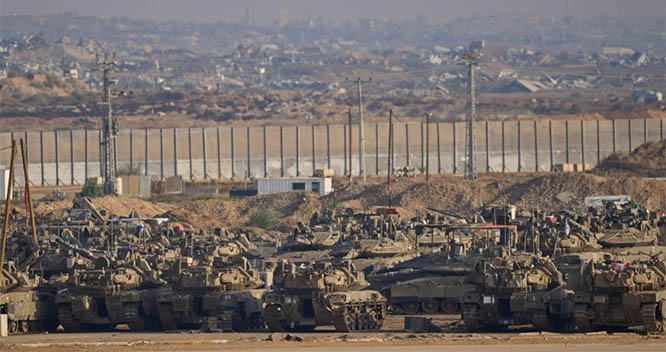
Local authorities say the Israeli military has expanded the so-called “yellow line” truce demarcation in Gaza City and repositioned its forces deeper into the territory in violation of a ceasefire agreement that came into force on October 10, besieging dozens of Palestinian families.

Gaza’s Government Media Office announced in a statement on Thursday that Israeli forces widened the boundary by shifting the markers, and advanced roughly 300 meters (984 feet) into the neighborhoods of Ash-Shaaf, An-Nazzaz and Baghdad Street.

The move pushed further into civilian areas, trapping families who were unable to flee as tanks rolled forward, it added.

“The fate of many of these families remains unknown amidst the shelling that targeted the area,” the office said, adding that the expansion of the yellow line shows a “blatant disregard” for the ceasefire deal.

On Friday, sources said the Israeli military carried out continued air and artillery strikes inside the so-called “yellow line” east of Khan Younis in the southern Gaza Strip.

According to the reports, Israeli warplanes and tanks targeted areas within the zone. One Palestinian was reported killed and several others wounded in the strikes, the sources said.

The fresh aggression came only a day after 25 Palestinians were killed in Israeli airstrikes on Gaza City and Khan Younis on Wednesday.

The media office reported that Israel has consistently violated the truce deal since its implementation last month, with near-daily attacks by air, artillery and direct shootings.

The office said over 400 violations have been documented. These breaches have resulted in the deaths of more than 300 Palestinians and left hundreds injured.

The Government Media Office in Gaza urged the guarantors of the ceasefire — the US, Egypt, Qatar and Turkey — to take swift action to halt the ongoing violations and facilitate the delivery of food, shelter materials, medical aid, and infrastructure equipment.

The so-called “yellow line,” set out in the agreement between Israel and Hamas resistance movement, refers to a non-physical partition where the Israeli military repositioned itself when the truce deal took effect.

It has allowed Israel, which routinely fires at Palestinians who approach the line, to retain control over more than half of the Gaza Strip.

International bodies, including the UN Independent International Commission of Inquiry, the International Association of Genocide Scholars, Amnesty International, Human Rights Watch, B’Tselem, and other rights groups, have concluded that the Israeli war on Gaza amounts to genocide.

In the attacks in Gaza since October 2023, Israel has killed at least 69,546 people and injured 170,833 others, leveling large swaths of the territory and displacing almost all of the population. 

Comments

Add new comment

  • Coastaldigest.com reserves the right to delete or block any comments.
  • Coastaldigset.com is not responsible for its readers’ comments.
  • Comments that are abusive, incendiary or irrelevant are strictly prohibited.
  • Please use a genuine email ID and provide your name to avoid reject.