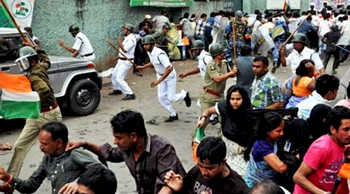
Violent stir in West Bengal; 1,000 held

September 3, 2015

New Delhi, Sep 3: The day-long nationwide strike on Wednesday impacted normal life in various parts of the country with coal production, banking operations and transport services being hit the most. The impact of the strike was most visible in states like West Bengal, where violent clashes erupted and resulted in the arrest of over 1,000 persons.
West Bengal
The strike call was given by 10 central trade unions against changes in labour laws, the privatisation of public sector undertakings and for other demands. The BJP-backed Bharatiya Mazdoor Sangh (BMS) and NFITU, however, stayed away from the strike.

Union leaders claimed that over 15 crore organised sector workers went on strike. The government, however, said the strike did not have much impact in most parts of the country even as it hinted at meeting the “aspirations” of the workers on nine of their 12 demands.

Terming the all-India general strike “a great success”, Left parties congratulated the protesters for staging “one of the biggest” demonstrations of the working class against the Centre’s alleged anti-labour policies. “Great success I should say. (The response) was more than expected. It is one of the biggest actions of the working class and the manifestation of their unity against the anti-labour policies of the government,” CPI general secretary S. Sudhakar Reddy said.

Apart from West Bengal, the other states where the impact was total were Tripura, Kerala, Karnataka, Puducherry and Orissa, while partial impact was visible in Delhi, Punjab, Haryana, Tamil Nadu, Goa, Gujarat, Bihar and Jharkhand.

In West Bengal, over 1,000 persons were arrested from different parts of the state after clashes occurred at some places between Left and Trinamul workers, including in Murshidabad district.

Altogether 974 people were arrested in various districts and 50 others in the metropolis for trying to enforce the bandh, West Bengal chief minister Mamata Banerjee told reporters in Kolkata.

Train services of the South Eastern Railway and Eastern Railway were partially affected, but Metro rail services in Kolkata remained normal. Ms Banerjee also said that “the bandh failed to evoke any response and state government offices in the city recorded 93 per cent attendance and 97 per cent in the districts”.

Normal life was affected in Assam, Andhra Pradesh, Telangana and Rajasthan also, but there was not much impact in Mumbai, except on banking services. Commodity markets remained closed in most part of India.

The labour ministry said that out of 12 central trade unions, two did not join the strike, three unions remained neutral and only seven unions went on strike. It claimed the situation by and large remained normal and peaceful across India and that the government was positive on many of the workers’ demands without any pressure. The 10 unions, however, said in a joint statement that the response to the strike call was “unprecedented” and ”millions of workers” had stayed away from work.

Banking services were among the worst hit as 23 public sector banks, 12 private sector banks, 52 regional rural banks and over 13,000 cooperative banks joined the stir. However, staff at SBI, Indian Overseas Bank, ICICI Bank, HDFC Bank and Axis Bank chose not to go on strike.

All-India Bank Employees Association general secretary C.H. Venkatachalam said nearly five lakh bank employees and officers joined the strike.

Labour minister Bandaru Dattatreya, who on Wednesday left for Turkey along with labour secretary Shankar Aggarwal for a G-20 meeting, had on Tuesday appealed to the trade unions to call off the agitation in the interest of the workers and the nation. But the unions decided to go ahead after their talks with a ministerial panel last month failed to yield the desired results on their 12 demands.

The demands included urgent measures to rein in price-rise, contain unemployment, the strict enforcement of basic labour laws, universal social security cover for all workers and a minimum wage of `15,000 per month. They also demanded higher pensions, the stopping of disinvestment in PSUs, ending the contract system, the removal of the ceiling on bonus payments and provident fund, compulsory registration of trade unions within 45 days, no unilateral amendment to labour laws and the stopping of FDI in the railways and in the defence sector.

Expressing solidarity with the strike, the Congress blamed the government’s “utter apathy” for the workers” agitation.

“It seems just as the British wanted to benefit the East India Company at the expense of millions of labourers of this country, the Modi government wants to benefit five-six crony businessmen friends of this government,” party spokesperson Abhishek Singhvi told reporters.


Comments

Add new comment

  • Coastaldigest.com reserves the right to delete or block any comments.
  • Coastaldigset.com is not responsible for its readers’ comments.
  • Comments that are abusive, incendiary or irrelevant are strictly prohibited.
  • Please use a genuine email ID and provide your name to avoid reject.
News Network
December 6,2025

pilot.jpg

New Delhi: IndiGo, India’s largest airline, faced major operational turbulence this week after failing to prepare for new pilot-fatigue regulations issued by the Directorate General of Civil Aviation (DGCA). The stricter rules—designed to improve flight safety—took effect in phases through 2024, with the latest implementation on November 1. IndiGo has acknowledged that inadequate roster planning led to widespread cancellations and delays.

Below are the key DGCA rules that affected IndiGo’s operations:

1. Longer Mandatory Weekly Rest

Weekly rest for pilots has been increased from 36 hours to 48 hours.

The government says the extended break is essential to curb cumulative fatigue. This rule remains in force despite the current crisis.

2. Cap on Night Landings

Pilots can now perform only two night landings per week—a steep reduction from the earlier limit of six.

Night hours, defined as midnight to early morning, are considered the least alert period for pilots.

Given the disruptions, this rule has been temporarily relaxed for IndiGo until February 10.

3. Reduced Maximum Night Flight Duty

Flight duty that stretches into the night is now capped at 10 hours.

This measure has also been kept on hold for IndiGo until February 10 to stabilize operations.

4. Weekly Rest Cannot Be Replaced With Personal Leave

Airlines can no longer count a pilot’s personal leave as part of the mandatory 48-hour rest.

Pilots say this closes a loophole that previously reduced actual rest time.

Currently, all airlines are exempt from this rule to normalise travel.

5. Mandatory Fatigue Monitoring

Airlines must submit quarterly fatigue reports along with corrective actions to DGCA.

This system aims to create a transparent fatigue-tracking framework across the industry.

The DGCA has stressed that these rules were crafted to strengthen flight safety and align India with global fatigue-management standards. The temporary relaxations are expected to remain until February 2025, giving IndiGo time to stabilise its schedules and restore normal air travel.

Comments

Add new comment

  • Coastaldigest.com reserves the right to delete or block any comments.
  • Coastaldigset.com is not responsible for its readers’ comments.
  • Comments that are abusive, incendiary or irrelevant are strictly prohibited.
  • Please use a genuine email ID and provide your name to avoid reject.
News Network
December 6,2025

indigoticket.jpg

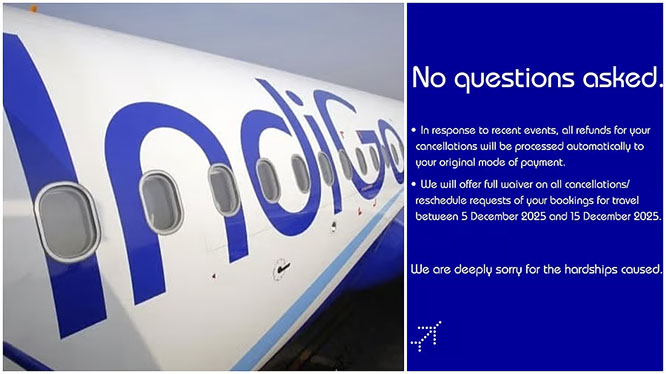
With IndiGo flight disruptions impacting thousands of passengers, the airline on Saturday said that it will offer full waiver on all cancellations/reschedule requests for travel bookings between December 5, 2025 and December 15, 2025.

Earlier in the day, the civil aviation ministry had directed the airline to complete the ticket refund process for the cancelled flights by Sunday evening, as well as ensure baggage separated from the travellers are delivered in the next two days.

In a post on X, titled 'No questions asked', IndiGo wrote, "In response to recent events, all refunds for your cancellations will be processed automatically to your original mode of payment."

"We are deeply sorry for the hardships caused," it further added.

Several passengers, however, complained of not getting full refund as promised by the airline.

Netizens have shared screenchots of getting charged for airline cancellation fee and convenience fee.

"Please tell me why u have did this airline cancellation charges when u say full amount will be refunded (sic)," a user wrote sharing a screenshot of the refund page.

"Well, but you have still debited the convenience charges," wrote another.

Passengers have also raised concerns about the "cancel" option being disabled on the IndiGo app. "First enable the 'Cancel' button on your App & offer full refund on tickets cancelled by customers between the said dates," wrote a user.

A day after the country's largest airline, IndiGo, cancelled more than 1,000 flights and caused disruptions for the fifth day on Saturday, the ministry said that any delay or non-compliance in refund processing will invite immediate regulatory action.

The refund process for all cancelled or disrupted flights must be completed by 8 pm on Sunday, the ministry said in a statement.

"Airlines have also been instructed not to levy any rescheduling charges for passengers whose travel plans were affected by cancellations," it said.

On Saturday, more than 400 flights were cancelled at various airports.

IndiGo has also been instructed to set up dedicated passenger support and refund facilitation cells.

Comments

Add new comment

  • Coastaldigest.com reserves the right to delete or block any comments.
  • Coastaldigset.com is not responsible for its readers’ comments.
  • Comments that are abusive, incendiary or irrelevant are strictly prohibited.
  • Please use a genuine email ID and provide your name to avoid reject.
News Network
December 16,2025

jordan.jpg

Prime Minister Narendra Modi on Monday held talks with Jordan’s King Abdullah II in Amman, during which the two leaders discussed ways to further strengthen bilateral relations, with the Prime Minister outlining an eight-point vision covering key areas of cooperation.

Describing the meeting as “productive”, PM Modi said he shared a roadmap focused on trade and economy, fertilisers and agriculture, information technology, healthcare, infrastructure, critical and strategic minerals, civil nuclear cooperation, and people-to-people ties.

In a post on social media platform X, the Prime Minister praised King Abdullah II’s personal commitment to advancing India–Jordan relations, particularly as both countries mark the 75th anniversary of the establishment of diplomatic ties this year.

“Held productive discussions with His Majesty King Abdullah II in Amman. His personal commitment towards vibrant India-Jordan relations is noteworthy. This year, we are celebrating the 75th anniversary of our bilateral diplomatic relations,” PM Modi said.

The meeting took place at the Al Husseiniya Palace, where the two leaders also exchanged views on regional and global issues of mutual interest. According to the Ministry of External Affairs (MEA), both sides agreed to further deepen cooperation in areas including trade and investment, defence and security, counter-terrorism and de-radicalisation, fertilisers and agriculture, infrastructure, renewable energy, tourism, and heritage.

The MEA said both leaders reaffirmed their united stand against terrorism.

PM Modi arrived in Amman earlier on Monday and was received by Jordanian Prime Minister Jafar Hassan, who accorded him a formal welcome. Following the talks, King Abdullah II hosted a banquet dinner in honour of the Prime Minister, reflecting the warmth of bilateral ties.

Jordan is the first leg of PM Modi’s three-nation tour. From Amman, the Prime Minister will travel to Ethiopia at the invitation of Prime Minister Abiy Ahmed Ali, marking his first official visit to the African nation. The tour will conclude with a visit to Oman.

Comments

Add new comment

  • Coastaldigest.com reserves the right to delete or block any comments.
  • Coastaldigset.com is not responsible for its readers’ comments.
  • Comments that are abusive, incendiary or irrelevant are strictly prohibited.
  • Please use a genuine email ID and provide your name to avoid reject.