



Virat Kohli, MS Dhoni star in series-levelling win for India against Australia

Agencies
January 15, 2019

Jan 15: M S Dhoni pulled off a tight finish for India just like old times to silence his critics after captain Virat Kohli laid the foundation for a series-levelling six-wicket win against Australia with his 39th ODI hundred here on Tuesday.

Chase master Kohli could not take his team to the finishing line this time but Dhoni (55 off 54) and Dinesh Karthik (25 off 14) rose to the occasion with an unbeaten 57-run stand off 34 balls, taking India home with four balls to spare. Australia scored 298-8 after opting to bat.

Man of the match Kohli was dismissed in the 44th over after making 104 off 112 balls with five fours and two sixes. Dhoni, who has been coping a lot of criticism for his waning finishing skills, turned back the clock and took India past the finish line with a final over six.

The third and final ODI will be in Melbourne on Friday.

India got off to a frantic start with Shikhar Dhawan hitting five boundaries in his 28-ball 32 runs. He put on 47 runs for the opening wicket with Rohit Sharma (43).

The latter had another strong outing, adding 54 runs with Kohli for the second wicket as India crossed 100 in the 18th over. But just when things were going smoothly, he mishit a pull off Marcus Stoinis (1-46) and was caught in the deep.

Ambati Rayudu (24) then came to the crease, and while he added 59 runs with Kohli for the third wicket, it was plain obvious that the number four batsman struggled for timing.

Kohli meanwhile was in cruise mode, rotating strike and picking the odd boundary with ease, as he reached fifty in 66 balls. The star batsman stayed in the same mode as the asking rate climbed.

But it was Rayudu who tried attacking the bowling and perished instead, caught in the deep off Glenn Maxwell (1-16) in the 31st over.

Dhoni then joined Kohli, and the duo put on 82 runs for the fourth wicket, with clever rotation of strike as India crossed 200 in the 37th over to keep pace with the asking rate.

Kohli changed gears as he hit two immaculate sixes through pure timing, and reached his hundred off 108 balls. It was his sixth ODI hundred against Australia.

The turning point came in the 44th over though, when Australia masterminded Kohli's dismissal through some clever field placement in the deep. He holed out to Maxwell off Jhye Richardson (1-59).

Dhoni then took over and put on match-winning partnership with Karthik. In doing so, he turned back the clocks to lead India to a tense finish, and completed his second consecutive half-century in as many matches, 69th overall, off 53 balls.

The veteran's running between the wickets, laced with two sixes as the only boundaries, finished things off in style for India.

Earlier, Shaun Marsh scored his seventh ODI hundred to take Australia to a challenging total.

Marsh arrived at the crease at 26-2 and scored 131 runs and added 94 runs off 65 balls with Glenn Maxwell (48 off 37 balls).

The hosts were unchanged from the previous game, while India brought in debutant Mohammed Siraj in place of Khaleel Ahmed.

Bhuvneshwar Kumar (4-45) and Mohammed Shami (3-58) exerted themselves on proceedings with the new ball, and didn't let the Australian openers get away quickly.

Kumar bowled Aaron Finch (6) through the gate in the seventh over, in a near-similar replay of his dismissal in the first ODI. At the other end, Alex Carey (18) looked set once again before getting out two overs later, a top-edge off Shami's quick bouncer caught at midwicket as Shikhar Dhawan took a skier.

It brought Marsh and Usman Khawaja (21) together, and they put on 56 runs off 65 balls. Their partnership threatened to turn the game away, but Ravindra Jadeja affected a brilliant run-out in the 19th over to dismiss Khawaja with a direct throw from backward point.

Marsh was able to manoeuvre the middle overs very well, as Mohammed Siraj (0-76) was proving expensive in every spell. The debutant sprayed the ball all over and was never able to hit a consistent line.

India were forced to bowl Kuldeep Yadav (0-66) and Jadeja (1-49) earlier in the innings than planned, and even Shami came back for a spell before the 25th over as the lack of a sixth bowling option started to show.

Australia did them a favour by losing wickets at regular intervals. Peter Handscomb (20) was stumped off Jadeja in the 28th over with MS Dhoni affecting another quick dismissal. But he had added 52 runs with Marsh for the fourth wicket carrying Australia past 100 in the 22nd over.

Marsh reached his half-century off 62 balls, and added 55 runs with Marcus Stoinis (29) for the fifth wicket.

Their partnership threatened to change the pace of scoring but Shami struck in the 37th over, an inside edge caught behind, to dismiss Stoinis.

Maxwell hit five fours and a six as Australia accelerated after reaching 200 in the 39th over. Marsh, meanwhile, had reached his hundred off 108 balls.

Siraj had a woeful day as he missed out twice on Maxwell's wicket as the hard-hitting batsman survived on 26 and 41. First, DRS overturned an lbw decision in the 44th over with the ball going down leg, and then Rohit Sharma dropped a tough chance at extra cover in the 47th over.

Kumar returned to account for both Maxwell and Marsh in the 48th over and it dented momentum towards 300, as Australia lost a flurry of wickets.

Comments

Add new comment

  • Coastaldigest.com reserves the right to delete or block any comments.
  • Coastaldigset.com is not responsible for its readers’ comments.
  • Comments that are abusive, incendiary or irrelevant are strictly prohibited.
  • Please use a genuine email ID and provide your name to avoid reject.
News Network
December 13,2025

New Delhi: School-going children are picking up drug and smoking habits and engaging in consumption of alcohol, with the average age of introduction to such harmful substances found to be around 13 years, suggesting a need for earlier interventions as early as primary school, a multi-city survey by AIIMS-Delhi said.

The findings also showed substance use increased in higher grades, with grade XI/XII students two times more likely to report use of substances when compared with grade VIII students. This emphasised the importance of continued prevention and intervention through middle and high school.

The study led by Dr Anju Dhawan of AIIMS's National Drug Dependence Treatment Centre, published in the National Medical Journal of India this month, looks at adolescent substance use across diverse regions.

The survey included 5,920 students from classes 8, 9, 11 and 12 in urban government, private and rural schools across 10 cities -- Bengaluru, Chandigarh, Delhi, Dibrugarh, Hyderabad, Imphal, Jammu, Lucknow, Mumbai, and Ranchi. The data were collected between May 2018 and June 2019.

The average age of initiation for any substance was 12.9 (2.8) years. It was lowest for inhalants (11.3 years) followed by heroin (12.3 years) and opioid pharmaceuticals (without prescription; 12.5 years).

Overall, 15.1 per cent of participants reported lifetime use, 10.3 per cent reported past year use, and 7.2 per cent reported use in the past month of any substance, the study found.

The most common substances used in the past year, after tobacco (4 per cent) and alcohol (3.8 per cent), were opioids (2.8 per cent), followed by cannabis (2 per cent) and inhalants (1.9 per cent). Use of non-prescribed pharmaceutical opioids was most common among opioid users (90.2 per cent).

On being asked, 'Do you think this substance is easily available for a person of your age' separately for each substance category, nearly half the students (46.3 per cent) endorsed that tobacco products and more than one-third of the students (36.5 per cent) agreed that a person of their age can easily procure alcohol products.

Similarly, for Bhang (21.9 per cent), ganja/charas (16.1 per cent), inhalants (15.2 per cent), sedatives (13.7 per cent), opium and heroin (10 per cent each), the students endorsed that these can be easily procured.

About 95 per cent of the children, irrespective of their grade, agreed with the statement that 'drug use is harmful'.

The rates of substance use (any) among boys were significantly higher than those of girls for substance use (ever), use in the past year and use in the past 30 days. Compared to grade VIII students, grade IX students were more likely, and grade XI/XII students were twice as likely to have used any substance (ever).

The likelihood of past-year use of any substance was also higher for grade IX students and for grade XI/XII students as compared to grade VIII students.

About 40 per cent of students mentioned that they had a family member who used tobacco or alcohol each. The use of cannabis (any product) and opioid (any product) by a family member was reported by 8.2 per cent and 3.9 per cent of students, respectively, while the use of other substances, such as inhalants/sedatives by family was 2-3 per cent, the study found.

A relatively smaller percentage of students reported use of tobacco or alcohol among peers as compared to among family members, while a higher percentage reported inhalants, sedatives, cannabis or opioid use among peers.

Children using substances (past year) compared to non-users reported significantly higher any substance use by their family members and peers.

There were 25.7 per cent students who replied 'yes' to the question 'conflicts/fights often occur in your family'. Most students also replied affirmatively to 'family members are aware of how their time is being spent' and 'damily members are aware of with whom they spend their time'.

Comments

Add new comment

  • Coastaldigest.com reserves the right to delete or block any comments.
  • Coastaldigset.com is not responsible for its readers’ comments.
  • Comments that are abusive, incendiary or irrelevant are strictly prohibited.
  • Please use a genuine email ID and provide your name to avoid reject.
News Network
December 19,2025

Saudi Arabia has abolished fees on expatriate workers employed in licensed industrial establishments, signaling a strong push to empower national factories and enhance the Kingdom’s global industrial competitiveness. The move reflects the leadership’s commitment to building a sustainable and resilient industrial economy under Saudi Vision 2030.

The decision was approved by the Council of Ministers, chaired by Crown Prince and Prime Minister Mohammed bin Salman, following a recommendation from the Council of Economic and Development Affairs (CEDA). It forms part of a broader strategy to support, modernize, and strengthen the industrial sector.

By removing fees on foreign workers, industrial establishments gain greater operational flexibility and relief from financial pressures. This is expected to help factories expand production, improve efficiency, and compete more effectively in international markets, while reinforcing long-term sustainability.

The initiative aligns closely with Saudi Vision 2030, which identifies industry as a key pillar of economic diversification. A competitive and resilient industrial base is viewed as essential for driving innovation, attracting investment, and sustaining long-term economic growth.

Overall, the fee exemption underscores the Kingdom’s commitment to creating a supportive environment for industrial development and ensuring that Saudi factories remain globally competitive and capable of leading the nation’s economic transformation.

Comments

Add new comment

  • Coastaldigest.com reserves the right to delete or block any comments.
  • Coastaldigset.com is not responsible for its readers’ comments.
  • Comments that are abusive, incendiary or irrelevant are strictly prohibited.
  • Please use a genuine email ID and provide your name to avoid reject.
News Network
December 16,2025

jordan.jpg

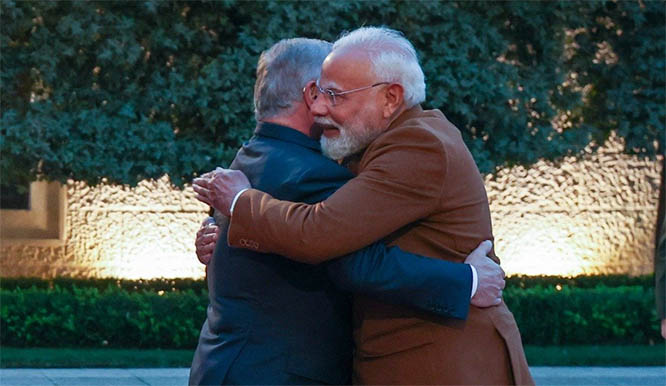
Prime Minister Narendra Modi on Monday held talks with Jordan’s King Abdullah II in Amman, during which the two leaders discussed ways to further strengthen bilateral relations, with the Prime Minister outlining an eight-point vision covering key areas of cooperation.

Describing the meeting as “productive”, PM Modi said he shared a roadmap focused on trade and economy, fertilisers and agriculture, information technology, healthcare, infrastructure, critical and strategic minerals, civil nuclear cooperation, and people-to-people ties.

In a post on social media platform X, the Prime Minister praised King Abdullah II’s personal commitment to advancing India–Jordan relations, particularly as both countries mark the 75th anniversary of the establishment of diplomatic ties this year.

“Held productive discussions with His Majesty King Abdullah II in Amman. His personal commitment towards vibrant India-Jordan relations is noteworthy. This year, we are celebrating the 75th anniversary of our bilateral diplomatic relations,” PM Modi said.

The meeting took place at the Al Husseiniya Palace, where the two leaders also exchanged views on regional and global issues of mutual interest. According to the Ministry of External Affairs (MEA), both sides agreed to further deepen cooperation in areas including trade and investment, defence and security, counter-terrorism and de-radicalisation, fertilisers and agriculture, infrastructure, renewable energy, tourism, and heritage.

The MEA said both leaders reaffirmed their united stand against terrorism.

PM Modi arrived in Amman earlier on Monday and was received by Jordanian Prime Minister Jafar Hassan, who accorded him a formal welcome. Following the talks, King Abdullah II hosted a banquet dinner in honour of the Prime Minister, reflecting the warmth of bilateral ties.

Jordan is the first leg of PM Modi’s three-nation tour. From Amman, the Prime Minister will travel to Ethiopia at the invitation of Prime Minister Abiy Ahmed Ali, marking his first official visit to the African nation. The tour will conclude with a visit to Oman.

Comments

Add new comment

  • Coastaldigest.com reserves the right to delete or block any comments.
  • Coastaldigset.com is not responsible for its readers’ comments.
  • Comments that are abusive, incendiary or irrelevant are strictly prohibited.
  • Please use a genuine email ID and provide your name to avoid reject.