



Was Emergency in India akin to Hitler’s Regime?

Ram Puniyani
July 9, 2018

On the eve of 43rd anniversary of the Emergency, which was imposed on the country in 1975, BJP has come out strongly condemning the event, has issued half page advertisement and Modi said that it was imposed to save the power of a family. There are claims that BJP’s parent organization RSS and its political predecessors valiantly fought against emergency. Surprisingly many streams of Indian politics, like CPI (M), shades of socialists, and sections of dissident Congress streams who fought against Emergency did not make any noise about their role. While Congress itself has not overtly criticized the act of its leader Indira Gandhi, it needs to be recalled that Mrs. Gandhi had regretted the excesses during this period in a speech in Yavatmal in 1978. Apart from Jaitly and BJP leaders there are many others also who compare the authoritarian regime and its excesses with what happened during Hitler’s fascist regime.

It’s true that during this period there was a serious violation of democratic freedoms. The similarity with Hitler’s fascist regime ends here. The main mechanism of Hitler’s regime was to instigate emotions, ntensifying divisiveness by activating the storm troopers and targeting against the racial minority; the Jews. Other characteristics of his regime were to promote the interests of big business houses and suppress the rights of working class in particular. It projected the golden past and also promoted ultra nationalism and implemented muscular foreign policy leading the soured relations with neighbors. People like Einstein left the country. The targeting of racial minorities was the central and most conspicuous part of the policy. The excesses which took place during emergency were not targeting any minority. It’s true that the pavement dwellers suffered a lot, demolitions and the compulsory vasectomy of poor sections affected Muslims as well, but it was not targeted against Muslim community in any way.

How can one say that Emergency which was authoritarianism was not fascism in any way? In fascist methods what is central to the undermining of democracy is to operate through the mechanism of mobilization of foot soldiers, whipping up mass hysteria and giving prominence to emotive issues. Let’s remember Indira Gandhi herself had lifted the Emergency and called for elections in a democratic way, elections in which she suffered a massive defeat. In Germany fascist regime destroyed Germany itself.

While a lot is being said about emergency, what was the role of RSS during this period? The claims that RSS was a central force to fight against this regime are a cock and bull story. TV Rajeswar, who served as Governor of Uttar Pradesh and Sikkim after his retirement from service, in his book, ‘India: The Crucial Years” [Harper Collins] tells us “Not only they (RSS) were supportive of this [Emergency], they wanted to establish contact apart from Mrs. Gandhi, with Sanjay Gandhi also”. Rajeswar in an interview with Karan Thapar disclosed that Deoras “quietly established a link with the PM’s house and expressed strong support for several steps taken to enforce order and discipline in the country. Deoras was keen to meet Mrs. Gandhi and Sanjay. But Mrs. Gandhi refused.”As a matter of fact the executioners of emergency excesses found good favor with BJP as it was formed after Jana Sangh component leaving the Janata Party. One recalls the emergency time slogan, “Aapatkal ke tin dalal: Sanjay, Vidya, Bansilal” (three executioners of Emergency: Sanjay, Vidya, Bansilal). Later BJP gave ticket to Vidya Charan Shukla, and allied with Bansilal to form the Government in Haryana. Sanjay Gandhi’s wife Maneka was taken in to BJP and became minister without ever condemning the excesses committed during that period.

As a matter of fact what is happening today is much more repressive though there is no official emergency. Many have labeled it as undeclared emergency. Nayantara Sahgal, who was a strong critic of Emergency, has stated very aptly that “…we have an undeclared Emergency; there is no doubt about that. We have seen a huge, massive attack on the freedom of expression.” The observation is that there are killings of innocent, helpless Indians killed because they did not fit into the RSS’s view of India. Every dissent is labeled as anti-National. She continues “Writers like Gauri Lankesh have been killed. And there has been no justice for the families of the wage earners who have lost their lives in this fashion. In fact they are now being called the accused. So we have a horrendous situation, a nightmare which is worse than the Emergency.” Similarly we know that today the dangers to civic liberties and democratic rights is through the ideologically indoctrinated foot soldiers, who have been called fringe elements, but as such they are part of a clear division of labor, working against Indian Constitution and for Hindu Nation.

The prevalence of violence against religious minorities, the intimidation, the lynching in the name of Holy cow, beef, love jihad, ghar wapasi has become a sort of New Normal of present regime. It not only goes beyond the authoritarian regime but borders on the divisive politics which is out to relegate the religious minorities to second class status in the country. While the top rulers keep quiet in cases of serious violations, the ground level vigilantes have a field day in furthering the agenda which is outcome of RSS ideology. Lately even the use of tricolor to instigate violence as witnessed in Kasgaonj is further stifling our democracy.

We need to distinguish between the authoritarian regime of Emergency where the machinery of state was used to suppress democratic rights with fascist regimes which are guided by narrow nationalism and target the minorities while pushing forward Hindu nationalism and bringing in divisions in society on sectarian grounds. Democracy is stifled in both cases, but in narrow nationalism the very concept of citizenship is denied to the sections o society on the grounds of their religion or race. And this is the crucial marker of sectarian nationalism.

Comments

Add new comment

  • Coastaldigest.com reserves the right to delete or block any comments.
  • Coastaldigset.com is not responsible for its readers’ comments.
  • Comments that are abusive, incendiary or irrelevant are strictly prohibited.
  • Please use a genuine email ID and provide your name to avoid reject.
News Network
November 28,2025

ministerPM.jpg

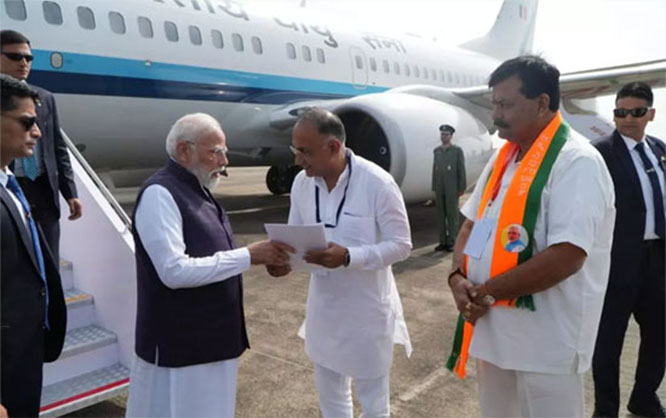
Mangaluru, Nov 28: Karnataka Health Minister and Dakshina Kannada district in-charge minister Dinesh Gundu Rao on Friday handed over Chief Minister Siddaramaiah’s letter to Prime Minister Narendra Modi, highlighting the severe distress faced by farmers due to crashing crop prices.

PM Modi arrived at the Mangaluru International Airport en route to Udupi, where Gundu Rao welcomed him and submitted the letter. The chief minister’s message stressed that farmers are suffering heavy losses because maize and green gram are being bought far below the Minimum Support Price (MSP). The state urged the Centre to immediately begin procurement at MSP.

According to the letter, Karnataka has a bumper harvest this year—over 54.74 lakh metric tons of maize and 1.98 lakh metric tons of green gram—yet farmers are unable to secure fair prices. Against the MSP of ₹2,400/MT for maize and ₹8,768/MT for green gram, market rates have plunged to ₹1,600–₹1,800 and ₹5,400 respectively.

The chief minister has requested the Centre to:

• Direct NAFED, FCI and NCCF to start MSP procurement immediately.
• Ensure ethanol units purchase maize directly from farmers or FPOs.
• Increase Karnataka’s ethanol allocation, citing high production capacity.
• Stop maize imports, which have depressed domestic prices.
• Relax quality norms for green gram, allowing up to 10% discoloration due to rains.

The letter stresses that MSP is crucial for farmer dignity and income stability and calls for swift central intervention to prevent a deepening crisis.

Comments

Add new comment

  • Coastaldigest.com reserves the right to delete or block any comments.
  • Coastaldigset.com is not responsible for its readers’ comments.
  • Comments that are abusive, incendiary or irrelevant are strictly prohibited.
  • Please use a genuine email ID and provide your name to avoid reject.
News Network
November 27,2025

Bengaluru, Nov 27: Karnataka Chief Minister Siddaramaiah’s camp is reportedly on alert as the Congress leadership tussle in the state intensifies, particularly amid speculation over the potential promotion of Deputy Chief Minister D.K. Shivakumar. Siddaramaiah is said to be in a “wait-and-watch” mode after admitting to “confusion” earlier this week and urging the party to “put a full stop” to it.

Sources say his supporters are ready to act if senior leaders — including party chief Mallikarjun Kharge, Sonia Gandhi, and Rahul Gandhi — give any indication of backing Shivakumar. If the party insists on a leadership change, Siddaramaiah’s camp has a list of alternatives, underscoring the deep rift between the two leaders. One possible candidate is Home Minister G. Parameshwara, a Siddaramaiah loyalist and influential Dalit leader.

The strategy was reportedly finalized at a meeting led by PWD Minister Satish Jarkiholi, another Siddaramaiah supporter, who stressed that Delhi leaders need to resolve the issue. Kharge and the Gandhis are expected to meet soon, after which Siddaramaiah and Shivakumar may be summoned to Delhi.

Shivakumar has largely stayed non-confrontational, publicly endorsing Siddaramaiah and downplaying speculation about his own ambitions. However, he has made pointed comments emphasizing the importance of honoring promises, directed at Siddaramaiah.

The feud traces back to the 2023 state election, when Siddaramaiah was chosen as Chief Minister while Shivakumar, who led the party’s campaign, was made Deputy CM and state party chief — a departure from the Congress’ usual “one post per person” rule.

There were also hints of a prior understanding that Siddaramaiah would step down midway through the term. As the halfway mark passed last week, Shivakumar-aligned lawmakers have ramped up pressure on the party for a leadership change, with Shivakumar himself hinting at stepping down as state party chief to pursue the top job.

Comments

Add new comment

  • Coastaldigest.com reserves the right to delete or block any comments.
  • Coastaldigset.com is not responsible for its readers’ comments.
  • Comments that are abusive, incendiary or irrelevant are strictly prohibited.
  • Please use a genuine email ID and provide your name to avoid reject.
News Network
December 2,2025

Puttur: The long-cherished dream of a government medical college in Puttur has moved a decisive step closer to reality, with the Karnataka State Finance Department granting its official approval for the construction of a new 300-bed hospital.

Puttur MLA Ashok Kumar Rai announced the crucial development to reporters on Monday, confirming that the official communication from the finance department was issued on November 27. This 300-bed facility is intended to be the cornerstone for the establishment of the government medical college, a project announced in the state budget.

Fast-Track Implementation

The MLA outlined an aggressive timeline for the project:

•    A Detailed Project Report (DPR) for the hospital is expected to be ready within 45 days.

•    The tender process for the construction will be completed within two months.

Following the completion of the tender process, Chief Minister Siddaramaiah is scheduled to lay the foundation stone for the project.

"Setting up a medical college in Puttur is a historical decision by the Congress government in Karnataka," Rai stated. The project has an estimated budget allocation of Rs 1,000 crore for the medical college.

Focus on Medical Education Department

The MLA highlighted a key strategic move: requesting the government to implement the hospital construction through the Medical Education Department instead of the Health and Family Welfare Department. This is intended to streamline the entire process of establishing the full medical college, ensuring the facilities—including labs, operation theatres, and other necessary infrastructure—adhere to the strict guidelines set by the Medical Council of India (MCI). The proposed site for the project is in Bannur.

Rai also took the opportunity to address political criticism, stating that the government has fulfilled its promise despite "apprehensions" and "mocking and criticising" from opposition parties who had failed to take similar initiatives when they were in power. "Chief Minister Siddaramaiah has kept his word," he added.

Comments

Add new comment

  • Coastaldigest.com reserves the right to delete or block any comments.
  • Coastaldigset.com is not responsible for its readers’ comments.
  • Comments that are abusive, incendiary or irrelevant are strictly prohibited.
  • Please use a genuine email ID and provide your name to avoid reject.