



What've you done to curb black money: Supreme Court asks Modi govt

September 4, 2015

New Delhi, Sep 4: After a lull, the Supreme Court on Thursday put the spotlight back on black money by asking the Centre to give details of action taken on the special investigation team's (SIT) recommendations advocating stringent measures against irregularities in capitation fees, cricket, stock markets and trade-based money laundering.
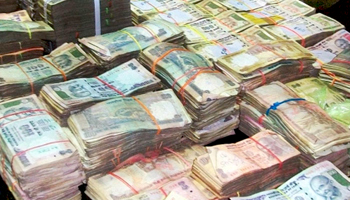
blackmoney
The SIT has recommended action against misuse of exemption of long-term capital gains tax for money laundering, misuse of participatory notes for money laundering, generation of black money in education sector through capitation fees and through donations to religious and charitable institutions, and, strict monitoring of match-fixing, spot-fixing and betting in cricket matches including T20 tournaments like IPL.

A bench of Chief Justice H L Dattu and Justices Madan B Lokur and A K Sikri asked attorney general Mukul Rohatgi, "What is the fate of these recommendations by the Supreme Court-appointed SIT? The Centre will tell us about it in the next hearing on October 28."

The bench also told senior advocate Dushyant Dave, who appeared for the SIT headed by former Supreme Court judges M B Shah and Arijit Pasayat, to ask the SIT to submit its fresh report by October 7 on ways and means to tackle the menace of black money.

Advocate Prashant Bhushan requested the court to make public the SIT reports but Dave objected, saying it would be unwise to make the reports public, except the recommendations. "The reports include analysis of intricate economic issues and policies. Till the government initiates action on these recommendations, it will not be proper to discuss the reports in public," he said. The bench agreed with Dave.

The SIT had given a string of recommendations in its third report submitted to the SC in May. The Centre will now be required to inform the SC on October 28 of the action it has taken on the following recommendations:

* To control generation of black money through huge capitation fees, mostly paid in cash, to technical and medical colleges for admissions. A specific provision should be inserted in Prevention of Corruption Act to make acceptance of cash by educational institutions a punishable offence.

* Large donations, including gift of ornaments, to religious and charitable institutions should be accompanied by PAN number of the donor.

* Illegal activity of cricket betting requires to be controlled by some provisions which are deterrent to all concerned. Considering the fact that large amount of black money is generated and used in this sector, it is suggested that some appropriate legislative directions or rules or regulations are required to be put in place to curb the menace of such betting.

* Ban on bulk transactions through cash. A number of European countries bar any cash transaction above a particular limit. This can be done in India.

* For holding cash/currency notes, there should be a limit by prescribing a reasonable threshold, may be Rs 10 lakh or Rs 15 lakh. This will control holding of unaccounted money to a large extent.

* SEBI needs to have an effective monitoring mechanism to study unusual rise of stock prices of companies while such a rise is taking place. In case it is established that stock platforms have been misused for taking long-term capital gains tax benefits, prosecution should be invariably launched.

* Obtaining information on 'beneficial ownership' of participatory notes is of crucial importance to prevent their misuse. SEBI needs to examine the issue and come up with regulations where the 'final beneficial owner' of participatory notes/offshore derivative instruments are known.

* Proactive detection of creation of shell companies, which are used to provide accommodation entries to launder black money. Deterrent penal action against persons involved in creation of shell companies and providing accommodation entries needed.


Comments

Add new comment

  • Coastaldigest.com reserves the right to delete or block any comments.
  • Coastaldigset.com is not responsible for its readers’ comments.
  • Comments that are abusive, incendiary or irrelevant are strictly prohibited.
  • Please use a genuine email ID and provide your name to avoid reject.
News Network
December 13,2025

New Delhi: School-going children are picking up drug and smoking habits and engaging in consumption of alcohol, with the average age of introduction to such harmful substances found to be around 13 years, suggesting a need for earlier interventions as early as primary school, a multi-city survey by AIIMS-Delhi said.

The findings also showed substance use increased in higher grades, with grade XI/XII students two times more likely to report use of substances when compared with grade VIII students. This emphasised the importance of continued prevention and intervention through middle and high school.

The study led by Dr Anju Dhawan of AIIMS's National Drug Dependence Treatment Centre, published in the National Medical Journal of India this month, looks at adolescent substance use across diverse regions.

The survey included 5,920 students from classes 8, 9, 11 and 12 in urban government, private and rural schools across 10 cities -- Bengaluru, Chandigarh, Delhi, Dibrugarh, Hyderabad, Imphal, Jammu, Lucknow, Mumbai, and Ranchi. The data were collected between May 2018 and June 2019.

The average age of initiation for any substance was 12.9 (2.8) years. It was lowest for inhalants (11.3 years) followed by heroin (12.3 years) and opioid pharmaceuticals (without prescription; 12.5 years).

Overall, 15.1 per cent of participants reported lifetime use, 10.3 per cent reported past year use, and 7.2 per cent reported use in the past month of any substance, the study found.

The most common substances used in the past year, after tobacco (4 per cent) and alcohol (3.8 per cent), were opioids (2.8 per cent), followed by cannabis (2 per cent) and inhalants (1.9 per cent). Use of non-prescribed pharmaceutical opioids was most common among opioid users (90.2 per cent).

On being asked, 'Do you think this substance is easily available for a person of your age' separately for each substance category, nearly half the students (46.3 per cent) endorsed that tobacco products and more than one-third of the students (36.5 per cent) agreed that a person of their age can easily procure alcohol products.

Similarly, for Bhang (21.9 per cent), ganja/charas (16.1 per cent), inhalants (15.2 per cent), sedatives (13.7 per cent), opium and heroin (10 per cent each), the students endorsed that these can be easily procured.

About 95 per cent of the children, irrespective of their grade, agreed with the statement that 'drug use is harmful'.

The rates of substance use (any) among boys were significantly higher than those of girls for substance use (ever), use in the past year and use in the past 30 days. Compared to grade VIII students, grade IX students were more likely, and grade XI/XII students were twice as likely to have used any substance (ever).

The likelihood of past-year use of any substance was also higher for grade IX students and for grade XI/XII students as compared to grade VIII students.

About 40 per cent of students mentioned that they had a family member who used tobacco or alcohol each. The use of cannabis (any product) and opioid (any product) by a family member was reported by 8.2 per cent and 3.9 per cent of students, respectively, while the use of other substances, such as inhalants/sedatives by family was 2-3 per cent, the study found.

A relatively smaller percentage of students reported use of tobacco or alcohol among peers as compared to among family members, while a higher percentage reported inhalants, sedatives, cannabis or opioid use among peers.

Children using substances (past year) compared to non-users reported significantly higher any substance use by their family members and peers.

There were 25.7 per cent students who replied 'yes' to the question 'conflicts/fights often occur in your family'. Most students also replied affirmatively to 'family members are aware of how their time is being spent' and 'damily members are aware of with whom they spend their time'.

Comments

Add new comment

  • Coastaldigest.com reserves the right to delete or block any comments.
  • Coastaldigset.com is not responsible for its readers’ comments.
  • Comments that are abusive, incendiary or irrelevant are strictly prohibited.
  • Please use a genuine email ID and provide your name to avoid reject.
News Network
December 6,2025

pilot.jpg

New Delhi: IndiGo, India’s largest airline, faced major operational turbulence this week after failing to prepare for new pilot-fatigue regulations issued by the Directorate General of Civil Aviation (DGCA). The stricter rules—designed to improve flight safety—took effect in phases through 2024, with the latest implementation on November 1. IndiGo has acknowledged that inadequate roster planning led to widespread cancellations and delays.

Below are the key DGCA rules that affected IndiGo’s operations:

1. Longer Mandatory Weekly Rest

Weekly rest for pilots has been increased from 36 hours to 48 hours.

The government says the extended break is essential to curb cumulative fatigue. This rule remains in force despite the current crisis.

2. Cap on Night Landings

Pilots can now perform only two night landings per week—a steep reduction from the earlier limit of six.

Night hours, defined as midnight to early morning, are considered the least alert period for pilots.

Given the disruptions, this rule has been temporarily relaxed for IndiGo until February 10.

3. Reduced Maximum Night Flight Duty

Flight duty that stretches into the night is now capped at 10 hours.

This measure has also been kept on hold for IndiGo until February 10 to stabilize operations.

4. Weekly Rest Cannot Be Replaced With Personal Leave

Airlines can no longer count a pilot’s personal leave as part of the mandatory 48-hour rest.

Pilots say this closes a loophole that previously reduced actual rest time.

Currently, all airlines are exempt from this rule to normalise travel.

5. Mandatory Fatigue Monitoring

Airlines must submit quarterly fatigue reports along with corrective actions to DGCA.

This system aims to create a transparent fatigue-tracking framework across the industry.

The DGCA has stressed that these rules were crafted to strengthen flight safety and align India with global fatigue-management standards. The temporary relaxations are expected to remain until February 2025, giving IndiGo time to stabilise its schedules and restore normal air travel.

Comments

Add new comment

  • Coastaldigest.com reserves the right to delete or block any comments.
  • Coastaldigset.com is not responsible for its readers’ comments.
  • Comments that are abusive, incendiary or irrelevant are strictly prohibited.
  • Please use a genuine email ID and provide your name to avoid reject.