World Bank says India has huge potential, projects 7.3% growth in 2018

Agencies
January 10, 2018

With an "ambitious government undertaking comprehensive reforms", India has "enormous growth potential" compared to other emerging economies, the World Bank said today, as it projected country's growth rate to 7.3 per cent in 2018 and 7.5 for the next two years.

India, despite initial setbacks from demonetisation and Goods and Services Tax (GST), is estimated to have grown at 6.7 per cent in 2017, according to the 2018 Global Economics Prospect released by the World Bank here today.

"In all likelihood India is going to register higher growth rate than other major emerging market economies in the next decade. So, I wouldn't focus on the short-term numbers. I would look at the big picture for India and big picture is telling us that it has enormous potential," Ayhan Kose, Director, Development Prospects Group, World Bank, told news agency in an interview.

He said in comparison with China, which is slowing, the World Bank is expecting India to gradually accelerate.

"The growth numbers of the past three years were very healthy," Kose, author of the report, said.

In 2017, China grew at 6.8 per cent, 0.1 per cent more than that of India, while in 2018, its growth rate is projected at 6.4 per cent. And in the next two years, the country's growth rate will drop marginally to 6.3 and 6.2 per cent, respectively.

To materialise its potential, India, Kose said, needs to take steps to boost investment prospects.

There are measures underway to do in terms of non- performing loans and productivity, he said.

"On the productivity side, India has enormous potential with respect to secondary education completion rate. All in all, improved labor market reforms, education and health reforms as well as relaxing investment bottleneck will help improve India's prospects," Kose said.

Noting that India has a favourable demographic profile, he said it is rarely seen in other economies.

"In that context, improving female labour force participation rate is going to be important. Female labour force participation still remains low relative to other emerging market economies. Bringing force right now idle outside of the productive activities will make a huge difference," he said.

Reducing youth unemployment is critical, and pushing for private investment, where problems are already well-known like bank assets quality issues...If these are done, India can reach its potential easily and exceed, Kose asserted.

"In fact, we expect India to do better than its potential in 2018 and move forward," he said.

India's growth potential, he said, would be around 7 per cent for the next 10 years.

The Indian government is "very serious" with GST being a major turning point and banking recapitalisation programme is really important, Kose said.

"The Indian government has already recognise some of these problems and undertaking measures and willing to see the outcomes of these measures," he said.

"India is a very large economy. It has a huge potential. At the same time, it has its own challenges. This government is very much aware of these challenges and is showing just doing its best in terms of dealing with them," the World Bank official said.

The latest World Bank growth estimate for 2017 is 0.5 per cent, less than the previous projection, and 0.2 per cent less in the next two years.

"It is slightly lower than its previous forecast, primarily because India is undertaking major reforms," Kose said.

These reforms, of course, will bring certain policy uncertainty, he said, "but the big issue about India, when you look at India's growth potential and our numbers down the road 2019 and 2020, is that it is going to be the fastest growing large emerging market."

"India has an ambitious government undertaking comprehensive reforms. GST is a major reform to have harmonised taxes, is one nation one market one tax concept. Then, of course, the late 2016 demonetisation reform was there. The government is well aware of these short-term implications," Kose said.

He said there might have been some temporary disruptions but "all in all" the Indian economy has done well.

"The potential growth rate of the Indian economy is very healthy to 7 per cent. I think the growth is going to be at a high rate going forward," the World Bank official said.

The big question is whether Indian policymakers would, under the necessary reforms, push its potential growth up, Kose said.

"So far we have seen ambitious policy initiatives and implementation like GST. And we have all the reasons to expect this government to continue economic policies to create friendly environment for businesses and push its growth potential up," he said.

In a South Asia regional press release, the World Bank said India is estimated to grow 6.7 per cent in fiscal year 2017-18, slightly down from the 7.1 per cent of the previous fiscal year.

This is due in part to the effects of the introduction of the Goods and Services Tax, but also to protracted balance sheet weaknesses, including corporate debt burdens and non- performing loans in the banking sector, weighing down private investment, it said.

Comments

Add new comment

  • Coastaldigest.com reserves the right to delete or block any comments.
  • Coastaldigset.com is not responsible for its readers’ comments.
  • Comments that are abusive, incendiary or irrelevant are strictly prohibited.
  • Please use a genuine email ID and provide your name to avoid reject.
News Network
December 4,2025

indigoflight.jpg

Domestic carrier IndiGo has cancelled over 180 flights from three major airports — Mumbai, Delhi and Bengaluru — on Thursday, December 4, as the airline struggles to secure the required crew to operate its flights in the wake of new flight-duty and rest-period norms for pilots.

While the number of cancellations at Mumbai airport stands at 86 (41 arrivals and 45 departures) for the day, at Bengaluru, 73 flights have been cancelled, including 41 arrivals, according to a PTI report that quoted sources.

"IndiGo cancelled over 180 flights on Thursday at three airports-Mumbai, Delhi and Bengaluru," the source told the news agency.

Besides, it had cancelled as many as 33 flights at Delhi airport for Thursday, the source said, adding, "The number of cancellations is expected to be higher by the end of the day."

The Gurugram-based airline's On-Time Performance (OTP) nosedived to 19.7 per cent at six key airports — Delhi, Mumbai, Chennai, Kolkata, Bengaluru and Hyderabad — on December 3, as it struggled to get the required crew to operate its services, down from almost half of December 2, when it was 35 per cent.

"IndiGo has been facing acute crew shortage since the implementation of the second phase of the FDTL (Flight Duty Time Limitations) norms, leading to cancellations and huge delays in its operations across the airports," a source had told PTI on Wednesday.

Chaos continued at several major airports for the third day on Thursday because of the cancellations.

A spokesperson for the Kempegowda International Airport (KIA) in Bengaluru said that 73 IndiGo flights had been cancelled on Thursday.

At least 150 flights were cancelled and dozens of others delayed on Wednesday, airport sources said, leaving thousands of travellers stranded, according to news agency Reuters.

The Directorate General of Civil Aviation (DGCA) has said it is investigating IndiGo flight disruptions and has asked the airline to submit the reasons for the current situation, as well as its plans to reduce flight cancellations and delays.

It may be mentioned here that the pilots' body, Federation of Indian Pilots (FIP), has alleged that IndiGo, despite getting a two-year preparatory window before the full implementation of new flight duty and rest period norms for cockpit crew, "inexplicably" adopted a "hiring freeze".

The FIP said it has urged the safety regulator, the DGCA, not to approve airlines' seasonal flight schedules unless they have adequate staff to operate their services "safely and reliably" in accordance with the New Flight Duty Time Limitations (FDTL) norms.

In a letter to the DGCA late on Wednesday, the FIP urged the DGCA to consider re-evaluating and reallocating slots to other airlines, which have the capacity to operate them without disruption during the peak holiday and fog season if IndiGo continues to "fail in delivering on its commitments to passengers due to its own avoidable staffing shortages."

Comments

Add new comment

  • Coastaldigest.com reserves the right to delete or block any comments.
  • Coastaldigset.com is not responsible for its readers’ comments.
  • Comments that are abusive, incendiary or irrelevant are strictly prohibited.
  • Please use a genuine email ID and provide your name to avoid reject.
News Network
November 24,2025

Mangaluru, Nov 24: The original departure time of 11.10 pm was a distant memory for scores of Dammam-bound passengers at Mangaluru International Airport last Friday night, as their Air India Express flight was abruptly cancelled at the eleventh hour, sparking hours of frustration and chaos.

The flight, IX 885, initially scheduled to depart at 11.10 pm on November 22, was subject to two back-to-back reschedules—first pushed to 11.45 pm and then significantly postponed to 1.40 am—before the final, crushing announcement of cancellation was made. For the travellers, many of whom are likely expatriate workers with tight schedules, the last-minute change marked the beginning of a distressing ordeal.

"There was no drinking water, no food, and absolutely no proper guidance. We were left stranded like refugees," complained a stranded passenger.

According to multiple passenger accounts, the airline's ground staff failed to provide adequate support or essential amenities following the cancellation. Complaints poured in about the total absence of drinking water, food provisions, and any reliable guidance from the carrier's representatives. Travellers alleged they were left stranded for a considerable period, with no immediate arrangements or clear communication offered regarding accommodation or alternative travel to send them back home.

The incident has highlighted serious concerns over the carrier's contingency planning and customer service protocols during flight disruptions at one of India's key international gateways. The airline is yet to issue a comprehensive statement addressing the alleged lapse in passenger care.
 

Comments

Add new comment

  • Coastaldigest.com reserves the right to delete or block any comments.
  • Coastaldigset.com is not responsible for its readers’ comments.
  • Comments that are abusive, incendiary or irrelevant are strictly prohibited.
  • Please use a genuine email ID and provide your name to avoid reject.
News Network
December 5,2025

indigoCEO.jpg

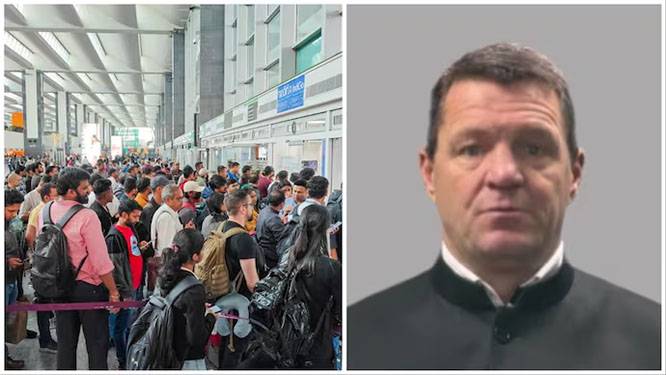
New Delhi, Dec 5: IndiGo CEO Pieter Elbers issued a public apology this evening after more than a thousand flights were cancelled today, making it the "most severely impacted day" in terms of cancellations. The biggest airline of the country cancelled "more than half" of its daily number of flights on Friday, said Elbers. He also said that even though the crisis will persist on Saturday, the airline anticipates fewer than 1,000 flight cancellations.

"Full normalisation is expected between December 10 and 15, though IndiGo cautions that recovery will take time due to the scale of operations," the IndiGo CEO said. 

IndiGo operates around 2,300 domestic and international flights daily.

Pieter Elbers, while apologising for the major inconvenience due to delays and cancellations, said the situation is a result of various causes.

The crisis at IndiGo stems from new regulations that boost pilots' weekly rest requirements by 12 hours to 48 and allow only two night-time landings per week, down from six. IndiGo has attributed the mass cancellations to "misjudgment and planning gaps".

Elbers also listed three lines of action that the airline will adopt to address the issue.

"Firstly, customer communication and addressing your needs, for this, messages have been sent on social media. And just now, a more detailed communication with information, refunds, cancellations and other customer support measures was sent," he said.

The airline has also stepped up its call centre capacity.

"Secondly, due to yesterday's situation, we had customers stranded mostly at the nation's largest airports. Our focus was for all of them to be able to travel today itself, which will be achieved. For this, we also ask customers whose flights are cancelled not to come to the airports as notifications are sent," the CEO said.

"Thirdly, cancellations were made for today to align our crew and planes to be where they need to start tomorrow morning afresh. Earlier measures of the last few days, regrettable, have proven not to be enough, but we have decided today to reboot all our systems and schedules, resulting in the highest numbers of cancellations so far, but imperative for progressive improvements starting from tomorrow," he added.

As airports witnessed chaotic scenes, the Directorate General of Civil Aviation (DGCA) stepped in to grant IndiGo a temporary exemption from stricter night duty rules for pilots. It also allowed substitution of leaves with a weekly rest period. 

Civil Aviation Minister Ram Mohan Naidu has said a high-level inquiry will be ordered and accountability will be fixed.

Comments

Add new comment

  • Coastaldigest.com reserves the right to delete or block any comments.
  • Coastaldigset.com is not responsible for its readers’ comments.
  • Comments that are abusive, incendiary or irrelevant are strictly prohibited.
  • Please use a genuine email ID and provide your name to avoid reject.