10 years of war | India calls for relaxing sanctions imposed on Syria

Agencies
March 16, 2021

India has told the UN Security Council that the humanitarian crisis, exacerbated by the Covid-19 pandemic, calls for relaxation of sanctions imposed on Syria, saying the international community must act with a “sense of urgency” to help the Syrian people.

India's Permanent Representative to the UN Ambassador T S Tirumurti said this on Monday while addressing the Security Council briefing on Syria.

“The 10-year long Syrian conflict has brought untold suffering to the Syrian people. The Covid-19 pandemic has further compounded the situation, posing serious challenges to the fragile health infrastructure. There is an urgent need to increase humanitarian assistance to all Syrians throughout the country without discrimination, politicisation, and any preconditions,” Tirumurti said.

He emphasised that the humanitarian crisis, exacerbated by the pandemic, “calls for relaxation of sanctions imposed on Syria. The international community must act with a sense of urgency to help the Syrian people.”

He voiced conviction that all efforts towards improving the humanitarian situation in Syria will positively impact the political track as well and called upon the wider UN system, in particular the World Health Organization and the United Nations Office for the Coordination of Humanitarian Affairs, to prioritise the vaccination programme in Syria, including through the COVAX initiative.

Tirumurti described it as “disheartening” that the conflict in Syria marks 10 years, peace and stability, unfortunately, remain elusive to the country and its people.

The political transition in Syria facilitated by the UN is not the only process presently underway and the five rounds of meetings of the drafting body of the Syrian constitutional committee have resulted in very little progress. “External influence is also adversely impacting the process,” he said.

“The situation on the ground does not present an optimistic picture either. It will be unrealistic to expect any dramatic outcomes in the near future, unless the international community takes decisive collective steps in the right direction,” he said, adding that if there is seriousness about achieving progress, there is need to have greater convergence of views and act to strengthen the hands of the Special Envoy Geir Pedersen.

Constructive international diplomacy is the need of the hour to bridge existing divides by focusing on mutual and reciprocal steps, he said.

In late December last year, UN human rights expert Alena Douhan had called on the US to remove unilateral sanctions against Syria, saying the sanctions imposed under the Caesar Act may “exacerbate the already dire humanitarian situation in Syria, especially in the course of Covid-19 pandemic, and put the Syrian people at even greater risk of human rights violations.”

The Caesar Syria Civilian Protection Act, also known as the Caesar Act, contains the most wide-ranging US sanctions ever applied against Syria, a UN Human Rights statement had said.

It added that the broad sweep of the US sanctions law that went into effect in June last year could target any foreigner helping in reconstruction of the conflict-ridden country, and even employees of foreign companies and humanitarian operators helping rebuild Syria.

In remarks to the press following the briefing to the Council, Pedersen said the Syrian conflict has now lasted for the same period as the First World War and the Second World War and the Syrian people must feel that they are really trapped in an endless conflict.

While there is a way forward, there is a need to find a way around the “you first” syndrome that has dominated much of the diplomacy around Syria for the last decade, he said.

“Right now, there are what I call ‘demands on all sides’ – but little movement on any side. And this dynamic has to change,” Pedersen said, adding that what is needed at the moment is to identify with realism and precision and implement in parallel mutual and reciprocal steps from Syrian and international players.

“All players – including the Syrian government and opposition, and key international players – would need to be ready to identify not only what they realistically hope to achieve, but what they can put on the table,” he said.

Tirumurti reiterated that delinking humanitarian and developmental work with progress on the political track will help in creating a conducive environment of trust and confidence.

He further noted that the Syrian conflict and involvement of external actors has contributed to the growth of terrorism in Syria and in its neighbouring countries, an issue that has been reiterated in the latest report of the Secretary-General on the threat posed by ISIL.

“We express our serious concern with the increased presence and terrorist activity of ‘Hayat Tahrir al-Sham’ and other affiliated terrorist groups that pose a threat to civilians inside and outside the Idlib de-escalation area,” he said.

“India firmly believes that long-term security and stability in this region can only be achieved by preserving the sovereignty and territorial integrity of Syria. We also remain convinced that there can be no military solution to the Syrian conflict and reaffirm our commitment to advancing a Syrian-led and Syrian-owned UN-facilitated political process” in line with relevant UNSC resolution.

India has extended developmental assistance and human resource development support to Syria regularly, including lines of credits for developmental projects and supply of medicine and food. 

Comments

Add new comment

  • Coastaldigest.com reserves the right to delete or block any comments.
  • Coastaldigset.com is not responsible for its readers’ comments.
  • Comments that are abusive, incendiary or irrelevant are strictly prohibited.
  • Please use a genuine email ID and provide your name to avoid reject.
News Network
January 20,2026

iran.jpg

Iranian security and intelligence forces have captured more than 470 individuals in three provinces, identified as key figures behind the recent wave of violent unrest and terrorist activities linked to foreign-backed networks.

The Intelligence Ministry's provincial office in Khorasan Razavi announced on Monday the arrest of 192 armed terrorists, identified as the main agents behind recent riots in the region. 

According to an official statement, the detainees were involved in the killing of several security personnel and civilians, setting fire to mosques, public service facilities, and buses, as well as attacks on military and law enforcement centers.

The seized items from the group include several bulletproof vests, Kalashnikov rifles, hunting weapons, Winchester rifles, and various cold weapons such as daggers, swords, brass knuckles, tactical knives, crossbows, and chains.

Evidence indicates that some of the individuals were tied to hostile movements and terrorist organizations, with links overseas. Others were identified as members of violent criminal gangs, actively taking part in the unrest alongside their associates.

Simultaneously, in the western province of Lorestan, the IRGC announced the arrest of 134 individuals as the main leaders and influential field agents of a US-Israeli terrorist network.

The IRGC statement stated that these individuals formed terrorist cells during the recent unrest, committing "Daesh-like" acts.

They wounded security forces with firearms and cold weapons, and burned and destroyed public and private properties, including mosques, shops, banks, and private and public vehicles.

In the northwestern province of Zanjan, the police reported detaining 150 people identified as principal leaders and agents behind recent riots.

Authorities noted that these individuals were responsible for destroying public and private property and intentionally setting fire to vehicles in the province's squares.

Their crimes include shedding the blood of innocent people, destroying public and private property, attempting to enter military sites, disrupting public order, and spreading terror among citizens.

A variety of cold weapons were reportedly seized from the detainees.

What began late last month as peaceful protests over economic hardship across Iran turned violent after public statements by US and Israeli regime figures encouraged vandalism and disorder.

During the unrest, foreign-backed mercenaries rampaged through cities, killing security forces and civilians and damaging public property.

Comments

Add new comment

  • Coastaldigest.com reserves the right to delete or block any comments.
  • Coastaldigset.com is not responsible for its readers’ comments.
  • Comments that are abusive, incendiary or irrelevant are strictly prohibited.
  • Please use a genuine email ID and provide your name to avoid reject.
News Network
January 23,2026

Mangaluru: The Karnataka Government Polytechnic (KPT), Mangaluru, has achieved autonomous status from the All India Council for Technical Education (AICTE), becoming the first government polytechnic in the country to receive such recognition in its 78-year history. The status was granted by AICTE, New Delhi, and subsequently approved by the Karnataka Board of Technical Education in October last year.

Officials said the autonomy was conferred a few months ago. Until recently, AICTE extended autonomous status only to engineering colleges, excluding diploma institutions. However, with a renewed national focus on skill development, several government polytechnics across India have now been granted autonomy.

KPT, the second-largest polytechnic in Karnataka, was established in 1946 with four branches and has since expanded to offer eight diploma programmes, including computer science and polymer technology. The institution is spread across a 19-acre campus.

Ravindra M Keni, the first dean of the institution, told The Times of India that AICTE had proposed autonomous status for polytechnic institutions that are over 25 years old. “Many colleges applied. In the first round, 100 institutions were shortlisted, which was further narrowed down to 15 in the second round. We have already completed one semester after becoming an autonomous institution,” he said. He added that nearly 500 students are admitted annually across eight three-year diploma courses.

Explaining the factors that helped KPT secure autonomy, Keni said the institution has consistently recorded 100 per cent admissions and placements for its graduates. He also noted its strong performance in sports, with the college emerging champions for 12 consecutive years, along with active student participation in NCC and NSS activities.

Autonomous status allows KPT to design industry-oriented curricula, conduct examinations, prepare question papers, and manage academic documentation independently. The institution can also directly collaborate with industries and receive priority funding from AICTE or the Ministry of Education. While academic autonomy has been granted, financial control will continue to rest with the state government.

“There will be separate committees for examinations, question paper setting, boards of studies, and boards of examiners. The institution will now have the freedom to conduct admissions without government notifications and issue its own marks cards,” Keni said, adding that new academic initiatives would be planned after a year of functioning under the autonomous framework.

Comments

Add new comment

  • Coastaldigest.com reserves the right to delete or block any comments.
  • Coastaldigset.com is not responsible for its readers’ comments.
  • Comments that are abusive, incendiary or irrelevant are strictly prohibited.
  • Please use a genuine email ID and provide your name to avoid reject.
News Network
January 19,2026

trump.jpg

Donald Trump has linked his repeated threats to seize Greenland to his failure to win the Nobel Peace Prize, in a letter to Norwegian Prime Minister Jonas Gahr Støre.

The authenticity of the letter, in which Trump says he no longer feels obligated to “think purely of peace,” was confirmed by Støre to the Norwegian newspaper VG.

“Considering your country decided not to give me the Nobel Peace Prize for having stopped eight wars plus, I no longer feel an obligation to think purely of peace,” Trump wrote, adding he can now “think about what is good and proper for the United States.”

Støre said Trump’s letter was in response to a short message he had sent earlier, on behalf of himself and Finland’s President Alexander Stubb.

Trump has escalated rhetoric toward Greenland, a self-governing Danish territory, insisting the US will take control “one way or the other.” Over the weekend, he tweeted: “Now it is time, and it will be done!!!”

On Saturday, Trump threatened a 10% tariff on imports from Denmark, Norway, Sweden, France, Germany, the UK, the Netherlands, and Finland from 1 February until the US is allowed to purchase the island. EU diplomats met for emergency talks on possible retaliatory tariffs and sanctions.

In his letter, Trump argued Denmark “cannot protect” Greenland from Russia or China, questioning Danish ownership: “There are no written documents; it’s only that a boat landed there hundreds of years ago.” He added that NATO should support the US, claiming the world is “not secure unless we have complete and total control of Greenland.”

Trump’s stance has unsettled the EU and NATO, as he refused to rule out military action to take control of the mineral-rich island.

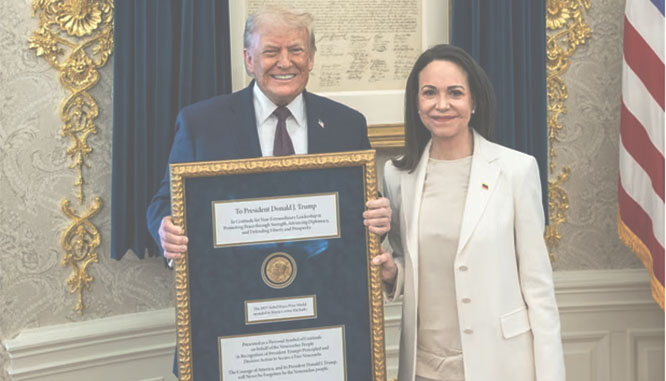
The Nobel Peace Prize is awarded by the independent Norwegian Nobel Committee, not the government. Trump had campaigned for last year’s prize, which went to Venezuelan opposition leader María Corina Machado, who dedicated her award to him.

Støre reiterated that the Nobel Prize decision rests solely with the committee.

Comments

Add new comment

  • Coastaldigest.com reserves the right to delete or block any comments.
  • Coastaldigset.com is not responsible for its readers’ comments.
  • Comments that are abusive, incendiary or irrelevant are strictly prohibited.
  • Please use a genuine email ID and provide your name to avoid reject.