



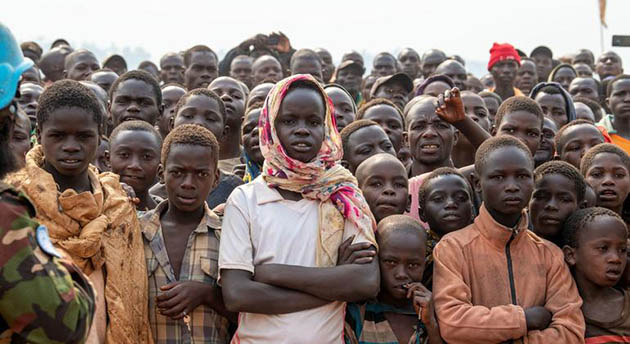
110 million people FORCIBLY displaced across this globe: United Nations

Agencies
June 14, 2023

displaced.jpg

The number of people forcibly displaced around the world has climbed to a record 110 million people, the head of the UN refugee agency (UNHCR) said, with conflicts in Ukraine and Sudan spurring millions of people to flee their homes.

The increase of around 19 million people to 108.4 million by the end of last year is the biggest annual jump on record, UNHCR said in a report released on Wednesday. That number has since risen further to 110 million, mostly due to Sudan's eight-week-old conflict, the UN High Commissioner for Refugees Filippo Grandi told journalists.

"It's quite an indictment on the state of our world to have to report that," he said at a Geneva press conference.

"Solutions to these movements are increasingly difficult to even imagine, to even put on the table," he said. "We are in a very polarised world, where international tensions play out all the way into humanitarian issues."

For the two decades before the Syria conflict in 2011, the global level was roughly stable at about 40 million refugees and internally displaced people, the Forced Displacement report showed. But they have risen each year since and have now more than doubled. More than one in every 74 people is now displaced, the report said.

Grandi blamed "the usual package of causes" which he said were conflict, persecution, discrimination, violence and climate change. Of the total refugees and those needing international protection, about half of them came from just three countries: Syria, Ukraine and Afghanistan.

Grandi raised concerns about tougher rules on admitting refugees and push-backs, without naming countries.

"We see increasingly a reluctance on the part of states to fully adhere to the principles of the (1951 refugee) convention, even states that have signed it," Grandi told Reuters on the sidelines of the briefing.

However, he was upbeat about some developments, namely a deal reached by EU ministers last week on sharing responsibility for migrants and refugees.

"There are issues of some concern. By and large however, I think it's a positive step," he said. "We're so happy that the Europeans agree on something."

He also praised Kenya which he said is looking for new solutions for the half million refugees it hosts, including many who have fled poverty and drought in the Horn of Africa.

Comments

Add new comment

  • Coastaldigest.com reserves the right to delete or block any comments.
  • Coastaldigset.com is not responsible for its readers’ comments.
  • Comments that are abusive, incendiary or irrelevant are strictly prohibited.
  • Please use a genuine email ID and provide your name to avoid reject.
News Network
January 23,2026

Karnataka Governor Thaawarchand Gehlot read only three lines from the 122-paragraph address prepared by the Congress-led state government while addressing the joint session of the Legislature on Thursday, effectively bypassing large sections critical of the BJP-led Union government.

The omitted portions of the customary Governor’s address outlined what the state government described as a “suppressive situation in economic and policy matters” under India’s federal framework. The speech also sharply criticised the Centre’s move to replace the Mahatma Gandhi National Rural Employment Guarantee Act (MGNREGA) with the Viksit Bharat–Guarantee for Rozgar and Ajeevika Mission (Gramin) Act, commonly referred to as the VB-GRAM (G) Act.

Governor Gehlot had earlier conveyed his objection to several paragraphs that were explicitly critical of the Union government. On Thursday, he confined himself to the opening lines — “I extend a warm welcome to all of you to the joint session of the State legislature. I am extremely pleased to address this august House” — before jumping directly to the concluding sentence of the final paragraph.

He ended the address by reading the last line of paragraph 122: “Overall, my government is firmly committed to doubling the pace of the State’s economic, social and physical development. Jai Hind — Jai Karnataka.”

According to the prepared speech, the Karnataka government demanded the scrapping of the VB-GRAM (G) Act, describing it as “contractor-centric” and detrimental to rural livelihoods, and called for the full restoration of MGNREGA. The state government argued that the new law undermines decentralisation, weakens labour protections, and centralises decision-making in violation of constitutional norms.

Key points from the unread sections of the speech:

•    Karnataka facing a “suppressive” economic and policy environment within the federal system

•    Repeal of MGNREGA described as a blow to rural livelihoods

•    VB-GRAM (G) Act accused of protecting corporate and contractor interests

•    New law alleged to weaken decentralised governance

•    Decision-making said to be imposed by the Centre without consulting states

•    Rights of Adivasis, women, backward classes and agrarian communities curtailed

•    Labourers allegedly placed under contractor control

•    States facing mounting fiscal stress due to central policies

•    VB-GRAM (G) Act accused of enabling large-scale corruption

Comments

Add new comment

  • Coastaldigest.com reserves the right to delete or block any comments.
  • Coastaldigset.com is not responsible for its readers’ comments.
  • Comments that are abusive, incendiary or irrelevant are strictly prohibited.
  • Please use a genuine email ID and provide your name to avoid reject.