



200 Taliban fighters, 58 Pak soldiers killed in Afghan-Pakistan border clashes

Agencies
October 12, 2025

pakafghan.jpg

Islamabad/Kabul: Over 200 Taliban fighters and affiliated militants were killed in intense overnight clashes along the Pakistan-Afghanistan border, the Pakistani Army said on Sunday, as tensions soared between the two neighbours amid mutual accusations of cross-border aggression.

In response, Taliban spokesperson Zabihullah Mujahid claimed that Afghan forces had killed at least 58 Pakistani soldiers and injured more than 30 others in retaliatory strikes near the Durand Line in Behrampur district. He warned that Afghanistan would “leave no attack unanswered” and accused Pakistan of allowing ISIS militants to shelter on its soil.

“Pakistan has turned a blind eye to the presence of ISIS. Afghanistan has the right to defend its borders and will not leave any attack unanswered. Pakistan should hand over or expel key ISIS members hiding on its soil,” Mujahid said.

The Taliban spokesperson added that “a significant amount of weapons” had fallen into the hands of Afghan forces and confirmed that “more than 20 members of the Islamic Emirate were also killed or wounded.”

The clashes reportedly erupted after Pakistan seized 19 Afghan military posts and what it called “terrorist hideouts,” accusing Kabul of launching “unprovoked attacks” along the border. Afghan officials, however, said their actions were retaliatory.

According to Pakistan’s Inter-Services Public Relations (ISPR), Taliban and Tehreek-e-Taliban Pakistan (TTP) militants “launched an unprovoked attack along the Pak-Afghan border” on the night of October 11–12. The statement said Pakistani forces “repelled the assault decisively,” killing more than 200 attackers, destroying 21 hostile positions inside Afghan territory, and rendering several training camps inoperative.

“Pakistan took all possible measures to avoid civilian casualties,” the army said, warning that while Islamabad preferred diplomacy, it would not tolerate the use of Afghan soil for terrorism.

The army confirmed the deaths of 23 Pakistani soldiers and injuries to 29 others in the overnight fighting.

The statement also noted that the “serious provocation” occurred during the Taliban Foreign Minister’s visit to India — a timing Islamabad described as “concerning.”

President Asif Ali Zardari and Prime Minister Shehbaz Sharif praised the army’s “befitting” response, vowing “no compromise on Pakistan’s sovereignty.” Sharif commended Chief of Army Staff Field Marshal Syed Asim Munir for his leadership, warning that “every provocation will be given a decisive response.”

The Taliban Defence Ministry confirmed the strikes on Sunday, describing them as “retaliatory and successful operations.” Afghan forces reportedly targeted Pakistani posts at Angoor Adda, Bajaur, Kurram, Dir, and Chitral in Khyber Pakhtunkhwa and Baramcha in Balochistan.

Mujahid claimed that 20 Pakistani outposts were destroyed and several weapons seized. He also said nine Afghan soldiers were killed and 16 wounded, according to TOLO News, and that the operation was halted at midnight following requests from Qatar and Saudi Arabia.

Pakistan’s Interior Minister Mohsin Naqvi called the Taliban’s actions “unprovoked” and accused them of firing on civilians. “Afghanistan is being answered with stones for bricks,” he said.

The situation has sharply deteriorated following repeated TTP attacks inside Pakistan — allegedly planned from Afghan territory — including one last week in Orakzai district that killed 11 Pakistani soldiers, among them a lieutenant colonel and a major.

Security officials said Pakistani forces also destroyed a Taliban tank position and struck the Second Battalion Headquarters of the First Brigade in Barabcha, reportedly used by TTP militants. Additional strikes in Kharlachi and Baramcha destroyed several Afghan outposts, including Doran Mela, Turkmanzai, Afghani Shaheedan, and Jandoser, they said.

Comments

Add new comment

  • Coastaldigest.com reserves the right to delete or block any comments.
  • Coastaldigset.com is not responsible for its readers’ comments.
  • Comments that are abusive, incendiary or irrelevant are strictly prohibited.
  • Please use a genuine email ID and provide your name to avoid reject.
News Network
January 19,2026

trump.jpg

Donald Trump has linked his repeated threats to seize Greenland to his failure to win the Nobel Peace Prize, in a letter to Norwegian Prime Minister Jonas Gahr Støre.

The authenticity of the letter, in which Trump says he no longer feels obligated to “think purely of peace,” was confirmed by Støre to the Norwegian newspaper VG.

“Considering your country decided not to give me the Nobel Peace Prize for having stopped eight wars plus, I no longer feel an obligation to think purely of peace,” Trump wrote, adding he can now “think about what is good and proper for the United States.”

Støre said Trump’s letter was in response to a short message he had sent earlier, on behalf of himself and Finland’s President Alexander Stubb.

Trump has escalated rhetoric toward Greenland, a self-governing Danish territory, insisting the US will take control “one way or the other.” Over the weekend, he tweeted: “Now it is time, and it will be done!!!”

On Saturday, Trump threatened a 10% tariff on imports from Denmark, Norway, Sweden, France, Germany, the UK, the Netherlands, and Finland from 1 February until the US is allowed to purchase the island. EU diplomats met for emergency talks on possible retaliatory tariffs and sanctions.

In his letter, Trump argued Denmark “cannot protect” Greenland from Russia or China, questioning Danish ownership: “There are no written documents; it’s only that a boat landed there hundreds of years ago.” He added that NATO should support the US, claiming the world is “not secure unless we have complete and total control of Greenland.”

Trump’s stance has unsettled the EU and NATO, as he refused to rule out military action to take control of the mineral-rich island.

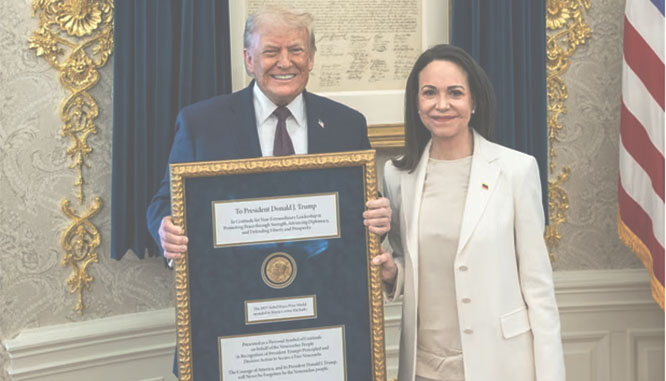
The Nobel Peace Prize is awarded by the independent Norwegian Nobel Committee, not the government. Trump had campaigned for last year’s prize, which went to Venezuelan opposition leader María Corina Machado, who dedicated her award to him.

Støre reiterated that the Nobel Prize decision rests solely with the committee.

Comments

Add new comment

  • Coastaldigest.com reserves the right to delete or block any comments.
  • Coastaldigset.com is not responsible for its readers’ comments.
  • Comments that are abusive, incendiary or irrelevant are strictly prohibited.
  • Please use a genuine email ID and provide your name to avoid reject.
News Network
January 23,2026

Karnataka Governor Thaawarchand Gehlot read only three lines from the 122-paragraph address prepared by the Congress-led state government while addressing the joint session of the Legislature on Thursday, effectively bypassing large sections critical of the BJP-led Union government.

The omitted portions of the customary Governor’s address outlined what the state government described as a “suppressive situation in economic and policy matters” under India’s federal framework. The speech also sharply criticised the Centre’s move to replace the Mahatma Gandhi National Rural Employment Guarantee Act (MGNREGA) with the Viksit Bharat–Guarantee for Rozgar and Ajeevika Mission (Gramin) Act, commonly referred to as the VB-GRAM (G) Act.

Governor Gehlot had earlier conveyed his objection to several paragraphs that were explicitly critical of the Union government. On Thursday, he confined himself to the opening lines — “I extend a warm welcome to all of you to the joint session of the State legislature. I am extremely pleased to address this august House” — before jumping directly to the concluding sentence of the final paragraph.

He ended the address by reading the last line of paragraph 122: “Overall, my government is firmly committed to doubling the pace of the State’s economic, social and physical development. Jai Hind — Jai Karnataka.”

According to the prepared speech, the Karnataka government demanded the scrapping of the VB-GRAM (G) Act, describing it as “contractor-centric” and detrimental to rural livelihoods, and called for the full restoration of MGNREGA. The state government argued that the new law undermines decentralisation, weakens labour protections, and centralises decision-making in violation of constitutional norms.

Key points from the unread sections of the speech:

•    Karnataka facing a “suppressive” economic and policy environment within the federal system

•    Repeal of MGNREGA described as a blow to rural livelihoods

•    VB-GRAM (G) Act accused of protecting corporate and contractor interests

•    New law alleged to weaken decentralised governance

•    Decision-making said to be imposed by the Centre without consulting states

•    Rights of Adivasis, women, backward classes and agrarian communities curtailed

•    Labourers allegedly placed under contractor control

•    States facing mounting fiscal stress due to central policies

•    VB-GRAM (G) Act accused of enabling large-scale corruption

Comments

Add new comment

  • Coastaldigest.com reserves the right to delete or block any comments.
  • Coastaldigset.com is not responsible for its readers’ comments.
  • Comments that are abusive, incendiary or irrelevant are strictly prohibited.
  • Please use a genuine email ID and provide your name to avoid reject.