



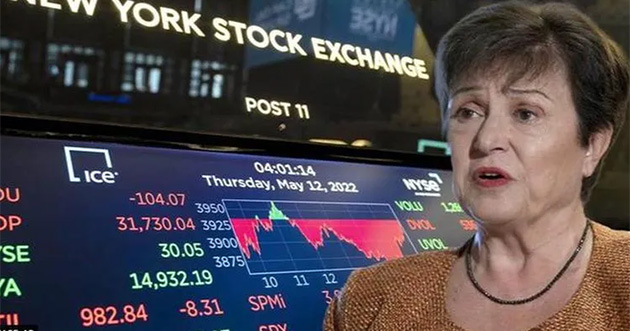
2023 tougher than last year as a third of the global economy set to hit recession: IMF chief

News Network
January 2, 2023

economy.jpg

For much of the global economy, 2023 is going to be a tough year as the main engines of global growth – the US, Europe and China – all experience weakening activity, the head of the International Monetary Fund has warned.

The new year is going to be “tougher than the year we leave behind,” IMF managing director Kristalina Georgieva said on the CBS Sunday morning news program Face the Nation on Sunday.

It comes as the war in Ukraine, rising prices, higher interest rates and the spread of Covid in China weigh on the global economy.

In October the IMF cut its global economic growth outlook for 2023.

"We expect one third of the world economy to be in recession," Ms Georgieva said on the CBS news programme Face the Nation.

"Even countries that are not in recession, it would feel like recession for hundreds of millions of people," she added.

Katrina Ell, an economist at Moody's Analytics in Sydney, gave the BBC her assessment of the world economy.

"While our baseline avoids a global recession over the next year, odds of one are uncomfortably high. Europe, however, will not escape recession and the US is teetering on the verge," she said.

The IMF cut its outlook for global economic growth in 2023 in October, due to the war in Ukraine as well as higher interest rates as central banks around the world attempt to rein in rising prices.

Since then China has scrapped its zero-Covid policy and started to reopen its economy, even as coronavirus infections have spread rapidly in the country.

Ms Georgieva warned that China, the world's second largest economy, would face a difficult start to 2023.

"For the next couple of months, it would be tough for China, and the impact on Chinese growth would be negative, the impact on the region will be negative, the impact on global growth will be negative," she said.

The IMF is an international organisation with 190 member countries. They work together to try to stabilise the global economy. One of its key roles is to act as an early economic warning system.

Ms Georgieva's comments will be alarming for people around the world, not least in Asia which endured a difficult year in 2022.

Inflation has been steadily rising across the region, largely because of the war in Ukraine, while higher interest rates have also hit households and business.

Figures released over the weekend pointed to weakness in the Chinese economy at the end of 2022.

The official purchasing managers' index (PMI) for December showed that China's factory activity shrank for the third month in a row and at the fastest rate in almost three years as coronavirus infections spread in the country's factories.

In the same month home prices in 100 cities fell for the sixth month in a row, according to a survey by one of the country's largest independent property research firms, China Index Academy.

On Saturday, in his first public comments since the change in policy, President Xi Jinping called for more effort and unity as China enters what he called a "new phase".

The downturn in the US also means there is less demand for the products that are made in China and other Asian countries including Thailand and Vietnam.

Higher interest rates also make borrowing more expensive - so for both these reasons companies may choose not to invest in expanding their businesses.

The lack of growth can trigger investors to pull money out of an economy and so countries, especially poorer ones, have less cash to pay for crucial imports like food and energy.

In these kinds of slowdowns a currencies can lose value against those of more prosperous economies, compounding the issue.

The impact of higher interest rates on loans affects economies at the government level too - especially emerging markets, which may struggle to repay their debts.

For decades the Asia-Pacific region has depended on China as a major trading partner and for economic support in times of crisis.

Now Asian economies are facing the lasting economic effects of how China has handled the pandemic.

The manufacture of products such as Tesla electric cars and Apple iPhones may get back on track as Beijing ends zero-Covid.

But renewed demand for commodities like oil and iron ore is likely to further increase prices just as inflation appeared to have peaked.

"China's relaxed domestic Covid restrictions are not a silver bullet. The transition will be bumpy and a source of volatility at least through the March quarter," Ms Ell said.


Comments

Add new comment

  • Coastaldigest.com reserves the right to delete or block any comments.
  • Coastaldigset.com is not responsible for its readers’ comments.
  • Comments that are abusive, incendiary or irrelevant are strictly prohibited.
  • Please use a genuine email ID and provide your name to avoid reject.
News Network
January 23,2026

modIKERALA.jpg

Prime Minister Narendra Modi, during his visit to Thiruvananthapuram on Friday, January 23, indicated that the Bharatiya Janata Party (BJP) is aiming to expand its political footprint in Kerala ahead of the Assembly elections scheduled in the coming months.

Speaking at a BJP-organised public meeting, Modi drew parallels between the party’s early electoral gains in Gujarat and its recent victory in the Thiruvananthapuram Municipal Corporation. The civic body win, which ended decades of Left control, was cited by the Prime Minister as a possible starting point for the party’s broader ambitions in the state.

Recalling BJP’s political trajectory in Gujarat, Modi said the party was largely insignificant before 1987 and received little media attention. He pointed out that the BJP’s first major breakthrough came with its victory in the Ahmedabad Municipal Corporation that year.

“Just as our journey in Gujarat began with one city, Kerala’s journey has also started with a single city,” Modi said, suggesting that the party’s municipal-level success could translate into wider electoral acceptance.

The Prime Minister alleged that successive governments led by the Left Democratic Front (LDF) and the United Democratic Front (UDF) had failed to adequately develop Thiruvananthapuram. He accused both fronts of corruption and neglect, claiming that basic infrastructure and facilities were denied to the capital city for decades.

According to Modi, the BJP’s control of the civic body represents a shift driven by public dissatisfaction with the existing political alternatives. He asserted that the BJP administration in Thiruvananthapuram had begun working towards development, though no specific details or timelines were outlined.

Addressing the gathering at Putharikandam Maidan, Modi said the BJP intended to project Thiruvananthapuram as a “model city,” reiterating his party’s commitment to governance-led change.

The Prime Minister’s visit to Kerala also included the inauguration of several development projects and the flagging off of new train services, as the BJP intensifies its political outreach in the poll-bound state.

Comments

Add new comment

  • Coastaldigest.com reserves the right to delete or block any comments.
  • Coastaldigset.com is not responsible for its readers’ comments.
  • Comments that are abusive, incendiary or irrelevant are strictly prohibited.
  • Please use a genuine email ID and provide your name to avoid reject.
News Network
February 1,2026

US President Donald Trump on Saturday claimed that the government of India led by Prime Minister Narendra Modi has made a deal to buy Venezuelan oil, as opposed to purchasing it from Iran.

"We've already made that deal, the concept of the deal," he told reporters on Air Force One.

Trump had imposed 25% tariffs on countries buying Venezuelan oil, including India, in March 2025. He had also hit India with tariffs for buying Russian oil, saying it was "funding" President Vladimir Putin's war against Ukraine.

Trump has said that the US has taken control of the oil-rich Venezuela after capturing former President Nicolas Maduro in January.

A fleet of 18 ships loaded with crude oil bound for refineries in Texas, Louisiana, and Mississippi in January, the most since December 2024, according to a report by the news agency Bloomberg.

Combined crude deliveries to the US will reach about 2,75,000 barrels a day, more than doubling volumes seen in December last year. Shipments to China, which averaged 4,00,000 barrels a day last year, fell to zero in January.

PM Modi, Venezuelan President Agree To Expand Ties

Prime Minister Narendra Modi and Venezuela's acting President Delcy Rodriguez spoke on Friday and agreed to take the bilateral relations to "new heights" in the years ahead.

It was the first phone call between the two leaders since the capture of Maduro and his wife by the US on January 3.

"Spoke with Acting President of Venezuela, Ms. Delcy Rodriguez. We agreed to further deepen and expand our bilateral partnership in all areas, with a shared vision of taking India-Venezuela relations to new heights in the years ahead," PM Modi said in a post on X.

A statement from Prime Minister Modi's office said the two leaders agreed to further expand and deepen the India-Venezuela partnership in all areas, including trade and investment, energy, digital technology, health, agriculture, and people-to-people ties.

They exchanged views on various regional and global issues of mutual interest and underscored the importance of their close cooperation for the Global South, the statement said.

Rodriguez also said that they discussed partnerships in the fields of agriculture, science and technology, mining, and tourism, as well as the pharmaceutical and automotive industries.

Comments

Add new comment

  • Coastaldigest.com reserves the right to delete or block any comments.
  • Coastaldigset.com is not responsible for its readers’ comments.
  • Comments that are abusive, incendiary or irrelevant are strictly prohibited.
  • Please use a genuine email ID and provide your name to avoid reject.
News Network
January 20,2026

Mangaluru: In a major step towards strengthening rural innovation, the Office of the Principal Scientific Adviser (PSA) to the Government of India is supporting the establishment of RuTAGe Smart Village Centres (RSVCs) across the country through collaborations with academic institutions, civil society organisations and philanthropic partners.

As part of this national initiative, Nitte (Deemed to be University) will set up the first RSVCs in the region at Nitte GP in Udupi district and at the Nitte Health Centre, Sevanjali Trust, Farangipete, in Dakshina Kannada district. The centres will be inaugurated on January 21. In South India, the programme is being implemented by the Section Infin-8 Foundation (SI-8).

Speaking to reporters on Monday, SI-8 founder-director Vishwas US said experts from Nitte University and SI-8 would work closely with farmers, students, youth and local entrepreneurs to adapt and deploy technologies tailored to local needs.

Project head Prof Iddya Karunasagar, representing Nitte DU, said the RSVCs at Nitte and Farangipete would serve as demonstration hubs for a wide range of agriculture, energy, skill-development and assistive technologies. These include solar dryers for fruits, vegetables and crops; soil-testing solutions; power weeders and women-friendly farm tools; wind-powered devices for rural artisans; grain storage systems; grass-cutting and tree-climbing equipment; and liquid fertiliser production using cowshed waste.

SI-8 CEO Aravind C Kumar said the centres would also provide access to digital and knowledge-based platforms such as ISRO applications, government scheme portals, market linkage tools and gamified learning resources, along with assistive technologies for persons with visual impairments.

Highlighting the broader impact of the initiative, Principal Scientific Adviser Prof Ajay Kumar Sood said it demonstrated how applied research could bridge the rural–urban divide and help create self-reliant, technology-enabled villages.

The initiative has been made possible through philanthropic support from Dr NC Murthy of ACM Business Solutions, LLC, USA. Dr Sapna Poti, Director (Strategic Alliances) at the Office of the Principal Scientific Adviser, said the long-term objective is to build self-sufficient, technology-driven communities capable of generating sustainable livelihoods on their own.

Comments

Add new comment

  • Coastaldigest.com reserves the right to delete or block any comments.
  • Coastaldigset.com is not responsible for its readers’ comments.
  • Comments that are abusive, incendiary or irrelevant are strictly prohibited.
  • Please use a genuine email ID and provide your name to avoid reject.