



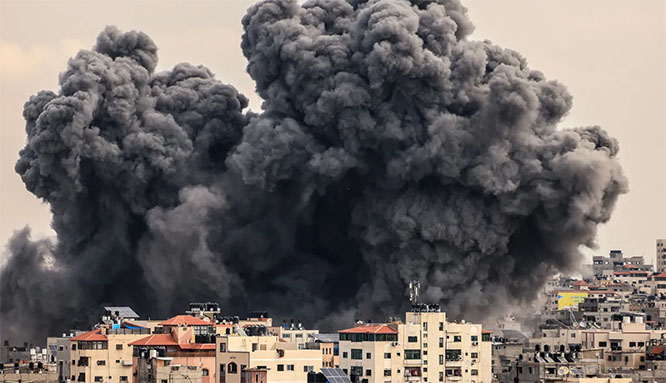
59 conflicts, 78 nations involved: World is now least peaceful since World War-2

News Network
June 19, 2025

conflict.jpg

The world is now witnessing the highest number of active state-based conflicts since the end of the Second World War, with 59 ongoing wars and 78 countries involved, according to the 2024 edition of the Global Peace Index released by the Institute for Economics & Peace.

The report paints a grim picture of international stability, warning that global peacefulness continues to erode amid a backdrop of deepening geopolitical rivalries, rising militarisation, and a growing number of cross-border disputes.

“Many of the leading indicators that typically precede large-scale conflict are now at their worst levels since 1945,” the study stated.

Sharp Rise in Conflicts

There are currently 59 active state-based armed conflicts, three more than last year, making this the most violent period since WWII. The conflicts are not only increasing in number but also in complexity, with 78 nations now engaged in violence beyond their borders, a trend that the index attributes to growing global fragmentation and the assertiveness of middle powers.

Major flashpoints highlighted in the report include:

Russia-Ukraine

Israel-Palestine and Israel-Iran

China-US tensions over Taiwan

India-Pakistan

Armenia-Azerbaijan

North Korea-US

Iran-US

Yemen-Saudi Arabia

EU-Russia and UK-Russia

The report particularly noted the recent escalation between Israel and Iran, where Israel launched airstrikes on June 13 targeting Iranian military and nuclear infrastructure, killing senior Iranian officers—an incident that marked a dangerous expansion of the Middle East conflict.

Internationalisation of War

Conflicts are no longer localised. The report stresses that 78 countries are directly involved in conflicts beyond their borders, marking a significant shift toward internationalised warfare. The causes range from proxy wars and foreign interventions to the increasing involvement of middle-tier powers asserting dominance in their regions.

Decline in Conflict Resolution

The world is also seeing a steep decline in effective conflict resolution. The success rate of wars ending in a decisive military victory has plummeted from 49% in the 1970s to just 9% in the 2010s, while peace agreements as a method of resolution have dropped from 23% to just 4%.

Meanwhile, the long-term trend of falling militarisation has reversed. In the last two years alone, 106 countries have become more militarised, reflecting a broader shift toward rearmament and power projection.

Global Rankings

The Global Peace Index ranks 163 countries and territories, covering 99.7% of the world’s population.

Most Peaceful Countries (Top 5):

Iceland (since 2008)

Ireland

Austria

New Zealand

Switzerland

Least Peaceful Countries (Bottom 5):

Russia (for the first time)

Ukraine

Sudan

Democratic Republic of Congo

Yemen

Regional Overview

Western and Central Europe remains the most peaceful region globally.

Middle East and North Africa (MENA) retains its position as the least peaceful.

South Asia is now the second least peaceful region, with growing political repression in Bangladesh and enduring tensions between India and Pakistan contributing to its decline.

Interestingly, South America was the only region to record an overall improvement in peacefulness last year, with 7 of 11 countries showing gains.

Final Outlook

Overall, 87 countries saw a decline in peacefulness, while only 74 improved, leading to a net global deterioration of 0.36%. The report concludes that without major diplomatic interventions, the world is on a trajectory of escalating conflict and instability unseen since the mid-20th century.


Comments

Add new comment

  • Coastaldigest.com reserves the right to delete or block any comments.
  • Coastaldigset.com is not responsible for its readers’ comments.
  • Comments that are abusive, incendiary or irrelevant are strictly prohibited.
  • Please use a genuine email ID and provide your name to avoid reject.
News Network
December 3,2025

indigo.jpg

IndiGo, India’s largest airline, is battling one of its worst operational disruptions in recent years, with hundreds of delays and cancellations throwing domestic travel into chaos.

Government data on Tuesday showed its on-time performance plunging to 35%, an unusual dip for a carrier long associated with punctuality.

By Wednesday afternoon, airports in Delhi, Mumbai, Bengaluru and Hyderabad had collectively reported close to 200 cancellations, stranding travellers across the country.

Crew Shortage After New Duty Norms

A major trigger behind the meltdown is a severe crew shortage, especially among pilots, following the rollout of revised Flight Duty Time Limitation (FDTL) norms last month.

The rules mandate longer rest hours and more humane rosters — a shift IndiGo has struggled to incorporate across its vast network.

Sources said several flights were grounded due to lack of cabin crew, while some delays stretched upwards of eight hours.

With IndiGo controlling over 60% of India’s domestic aviation market, the ripple effect has impacted airports nationwide.

IndiGo Issues Apology, Lists “Compounding Factors”

In a statement, IndiGo acknowledged the large-scale disruption:

“We sincerely apologise to customers. A series of unforeseen operational challenges — technology glitches, winter schedule changes, adverse weather, system congestion and updated FDTL norms — created a compounding impact that could not have been anticipated.”

To stabilise operations, the airline has begun calibrated schedule adjustments for the next 48 hours, aiming to restore punctuality. Affected passengers are being offered refunds or alternate travel arrangements, IndiGo said.

What the FDTL Rules Require

The FDTL norms, designed to reduce pilot fatigue, cap duty and flying hours as follows:
•    Maximum 8 hours of flying per day
•    35 hours per week
•    125 hours per month
•    1,000 hours per year

Crew must also receive rest equalling twice the flight duration, with a minimum 10-hour rest period in any 24-hour window.

The DGCA introduced these limits to enhance flight safety.

Hyderabad: 33 Flights Cancelled, Long Queues Reported

Hyderabad’s Rajiv Gandhi International Airport saw heavy early-morning crowds as 33 IndiGo flights (arrivals and departures) were cancelled.

The airport clarified on X that operations were normal, advising passengers to contact IndiGo directly for latest flight status.

Cancellations included flights to and from Visakhapatnam, Goa, Ahmedabad, Delhi, Bengaluru, Chennai, Madurai, Hubli, Bhopal and Bhubaneswar.

Bengaluru: 42 Flights Disrupted

Bengaluru’s Kempegowda International Airport recorded 42 cancellations — 22 arrivals and 20 departures — affecting routes to Delhi, Mumbai, Chennai, Hyderabad, Goa, Kolkata and Lucknow.

Passengers Vent on Social Media

Irate travellers took to X to share their experiences. One passenger stranded in Hyderabad wrote: “I have been here since 3 a.m. and missed an important meeting.”

Another said: “My flight was pushed from 1:55 PM to 2:55 PM and now 4:35 PM. I was informed only three minutes before entering the airport.”

Delhi Airport Hit by Tech Glitch

At Delhi Airport, the disruption deepened due to a slowdown in the Amadeus system — used for reservations, check-ins and departure control.

The technical issue led to longer queues and sluggish processing, adding to delays already worsened by staff shortages.

Comments

Add new comment

  • Coastaldigest.com reserves the right to delete or block any comments.
  • Coastaldigset.com is not responsible for its readers’ comments.
  • Comments that are abusive, incendiary or irrelevant are strictly prohibited.
  • Please use a genuine email ID and provide your name to avoid reject.
News Network
November 26,2025

Mangaluru, Nov 26: Mangaluru East police have registered a case following a sophisticated online fraud where a 57-year-old local resident was allegedly cheated out of ₹13.4 lakh after being targeted on Facebook.

The scam began in February when the complainant, while browsing Facebook reels, was contacted by a woman identifying herself as "Lillian Mary George" from London. After establishing a chat relationship, the woman claimed she would visit India in November and bring a significant sum of money.

The trap was sprung on November 15, when the victim received a call from a woman named "Sonali Gupta," who claimed Lillian had arrived at Mumbai International Airport but was detained by customs. The fraudsters convinced the man that Lillian was carrying £25,000 (about ₹26 lakh) in traveller’s cheques and 1 kg of gold (valued at around ₹30 lakh).

Under the pretense of clearing these items, the victim was asked to make numerous online transfers between November 15 and 18 for various bogus charges, including:

•    "Pounds exchange registration"
•    "Customs declaration issues"
•    "Discount charges"
•    "Money-laundering charges"

Believing the fictitious story, the complainant transferred the cumulative sum of ₹13.4 lakh to various bank accounts provided by the fraudsters. He realised he was cheated when the culprits later promised a refund within two days but stopped answering his calls. The Mangaluru East police are now investigating the case, which highlights the continuing threat of transnational cyber fraud using social engineering and promises of fictitious wealth.

Comments

Add new comment

  • Coastaldigest.com reserves the right to delete or block any comments.
  • Coastaldigset.com is not responsible for its readers’ comments.
  • Comments that are abusive, incendiary or irrelevant are strictly prohibited.
  • Please use a genuine email ID and provide your name to avoid reject.
News Network
November 26,2025

students.jpg

Bengaluru, Nov 26: Karnataka is taking its first concrete steps towards lifting a three-decade-old ban on student elections in colleges and universities. Deputy Chief Minister D.K. Shivakumar announced Wednesday that the state government will form a small committee to study the reintroduction of campus polls, a practice halted in 1989 following incidents of violence.

Speaking at a 'Constitution Day' event organised by the Karnataka Congress, Mr. Shivakumar underscored the move's aim: nurturing new political leadership from the grassroots.

"Recently, (Leader of the Opposition in Lok Sabha) Rahul Gandhi wrote a letter to me and Chief Minister (Siddaramaiah) asking us to think about restarting student elections," Shivakumar stated. "I'm announcing today that we'll form a small committee and seek a report on this."

Student elections were banned in Karnataka in 1989, largely due to concerns over violence and the infiltration of political party affiliates into campus life. The ban effectively extinguished vibrant student bodies and the pipeline of young leaders they often produced.

Mr. Shivakumar, who also serves as the Karnataka Congress president, said that former student leaders will be consulted to "study the pros and cons" of the re-introduction.

Acknowledging the history of the ban, he added, "There were many criminal activities taking place back then. We’ll see how we can conduct (student) elections by regulating such criminal activities."

The Deputy CM reminisced about his own journey, which began on campus. He recalled his political activism at Sri Jagadguru Renukacharya College leading to his first Assembly ticket in 1985 at the age of 23. "That's how student leadership was at the time. Such leadership has gone today. College elections have stopped," he lamented, adding that for many, college elections were "like a big movement" where leaders were forged.

The move, driven by the Congress high command's push to cultivate young talent, will face scrutiny from academics and university authorities who have, in the past, expressed concern that the return of polls could disrupt the peaceful academic environment and turn campuses into political battlegrounds.

Comments

Add new comment

  • Coastaldigest.com reserves the right to delete or block any comments.
  • Coastaldigset.com is not responsible for its readers’ comments.
  • Comments that are abusive, incendiary or irrelevant are strictly prohibited.
  • Please use a genuine email ID and provide your name to avoid reject.