



Afghan troops outnumber Taliban; they must fight: US president

News Network
August 11, 2021

Washington, Aug 11: Taleban tightened their grip on captured Afghan territory on Tuesday, now controlling 65 per cent of the country, as US President Joe Biden urged the nation's US-backed political leaders to fight for their homeland.

Pul-e-Khumri, capital of the northern province of Baghlan, fell to the Taleban on Tuesday evening, according to residents who reported Afghan security forces retreating toward the Kelagi desert, home to a large Afghan army base.

Pul-e-Khumri became the seventh regional capital to come under the control of the militants in about a week.

"Afghan leaders have to come together," Biden told reporters at the White House, saying the Afghan troops outnumber the Taleban and must want to fight. "They've got to fight for themselves, fight for their nation."

The US president said he does not regret his decision to withdraw, noting that Washington has spent more than $1 trillion over 20 years and lost thousands of troops. He said the United States continues to provide significant air support, food, equipment and salaries to Afghan forces.

In Kabul, Afghan President Ashraf Ghani said he was seeking help from regional militias he has squabbled with for years. He appealed to civilians to defend Afghanistan's "democratic fabric."

In Aibak, a provincial capital between the northern city of Mazar-i-Sharif and Kabul, Taleban fighters were moving into government buildings. Most government forces appeared to have withdrawn.

"The only way is self-imposed house arrest or to find a way to leave for Kabul," said tax officer Sher Mohamed Abbas, when asked about living conditions in Aibak.

"But then even Kabul is not a safe option anymore," said Abbas, who supports a family of nine.

The north for years was Afghanistan's most peaceful region, with only a minimal Taleban presence. The militants' strategy appears to be to take the north, and border crossings in the north, west and south, and then close in on Kabul.

The Taleban, battling to defeat the US-backed government and reimpose Islamic law with peace talks at an impasse, met little resistance as they swept into Aibak on Monday.

A spokesman for the group's political office told Al Jazeera TV on Tuesday that the group is committed to the negotiation path in Doha and does not want it to collapse.

Taleban forces now control 65 per cent of Afghanistan, threaten to take 11 provincial capitals and seek to deprive Kabul of its traditional support from national forces in the north, a senior European Union official said on Tuesday.

The government has withdrawn from hard-to-defend rural districts to focus on holding population centers. Officials have appealed for pressure on Pakistan to stop Taleban reinforcements and supplies flowing over the border.

Pakistan denies backing the Taleban.

The United States has been carrying out some air strikes to support government troops. Defense Department spokesman John Kirby said the strikes were having a "kinetic" effect on the Taleban, but acknowledged limitations.

"Nobody has suggested here that air strikes are a panacea, that will solve all the problems of the conditions on the ground. We've never said that," Kirby said.

DISPLACED FAMILIES

Taleban and government officials confirmed that the Taleban fighters have overrun six provincial capitals in recent days in the north, west and south.

Gulam Bahauddin Jailani, head of the national disaster authority, told Reuters fighting was going on in 25 of 34 provinces and 60,000 families had been displaced over the past two months, with most seeking refuge in Kabul.

Six EU member states warned the bloc's executive against halting deportations of rejected Afghan asylum seekers arriving in Europe, fearing a possible replay of a 2015-16 crisis over the arrival of more than a million migrants, mainly from the Middle East.

UN human rights chief Michelle Bachelet said reports of violations that could amount to war crimes and crimes against humanity were emerging, including "deeply disturbing reports" of the summary execution of surrendering government troops.

"People rightly fear that a seizure of power by the Taleban will erase the human rights gains of the past two decades,” Bachelet said.

The Taleban, ousted after the September 11 attacks on the United States, appeared to be in a position to advance from different directions on Mazar-i-Sharif. Its fall would deal a devastating blow to Ghani's government.

Atta Mohammad Noor, a northern militia commander, vowed there would be "resistance until the last drop of my blood". He added on Twitter: "I prefer dying in dignity than dying in despair."

Washington will complete the withdrawal of its forces this month in exchange for Taleban promises to prevent Afghanistan being used for international terrorism. The Taleban promised not to attack foreign forces as they withdraw but did not agree to a ceasefire with the government.

Comments

Add new comment

  • Coastaldigest.com reserves the right to delete or block any comments.
  • Coastaldigset.com is not responsible for its readers’ comments.
  • Comments that are abusive, incendiary or irrelevant are strictly prohibited.
  • Please use a genuine email ID and provide your name to avoid reject.
News Network
February 1,2026

US President Donald Trump on Saturday claimed that the government of India led by Prime Minister Narendra Modi has made a deal to buy Venezuelan oil, as opposed to purchasing it from Iran.

"We've already made that deal, the concept of the deal," he told reporters on Air Force One.

Trump had imposed 25% tariffs on countries buying Venezuelan oil, including India, in March 2025. He had also hit India with tariffs for buying Russian oil, saying it was "funding" President Vladimir Putin's war against Ukraine.

Trump has said that the US has taken control of the oil-rich Venezuela after capturing former President Nicolas Maduro in January.

A fleet of 18 ships loaded with crude oil bound for refineries in Texas, Louisiana, and Mississippi in January, the most since December 2024, according to a report by the news agency Bloomberg.

Combined crude deliveries to the US will reach about 2,75,000 barrels a day, more than doubling volumes seen in December last year. Shipments to China, which averaged 4,00,000 barrels a day last year, fell to zero in January.

PM Modi, Venezuelan President Agree To Expand Ties

Prime Minister Narendra Modi and Venezuela's acting President Delcy Rodriguez spoke on Friday and agreed to take the bilateral relations to "new heights" in the years ahead.

It was the first phone call between the two leaders since the capture of Maduro and his wife by the US on January 3.

"Spoke with Acting President of Venezuela, Ms. Delcy Rodriguez. We agreed to further deepen and expand our bilateral partnership in all areas, with a shared vision of taking India-Venezuela relations to new heights in the years ahead," PM Modi said in a post on X.

A statement from Prime Minister Modi's office said the two leaders agreed to further expand and deepen the India-Venezuela partnership in all areas, including trade and investment, energy, digital technology, health, agriculture, and people-to-people ties.

They exchanged views on various regional and global issues of mutual interest and underscored the importance of their close cooperation for the Global South, the statement said.

Rodriguez also said that they discussed partnerships in the fields of agriculture, science and technology, mining, and tourism, as well as the pharmaceutical and automotive industries.

Comments

Add new comment

  • Coastaldigest.com reserves the right to delete or block any comments.
  • Coastaldigset.com is not responsible for its readers’ comments.
  • Comments that are abusive, incendiary or irrelevant are strictly prohibited.
  • Please use a genuine email ID and provide your name to avoid reject.
News Network
January 19,2026

trump.jpg

Donald Trump has linked his repeated threats to seize Greenland to his failure to win the Nobel Peace Prize, in a letter to Norwegian Prime Minister Jonas Gahr Støre.

The authenticity of the letter, in which Trump says he no longer feels obligated to “think purely of peace,” was confirmed by Støre to the Norwegian newspaper VG.

“Considering your country decided not to give me the Nobel Peace Prize for having stopped eight wars plus, I no longer feel an obligation to think purely of peace,” Trump wrote, adding he can now “think about what is good and proper for the United States.”

Støre said Trump’s letter was in response to a short message he had sent earlier, on behalf of himself and Finland’s President Alexander Stubb.

Trump has escalated rhetoric toward Greenland, a self-governing Danish territory, insisting the US will take control “one way or the other.” Over the weekend, he tweeted: “Now it is time, and it will be done!!!”

On Saturday, Trump threatened a 10% tariff on imports from Denmark, Norway, Sweden, France, Germany, the UK, the Netherlands, and Finland from 1 February until the US is allowed to purchase the island. EU diplomats met for emergency talks on possible retaliatory tariffs and sanctions.

In his letter, Trump argued Denmark “cannot protect” Greenland from Russia or China, questioning Danish ownership: “There are no written documents; it’s only that a boat landed there hundreds of years ago.” He added that NATO should support the US, claiming the world is “not secure unless we have complete and total control of Greenland.”

Trump’s stance has unsettled the EU and NATO, as he refused to rule out military action to take control of the mineral-rich island.

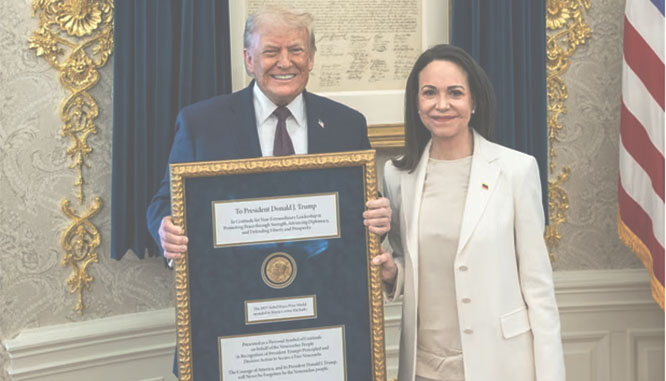
The Nobel Peace Prize is awarded by the independent Norwegian Nobel Committee, not the government. Trump had campaigned for last year’s prize, which went to Venezuelan opposition leader María Corina Machado, who dedicated her award to him.

Støre reiterated that the Nobel Prize decision rests solely with the committee.

Comments

Add new comment

  • Coastaldigest.com reserves the right to delete or block any comments.
  • Coastaldigset.com is not responsible for its readers’ comments.
  • Comments that are abusive, incendiary or irrelevant are strictly prohibited.
  • Please use a genuine email ID and provide your name to avoid reject.
News Network
January 23,2026

Karnataka Governor Thaawarchand Gehlot read only three lines from the 122-paragraph address prepared by the Congress-led state government while addressing the joint session of the Legislature on Thursday, effectively bypassing large sections critical of the BJP-led Union government.

The omitted portions of the customary Governor’s address outlined what the state government described as a “suppressive situation in economic and policy matters” under India’s federal framework. The speech also sharply criticised the Centre’s move to replace the Mahatma Gandhi National Rural Employment Guarantee Act (MGNREGA) with the Viksit Bharat–Guarantee for Rozgar and Ajeevika Mission (Gramin) Act, commonly referred to as the VB-GRAM (G) Act.

Governor Gehlot had earlier conveyed his objection to several paragraphs that were explicitly critical of the Union government. On Thursday, he confined himself to the opening lines — “I extend a warm welcome to all of you to the joint session of the State legislature. I am extremely pleased to address this august House” — before jumping directly to the concluding sentence of the final paragraph.

He ended the address by reading the last line of paragraph 122: “Overall, my government is firmly committed to doubling the pace of the State’s economic, social and physical development. Jai Hind — Jai Karnataka.”

According to the prepared speech, the Karnataka government demanded the scrapping of the VB-GRAM (G) Act, describing it as “contractor-centric” and detrimental to rural livelihoods, and called for the full restoration of MGNREGA. The state government argued that the new law undermines decentralisation, weakens labour protections, and centralises decision-making in violation of constitutional norms.

Key points from the unread sections of the speech:

•    Karnataka facing a “suppressive” economic and policy environment within the federal system

•    Repeal of MGNREGA described as a blow to rural livelihoods

•    VB-GRAM (G) Act accused of protecting corporate and contractor interests

•    New law alleged to weaken decentralised governance

•    Decision-making said to be imposed by the Centre without consulting states

•    Rights of Adivasis, women, backward classes and agrarian communities curtailed

•    Labourers allegedly placed under contractor control

•    States facing mounting fiscal stress due to central policies

•    VB-GRAM (G) Act accused of enabling large-scale corruption

Comments

Add new comment

  • Coastaldigest.com reserves the right to delete or block any comments.
  • Coastaldigset.com is not responsible for its readers’ comments.
  • Comments that are abusive, incendiary or irrelevant are strictly prohibited.
  • Please use a genuine email ID and provide your name to avoid reject.