After tech giants banish Donald Trump, things get complicated

Agencies
January 13, 2021

654.jpg

San Francisco Jan 13: As the world adjusts to a Twitter without @realdonaldtrump, the next big question is: “Now what?"

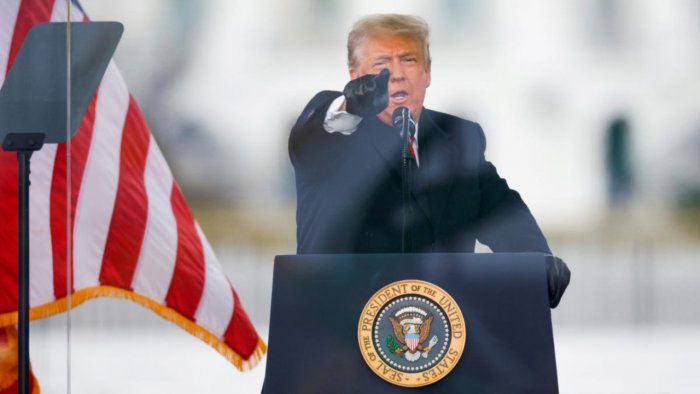
Major tech platforms, long accused of giving President Donald Trump special treatment not allotted to regular users, have shown him the door in the wake of his incitement of violence by supporters at the US Capitol on January 6. He's gone from Twitter, Facebook, Snapchat — even Shopify.

But in many ways, booting the president was the easy part.

Will companies now hold other world leaders to the same standard? Will they wade further into deciding what is and isn't allowed on their platforms, potentially alienating large swaths of their user base? Will all this lead to further online splintering, pushing those flirting with extreme views to fringe sites and secret chat groups?

Although they've long sought to remain neutral, Facebook, Twitter and other social platforms are slowly waking up to the active role they and their algorithms have played in shaping a modern world filled with polarised, angry groups and huge factions falling for bogus conspiracies and misinformation about science, politics and medicine.

“What we're seeing is a shift from the platforms from a stance of free-speech absolutism, towards an understanding of speech moderation as a matter of public health," said civic media professor Ethan Zuckerman of the University of Massachusetts-Amherst.

None of this can be fixed soon, if ever. Certainly not by blocking a president with just a few days left in his term.

But there are blueprints for future action. Remember “Plandemic?" That was the slickly-produced, 26-minute, misinformation-ridden video promoting COVID-19 conspiracies that emerged seemingly out of nowhere and racked up millions of views in a matter of days.

Facebook, Twitter and YouTube scrambled to take it down — too late. But they were ready for the sequel, which failed to attract even a fraction of the attention of the first.

“Sharing disinformation about COVID is a danger because it makes it harder for us to fight the disease," Zuckerman said.

“Similarly, sharing disinformation about voting is an attack on our democracy.”

Unsurprisingly, it's been easier for tech giants to act decisively on matters of public health than on politics. Corporate bans of the US president and his supporters have led to loud, if generally unfounded, cries of censorship as well as charges of left-wing bias.

It's even attracted criticism from European leaders such as German Chancellor Angela Merkel — not exactly a friend of Trump's.

Merkel's spokesman, Steffen Seibert, said freedom of opinion is a fundamental right of “elementary significance.”

“This fundamental right can be intervened in, but according to the law and within the framework defined by legislators — not according to a decision by the management of social media platforms,” he told reporters in Berlin.

“Seen from this angle, the chancellor considers it problematic that the accounts of the US president have now been permanently blocked.”

From that German perspective, it should be the government, and not private companies like Facebook and Twitter, who decides what counts as dangerous speech on social platforms.

That approach might be feasible in Europe, but it's much more complicated in the US, where the First Amendment of the US Constitution protects freedom of expression from government interference, although not from corporate policy on privately owned communication platforms.

Governments, of course, remain free to regulate tech companies, another area of ferment. Over the past year, Trump, other Republicans and some Democrats have called for revoking a fundamental 1996 legal provision known as Section 230.

That protects social platforms, which can host trillions of messages, from being sued into oblivion by anyone who feels wronged by something someone else has posted. But so far there's been more heat than light on the issue.

Still, few are happy with the often sluggish, after-the-fact, three-strikes takedowns and suspensions that have characterized Twitter and Facebook for years.

Particularly in the light of the Capitol insurrection, the deadly Charlottesville rally in 2017 and live-streamed mass shootings.

Sarita Schoenebeck, University of Michigan professor who focuses on online harassment, said it might be time for platforms to reevaluate how they approach problematic material on their sites.

“For years, platforms have evaluated what kinds of content are appropriate or not by evaluating the content in isolation, without considering the broader social and cultural context that it takes place in,” she said.

“We need to revisit this approach. We should rely on a combination of democratic principles, community governance and platform rules to shape behavior.”

Jared Schroeder, an expert in social media and the First Amendment at Southern Methodist University, thinks the Trump bans will encourage his base of followers to move towards other social platforms where they can organise and communicate with fewer — if any — restrictions.

“It's likely the bans will fuel the us-against-them narrative – and it's also likely other forums will get a boost in traffic, as we saw after the 2020 election," he said.

“The bans have taken away the best tools for organizing people and for Trump to speak to the largest audiences, but these are by no means the only tools."


Comments

robert Riepe
 - 
Wednesday, 13 Jan 2021

You look at the pictures of the doos to congress you will see the pictures of Antifa thugs wearing trump supporter gear and the guards letting them in.

Add new comment

  • Coastaldigest.com reserves the right to delete or block any comments.
  • Coastaldigset.com is not responsible for its readers’ comments.
  • Comments that are abusive, incendiary or irrelevant are strictly prohibited.
  • Please use a genuine email ID and provide your name to avoid reject.
News Network
December 4,2025

Mangaluru: Chaos erupted at Mangaluru International Airport (MIA) after IndiGo flight 6E 5150, bound for Mumbai, was repeatedly delayed and ultimately cancelled, leaving around 100 passengers stranded overnight. The incident highlights the ongoing country-wide operational disruptions affecting the airline, largely due to the implementation of new Flight Duty Time Limitations (FDTL) norms for crew.

The flight was initially scheduled for 9:25 PM on Tuesday but was first postponed to 11:40 PM, then midnight, before being cancelled around 3:00 AM. Passengers expressed frustration over last-minute communication and the lack of clarity, with elderly and ailing travellers particularly affected. “Though the airline arranged food, there was no proper communication, leaving us confused,” said one family member.

An IndiGo executive at MIA cited the FDTL rules, designed to prevent pilot fatigue by limiting crew working hours, as the cause of the cancellation. While alternative arrangements, including hotel stays, were offered, about 100 passengers chose to remain at the airport, creating tension. A replacement flight was arranged but also faced delays due to the same constraints, finally departing for Mumbai around 1:45 PM on Wednesday. Passengers either flew, requested refunds, or postponed their travel.

The Mangaluru delay is part of a broader crisis for IndiGo. The airline has been forced to make “calibrated schedule adjustments”—a euphemism for widespread cancellations and delays—after stricter FDTL norms came into effect on November 1.

While an IndiGo spokesperson acknowledged unavoidable flight disruptions due to technology issues, operational requirements, and the updated crew rostering rules, the DGCA has intervened, summoning senior airline officials to explain the chaos and outline corrective measures.

The ripple effect has been felt across the country, with major hubs like Bengaluru and Mumbai reporting numerous cancellations. The Mangaluru incident underscores the systemic operational strain currently confronting India’s largest carrier, leaving passengers nationwide grappling with uncertainty and delays.

Comments

Add new comment

  • Coastaldigest.com reserves the right to delete or block any comments.
  • Coastaldigset.com is not responsible for its readers’ comments.
  • Comments that are abusive, incendiary or irrelevant are strictly prohibited.
  • Please use a genuine email ID and provide your name to avoid reject.
Agencies
November 22,2025

indiapak.jpg

New York/Washington: US President Donald Trump has again claimed to have solved the conflict between India and Pakistan, repeating his assertion during a meeting with New York City Mayor-elect Zohran Mamdani in the Oval Office.

Mamdani flew to Washington DC for his first meeting with Trump in the White House on Friday. Trump said he “enjoyed” the meeting, which he described as “great.”

During remarks in the Oval Office, with Mamdani standing next to him, Trump repeated his claim that he solved the May conflict between India and Pakistan.

"I did eight peace deals of countries, including India and Pakistan,” he said.

On Wednesday, Trump had said he threatened to put 350 per cent tariffs on India and Pakistan if they did not end their conflict, repeating his claim that he solved the fighting between the nuclear-armed neighbours and that Prime Minister Narendra Modi had called him to say “we're not going to go to war.”

Since May 10, when Trump announced on social media that India and Pakistan had agreed to a “full and immediate” ceasefire after a “long night” of talks mediated by Washington, he has repeated his claim over 60 times that he “helped settle” the tensions between India and Pakistan.

India has consistently denied any third-party intervention. India launched Operation Sindoor on May 7, targeting terror infrastructure in Pakistan and Pakistan-occupied Kashmir in retaliation for the April 22 Pahalgam attack that killed 26 civilians. India and Pakistan reached an understanding on May 10 to end the conflict after four days of intense cross-border drone and missile strikes.

Mamdani emerged victorious in the closely-watched battle for New York City Mayor, becoming the first South Asian and Muslim to be elected to sit at the helm of the largest city in the US.

He had been the front-runner in the NYC Mayoral election for months and defeated Republican nominee Curtis Sliwa and political heavyweight former New York State Governor Andrew Cuomo, who ran as an independent candidate and was officially endorsed by Trump just hours before the elections.

Indian-descent Mamdani is the son of renowned filmmaker Mira Nair and Columbia University professor Mahmood Mamdani. He was born and raised in Kampala, Uganda and moved to New York City with his family when he was 7. Mamdani became a naturalised US citizen only recently, in 2018.

Comments

Add new comment

  • Coastaldigest.com reserves the right to delete or block any comments.
  • Coastaldigset.com is not responsible for its readers’ comments.
  • Comments that are abusive, incendiary or irrelevant are strictly prohibited.
  • Please use a genuine email ID and provide your name to avoid reject.
News Network
November 27,2025

imrankhan.jpg

Authorities at Pakistan’s high-security Adiala Jail in Rawalpindi on Wednesday dismissed speculation about the condition of imprisoned former Pakistan Prime Minister Imran Khan, rejecting rumours that he had been moved out of the facility or was in danger. Officials said Khan was in “good health” and described the viral death claims as “baseless.”

“There is no truth to reports about his transfer from Adiala Jail,” the Rawalpindi prison administration said in a statement, according to Geo News. “He is fully healthy and receiving complete medical attention.”

Amid swirling rumours on social media, Imran Khan’s party, Pakistan Tehreek-e-Insaf (PTI), urged the federal government to issue an official clarification and demanded that authorities allow his family to meet him immediately, Dawn reported.

The frenzy began after Khan’s three sisters called for an impartial probe into what they described as a “brutal” police assault on them and other PTI supporters outside Adiala Jail last week. Soon after, several social media handles circulated unverified claims alleging that Khan had been “killed” inside the prison.

The rumours intensified when a handle named “Afghanistan Times” claimed that “credible sources” had confirmed Khan’s “murder” and that his body had been moved out of the jail — allegations that have not been verified by any credible agency.

Imran Khan, PTI’s patron-in-chief, has been lodged in the Rawalpindi prison since August 2023 in multiple cases. For over a month, an undeclared restriction has prevented family members and senior PTI leaders from meeting him. Khyber-Pakhtunkhwa Chief Minister Sohail Afridi has reportedly been denied access despite making seven attempts.

In a letter to Punjab Police Chief Usman Anwar, Khan’s sisters — Noreen Niazi, Aleema Khan, and Dr. Uzma Khan — said they were “peacefully protesting” outside the jail when police allegedly launched an unprovoked assault after streetlights were switched off.

“At 71, I was seized by my hair, thrown to the ground and dragged across the road,” Noreen Niazi said, alleging that other women present were also slapped and manhandled.

Adiala Jail officials reiterated that speculation over Imran Khan’s health was unfounded and insisted that his well-being was being ensured, Geo News reported.

Comments

Add new comment

  • Coastaldigest.com reserves the right to delete or block any comments.
  • Coastaldigset.com is not responsible for its readers’ comments.
  • Comments that are abusive, incendiary or irrelevant are strictly prohibited.
  • Please use a genuine email ID and provide your name to avoid reject.