



The undecided presidential election entered a new phase on Wednesday as former Vice President Joe Biden was declared the winner of the key swing states of Michigan and Wisconsin, two key swing states that President Donald Trump won four years ago.
The Trump campaign, whose path to victory was narrowing, said that it would seek a recount in Wisconsin and then announced that it had taken legal action seeking to halt the vote count in Michigan, one of a flurry of lawsuits that included joining an action challenging the extension of ballot deadlines in Pennsylvania and filing another seeking to segregate late absentee ballots in Georgia.
The Trump campaign’s string of challenges came as the president found himself with few paths remaining to winning the 270 electoral votes needed to win reelection. By Wednesday afternoon, Biden was holding slim leads in several key states which, if the trend continues, could propel him to the critical Electoral College threshold and the presidency.
The lingering uncertainty of the 2020 campaign was perhaps unsurprising in an election with record-breaking turnout where most ballots were cast before Election Day but many could not be counted until afterwards.
Trump’s chances of winning a second term depended on his ability to hang on to his leads in states like Georgia and in Pennsylvania, where Biden has been narrowing the gap as vote counting progresses, and on overtaking Biden in one of the states where Biden is currently ahead.
With millions of votes yet to be counted across several key states — there is a reason that news organizations and other usually impatient actors were waiting to declare victors — Biden was holding narrow leads in Arizona and Nevada. If he can hold those states, the former vice president could win the election even without Pennsylvania, which has long been viewed as a must-have battleground state.
“I’m not here to declare that we’ve won,” Biden said in a speech Wednesday afternoon in Wilmington, Delaware, “but I am here to report that when the count is finished, we believe we will be the winners.”
Even before the Wisconsin race was called, the Trump campaign said that it would request a recount. Under Wisconsin law, a recount can be requested if the margin between the top two candidates is less than 1 percentage point.
Bill Stepien, Trump’s campaign manager, said in a statement that “the President is well within the threshold to request a recount and we will immediately do so.”
And Stepien later claimed that the Trump campaign had not been given “meaningful access” to several counting locations in Michigan, and that it had a filed suit in the Michigan Court of Claims to halt counting until access was granted. Shortly after that he announced that the campaign would intervene in Pennsylvania. Later in the evening the campaign said it was filing suit in Georgia seeking to get counties to separate late-arriving ballots from the rest.
Taken together, the legal actions threatened to slow the counting in states where Trump was projected to lose or in danger of losing.
One source of Biden’s resilience lies in the nature of the votes still to be counted. Many are mail-in ballots, which favour him because the Democratic Party spent months promoting the message of submitting votes in advance, while Trump encouraged his voters to turn out on Election Day. And in Michigan and Pennsylvania many of the uncounted votes are from populous urban and suburban areas that tend to vote heavily for Democrats.
Four years ago, Michigan provided one of Trump’s most surprising victories and helped him take back the Northern industrial states that had favoured Democrats in presidential elections since the 1990s. In this election, Trump’s popularity took a serious hit with the coalition of white voters — independents, those who had an unfavourable view of him but supported him anyway, people with and without college educations — that helped secure his win in Michigan in 2016.
Even in Pennsylvania, where Trump had run up a daunting lead of roughly 8 percentage points as of Wednesday afternoon, Biden had a plausible shot of catching up. Pennsylvania’s secretary of state said there were more than 1.4 million mail-in ballots still to be counted, and those votes are expected to heavily favour Biden.
Trump held leads in North Carolina and Georgia, and his campaign expressed hopes that his early Pennsylvania lead could withstand an influx of mail-in ballots for Biden. Then, if Trump was able to retake the lead from Biden in Arizona or Nevada, which has gone Democratic in recent elections, he would have a path to a second term.
Early Wednesday, Trump prematurely declared victory and said he would petition the Supreme Court to demand a halt to the counting. Biden urged his supporters — and by implication, Trump — to show patience and allow the process to play out.
Biden says in Delaware that it’s ‘clear’ he will reach 270 electoral votes.
Wilmington, Del. — Joe Biden on Wednesday said it was “clear” that he would reach 270 electoral votes and win the presidency, though he stopped short of claiming victory.
“I’m not here to declare that we’ve won, but I am here to report that when the count is finished, we believe we will be the winners,” Biden said in a speech at an event centre in Wilmington.
After President Donald Trump said in the early morning hours that vote counting should be halted, Biden offered a strikingly different message, paying tribute to democracy.
“Here, the people rule,” he said. “Power can’t be taken or asserted. It flows from the people. And it’s their will that determines who will be the president of the United States, and their will alone.”
Biden added that “every vote must be counted.”
“No one’s going to take our democracy away from us,” he said. “Not now, not ever.”
And in a continuation of one of the broad themes of his campaign, Biden offered a unifying message for the American people.
He said that the presidency “is not a partisan institution” and promised, “I will work as hard for those who didn’t vote for me as I will for those who did vote for me.”
"My friends, I’m confident we’ll emerge victoriously,” Biden said. “But this will not be my victory alone or our victory alone. It will be a victory for the American people, for our democracy, for America. And there will be no blue states and red states when we win — just the United States of America.”
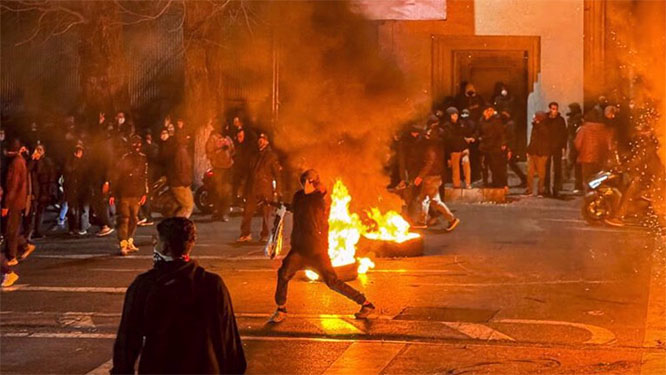
Tensions escalate as election workers continue to count the votes in Detroit.
Not long before multiple news outlets declared former Vice President Joe Biden the winner in Michigan, tensions escalated on Wednesday at a ballot-counting center in Detroit, a critical reservoir of votes for Biden in the battleground state.
President Donald Trump’s supporters and Democratic observers converged on the TCF Center to monitor poll workers as they tried to finish counting more than 170,000 absentee ballots in the state’s largest city.
The president’s backers chanted “stop the count” as law enforcement officers stood in front of the doors to the convention center, a video of the episode showed.
While there was a standoff at the convention centre, there were no apparent episodes of violence. It was not immediately clear if there were any arrests.
Though Trump took an early lead in Michigan as votes began to be counted, his margin evaporated overnight as ballots from Detroit, which is in Wayne County, were counted. The president’s campaign filed a lawsuit on Wednesday in which it accused election officials of blocking access to observers from the Trump campaign as the ballots were tabulated.
When counting began, 85 challengers were monitoring the 900 city workers who were counting the absentee ballots in shifts.
Outside the TCF Center, dozens of challengers — most not wearing masks — urged poll workers to stop counting votes and chanted “let us in.” A group of counterdemonstrators responded with “count every vote” chants.
Rich Henry, a protester from Livonia, a city in Wayne County, said that he was angered that the county was still counting ballots. His comments echoed the president’s false claims that ballots tabulated after Election Day should not count, despite it being commonplace in US elections.
Henry, who owns a construction business and voted in person on Tuesday, called the mail-in ballot system a “fraud.”
“Why are we pushing it, because of the pandemic?” he said.
Behind the crowd, about 20 police officers watched as people continued to congregate in the late afternoon, and a helicopter circled overhead. At one point, an argument between two demonstrators broke out after the group challenging the ballot count began chanting “no more abortion.”
Some of the counterdemonstrators held signs saying “count every vote.” Beryl Satter, a history professor at Rutgers University who travelled to the Detroit area for the election, stood with the group.
“It seems to me, that if they’re going to have an election and a democracy, the votes should be counted,” she said. “It seems common sense and completely uncontroversial.”
Trump is demanding a recount in Wisconsin, which Biden won
MADISON, Wis. — Even before Joe Biden was declared the winner in Wisconsin, successfully flipping a state President Donald Trump narrowly won in 2016, Trump’s campaign signalled it would request a recount.
Under Wisconsin law, a recount can be requested if the margin between the leading candidates is less than one per cent, and Trump’s campaign manager, Bill Stepien, said that the campaign would “immediately do so.”
Biden currently leads in Wisconsin by 0.6 percentage points. “The president is well within the threshold to demand a recount,” Stepien said.
In 2016, a statewide recount increased Trump’s margin in Wisconsin by 131 votes.
Whoever requests the recount would have to pay for it unless the margin is less than one-quarter of one per cent.
Andrew Bates, a spokesman for the Biden campaign, said the push for a recount was not the behaviour of a winning campaign.
“When Donald Trump won Wisconsin in 2016 by roughly the same amount of votes that Joe Biden just did, or won Michigan with fewer votes than Joe Biden is winning it now, he bragged about a ‘landslide,’ and called recount efforts ‘sad,’” Bates said. “What makes these charades especially pathetic is that while Trump is demanding recounts in places he has already lost, he’s simultaneously engaged in fruitless attempts to halt the counting of votes in other states in which he’s on the road to defeat.”
Biden’s narrow Wisconsin advantage came after several of the state’s large cities — including Milwaukee, Green Bay and Kenosha — reported results from their absentee ballots on Wednesday morning.
The Biden campaign maintained a sharp focus on Wisconsin after the state was one of three crucial Great Lakes states that the party lost four years ago. It was a key part of the campaign’s hope of clearing a straightforward path to 270 electoral votes.
During his campaign, Biden made three visits to the state, which was set to host the Democratic National Convention before it became an all-virtual event because of the coronavirus pandemic, which is currently worse in Wisconsin than in any other battleground state. He maintained a steady lead in the polls in the run-up to Election Day.
In 2016, Trump became the first Republican presidential candidate to win Wisconsin since 1984, narrowly defeating Hillary Clinton in a state with a large population of white, working-class Democrats.
Wisconsin saw a surge of infections from the coronavirus this fall as voters were preparing to go to the polls. The state had also been upended this year after Kenosha became the site of unrest and protests over the police shooting of Jacob Blake.
A judge threatens the postmaster general over slow execution of sweeps for undelivered ballots.
A federal judge on Wednesday threatened to call Postmaster General Louis DeJoy to appear before him, expressing frustration with the Postal Service’s slow response in carrying out Election Day sweeps of postal facilities looking for undelivered ballots.
“The postmaster is either going have to be deposed or appear before me,” said Judge Emmet Sullivan of the District of Columbia, as he continued to monitor the agency’s performance delivering ballots, which can be counted for days after the election in many states.
On Tuesday, Sullivan had ordered inspectors to sweep facilities in 12 districts after the Postal Service said in court that some 300,000 ballots it had received had not been scanned for delivery. He said he was particularly concerned about ballot delivery in key swing districts with low on-time delivery scores, including Central Pennsylvania, Philadelphia and Detroit.
The judge gave the agency until 3 pm to complete the sweeps, but the Postal Service said it would need until 8 pm to do the work without disrupting the processing of a flood of Election Day ballots.
On Wednesday morning, the Postal Service said it had completed the sweeps, and that they turned up only a “relative handful of ballots” — about 12 or 13, according to a US Department of Justice lawyer representing the Postal Service.
The judge’s dramatic Election Day order came as record numbers of Americans cast ballots by mail this year, with voters anxious to avoid crowds at the polls during the pandemic.
“Why was it as of yesterday there were still ballots being delivered late?” Shankar Duraiswamy, the lead lawyer for the nonprofit coalition Vote Forward, which is suing the Postal Service to try to ensure all ballots are delivered, asked during Wednesday’s hearing.
He said the court must now focus on getting ballots to the 21 states in the country that accept ballots postmarked by or before Election Day in the days after the election.
Roughly 300,000 ballots that the Postal Service says it processed showed no scan confirming their delivery to ballot-counting sites, according to data filed recently in federal court in Washington, DC, leaving voter-rights advocates concerned.
Postal officials said that just because a ballot never received a final scan before going out for delivery, it did not mean that it wasn’t delivered. A machine scanning ballots for final processing can sometimes miss ballots that are stuck together or have smudged bar codes. And hand-sorted ballots typically do not receive a final scan before delivery.
The Postal Service said Wednesday morning it had been conducting daily searches at all of its facilities for ballots that might fall through the cracks.
In a statement, a Postal Service spokesman said some ballots, expedited to election officials, had bypassed certain processing operations and did not receive a final scan.
“The assumption that there are unaccounted ballots within the Postal Service network is inaccurate,” he said. “We remain in close contact with state and local boards of elections and we do not currently have any open issues.”
As the agency continues to process ballots, states across the country are still counting votes cast by mail. In the final hours that election officials in Texas can accept some mail-in ballots, Sullivan also ruled Wednesday that the Postal Service must instruct employees in Texas to conduct additional sweeps for ballots sent to election officials. The Associated Press has already called the state in Trump’s favour.

Comments
Add new comment