Bloodshed avoided in Russia: Private army halts advance on Moscow; govt says ‘no action’ against rebels

News Network
June 25, 2023

russia.jpg

Moscow, June 25: Heavily armed Russian mercenaries who advanced most of the way to Moscow halted their approach, de-escalating a major challenge to President Vladimir Putin’s grip on power, in a move that their leader said would avoid bloodshed.

Yevgeny Prigozhin, a former Putin ally and founder of the Wagner army, said his men reached within 125 miles (200 km) of the capital on Saturday. Earlier, Moscow deployed soldiers in preparation for their arrival and told residents to stay indoors.

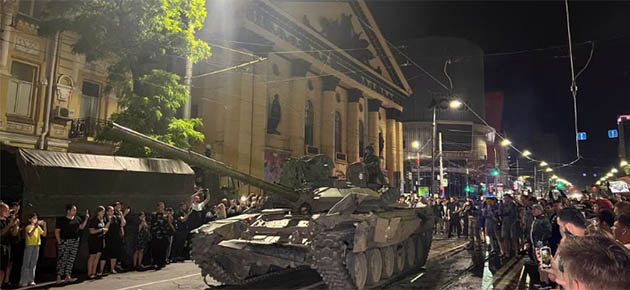
The Wagner fighters captured the city of Rostov hundreds of miles to the south before racing north in convoy, transporting tanks and armoured trucks and smashing through barricades set up to stop them, video showed.

On Saturday night, they began withdrawing from the Rostov military headquarters they had seized, a Reuters witness said.

“In 24 hours we got to within 200 km of Moscow. In this time we did not spill a single drop of our fighters’ blood,” Prigozhin, dressed in full combat uniform at an undisclosed location, said in a video.

“Understanding … that Russian blood will be spilled on one side, we are turning our columns around and going back to field camps as planned.”

Video earlier showed convoys of Wagner vehicles less than 310 miles (500 km) from Moscow.

Kremlin spokesman Dmitry Peskov said that under a deal brokered by Belarus President Alexander Lukashenko, the criminal case opened against Prigozhin for armed mutiny would be dropped, Prigozhin would move to Belarus, and Wagner fighters who joined his “march for justice” would face no action, in recognition of their previous service to Russia.

Peskov, who called the events of the day “tragic”, said Lukashenko had offered to mediate, with Putin’s approval, because he had known Prigozhin personally for around 20 years.

Little pushback from armed forces

Wagner’s lightning insurrection appeared to develop with little pushback from Russia’s regular armed forces, raising questions about Putin’s hold on power in the nuclear-armed nation even after the abrupt halt to Wagner’s advance.

Earlier, Prigozhin said his “march” on Moscow was intended to remove corrupt and incompetent Russian commanders he blames for botching the war in Ukraine.

In a televised address, Putin said the rebellion put Russia’s very existence under threat.

“We are fighting for the lives and security of our people, for our sovereignty and independence, for the right to remain Russia, a state with a thousand-year history,” Putin said, vowing punishment for those behind “an armed insurrection”.

In later outlining the deal brokered by Lukashenko, Peskov said the agreement had the “higher goal” of avoiding confrontation and bloodshed.

Peskov declined to say whether any concessions were made to Prigozhin, other than guarantees of safety for him – something he said Putin gave his word to vouch for – and for Prigozhin’s men, to persuade him to withdraw all his forces.

Ukrainian President Volodymyr Zelenskiy said the developments, which sparked a flurry of high-level calls between Western leaders, exposed turmoil at the heart of in Russia.

“Today the world can see that the masters of Russia control nothing. And that means nothing. Simply complete chaos. An absence of any predictability,” Zelenskiy said in his nightly video address.

Ex-convicts in Wagner ranks

The fighters led by Prigozhin, a former convict, include thousands of ex-prisoners recruited from Russian jails.

His men fought the bloodiest battles of the 16-month Ukraine war, including for the eastern city of Bakhmut. He railed for months against the military’s top brass, especially Defence Minister Sergei Shoigu and the chief of the general staff, Valery Gerasimov, accusing them of incompetence and of withholding ammunition from his fighters.

This month, he defied orders to sign a contract placing his troops under Defence Ministry command.

He launched the apparent mutiny on Friday after alleging that the military had killed many of his fighters in an air strike. The Defence Ministry denied this.

He said he had captured the headquarters of Russia’s Southern Military District without firing a shot in Rostov, which serves as the main rear logistical hub for Russia’s entire invasion force in Ukraine.

Residents of the city had milled about calmly, filming on mobile phones as Wagner fighters in armoured vehicles and battle tanks took up positions.

Western capitals were closely following the situation. U.S. President Joe Biden spoke with the leaders of France, Germany and Britain, while Secretary of State Antony Blinken spoke to G7 counterparts. The top U.S. military officer, Army General Mark Milley, canceled a scheduled trip to the Middle East.

Ukraine attacks near Bakhmut

The insurrection risked leaving Russia’s invasion force in Ukraine in disarray, just as Kyiv is launching its strongest counteroffensive since the war began in February last year.

Some Ukrainians were gleeful at the prospect of a split in Russian ranks 16 months after the Kremlin’s troops invaded their country.

Ukraine’s military said on Saturday its forces made advances near Bakhmut, on the eastern front, and further south.

Deputy Defence Minister Hanna Maliar said an offensive was launched near a group of villages ringing Bakhmut, which was taken by Wagner forces in May after months of fighting.

Oleksandr Tarnavskiy, commander of the southern front, said Ukrainian forces had liberated an area near Krasnohorivka, west of the Russian-held regional centre of Donetsk.

Tarnavskiy said the area had been under Russian control since separatist forces backed by Moscow seized it in 2014.

Comments

Add new comment

  • Coastaldigest.com reserves the right to delete or block any comments.
  • Coastaldigset.com is not responsible for its readers’ comments.
  • Comments that are abusive, incendiary or irrelevant are strictly prohibited.
  • Please use a genuine email ID and provide your name to avoid reject.
News Network
December 13,2025

New Delhi: School-going children are picking up drug and smoking habits and engaging in consumption of alcohol, with the average age of introduction to such harmful substances found to be around 13 years, suggesting a need for earlier interventions as early as primary school, a multi-city survey by AIIMS-Delhi said.

The findings also showed substance use increased in higher grades, with grade XI/XII students two times more likely to report use of substances when compared with grade VIII students. This emphasised the importance of continued prevention and intervention through middle and high school.

The study led by Dr Anju Dhawan of AIIMS's National Drug Dependence Treatment Centre, published in the National Medical Journal of India this month, looks at adolescent substance use across diverse regions.

The survey included 5,920 students from classes 8, 9, 11 and 12 in urban government, private and rural schools across 10 cities -- Bengaluru, Chandigarh, Delhi, Dibrugarh, Hyderabad, Imphal, Jammu, Lucknow, Mumbai, and Ranchi. The data were collected between May 2018 and June 2019.

The average age of initiation for any substance was 12.9 (2.8) years. It was lowest for inhalants (11.3 years) followed by heroin (12.3 years) and opioid pharmaceuticals (without prescription; 12.5 years).

Overall, 15.1 per cent of participants reported lifetime use, 10.3 per cent reported past year use, and 7.2 per cent reported use in the past month of any substance, the study found.

The most common substances used in the past year, after tobacco (4 per cent) and alcohol (3.8 per cent), were opioids (2.8 per cent), followed by cannabis (2 per cent) and inhalants (1.9 per cent). Use of non-prescribed pharmaceutical opioids was most common among opioid users (90.2 per cent).

On being asked, 'Do you think this substance is easily available for a person of your age' separately for each substance category, nearly half the students (46.3 per cent) endorsed that tobacco products and more than one-third of the students (36.5 per cent) agreed that a person of their age can easily procure alcohol products.

Similarly, for Bhang (21.9 per cent), ganja/charas (16.1 per cent), inhalants (15.2 per cent), sedatives (13.7 per cent), opium and heroin (10 per cent each), the students endorsed that these can be easily procured.

About 95 per cent of the children, irrespective of their grade, agreed with the statement that 'drug use is harmful'.

The rates of substance use (any) among boys were significantly higher than those of girls for substance use (ever), use in the past year and use in the past 30 days. Compared to grade VIII students, grade IX students were more likely, and grade XI/XII students were twice as likely to have used any substance (ever).

The likelihood of past-year use of any substance was also higher for grade IX students and for grade XI/XII students as compared to grade VIII students.

About 40 per cent of students mentioned that they had a family member who used tobacco or alcohol each. The use of cannabis (any product) and opioid (any product) by a family member was reported by 8.2 per cent and 3.9 per cent of students, respectively, while the use of other substances, such as inhalants/sedatives by family was 2-3 per cent, the study found.

A relatively smaller percentage of students reported use of tobacco or alcohol among peers as compared to among family members, while a higher percentage reported inhalants, sedatives, cannabis or opioid use among peers.

Children using substances (past year) compared to non-users reported significantly higher any substance use by their family members and peers.

There were 25.7 per cent students who replied 'yes' to the question 'conflicts/fights often occur in your family'. Most students also replied affirmatively to 'family members are aware of how their time is being spent' and 'damily members are aware of with whom they spend their time'.

Comments

Add new comment

  • Coastaldigest.com reserves the right to delete or block any comments.
  • Coastaldigset.com is not responsible for its readers’ comments.
  • Comments that are abusive, incendiary or irrelevant are strictly prohibited.
  • Please use a genuine email ID and provide your name to avoid reject.
News Network
December 7,2025

envoy.jpg

Since 1946, the United States has attempted 93 coups or “regime change” operations across the world — including two in Iran, US Special Envoy for Syria Tom Barrack has admitted.

Speaking to the UAE-based IMI Media Group, in remarks published by The National, Barrack said Washington tried twice to overthrow the Iranian government but failed both times. 

“For (Trump) then to be imputed with regime change — we had two regime changes in Iran already. Neither one worked. So I think wisely leave it to the region to solve,” said Barrack, who also serves as the US ambassador to Turkey.

His comments come six months after the US joined Israel in airstrikes against Iran during ongoing indirect nuclear negotiations between Tehran and Washington.

On June 13, Israel launched an attack on Iran that killed at least 1,064 people and hit civilian infrastructure. Days later, the United States targeted three nuclear facilities — Fordow, Natanz and Isfahan — in what Iran called a clear violation of international law. Iranian retaliation eventually forced a halt to the assault on June 24.

Barrack further claimed that US President Donald Trump and Foreign Secretary Marco Rubio are “not into regime change” and prefer a regional approach driven by Middle Eastern countries themselves. According to him, regional dialogue and non-interference by outside powers offer a more durable path forward.

He added that Washington is still open to an agreement with Tehran if Iranian authorities show “seriousness” and willingness to engage constructively.

However, Iran maintains the US has not shown readiness for meaningful talks. In an interview with Japan’s Kyodo News, Iranian Foreign Minister Abbas Araghchi said negotiations could advance only if Washington acknowledges Iran’s right to peaceful nuclear energy and lifts unilateral sanctions.

Comments

Add new comment

  • Coastaldigest.com reserves the right to delete or block any comments.
  • Coastaldigset.com is not responsible for its readers’ comments.
  • Comments that are abusive, incendiary or irrelevant are strictly prohibited.
  • Please use a genuine email ID and provide your name to avoid reject.
News Network
December 15,2025

Udupi, Dec 15: What was meant to be a post-pilgrimage gathering turned tragic in Padukere village of Brahmavar taluk, Udupi district, late Sunday night, when a clash among youths escalated into a fatal assault, leaving one man dead.

The victim has been identified as 30-year-old Santosh Mogaveera, a resident of Padukere.

According to preliminary information, the incident took place during a late-night drinking party involving a group of local youths who had recently returned after completing their pilgrimage to the Sabarimala shrine. An argument reportedly broke out among the group and soon escalated into a violent confrontation.

During the ensuing brawl, Santosh Mogaveera was allegedly assaulted and collapsed at the spot after sustaining serious injuries. He was rushed by local residents to a private hospital in Brahmavar, where doctors declared him dead.

On receiving information, senior police officials, including Brahmavar Circle Inspector Gopikrishna, Kota Police Sub-Inspector Praveen Kumar T, Station ASI Manthesh Jabagoudar, and head constables Pradeep and Ashok, visited the spot and conducted an inspection.

Police have taken four youths into custody in connection with the incident. A case has been registered at the Kota police station, and further investigation is underway to ascertain the exact sequence of events leading to the death.

Comments

Add new comment

  • Coastaldigest.com reserves the right to delete or block any comments.
  • Coastaldigset.com is not responsible for its readers’ comments.
  • Comments that are abusive, incendiary or irrelevant are strictly prohibited.
  • Please use a genuine email ID and provide your name to avoid reject.