Canada ‘temporarily’ adjusts diplomatic staff in India after social media threats

News Network
September 21, 2023

Canada.jpg

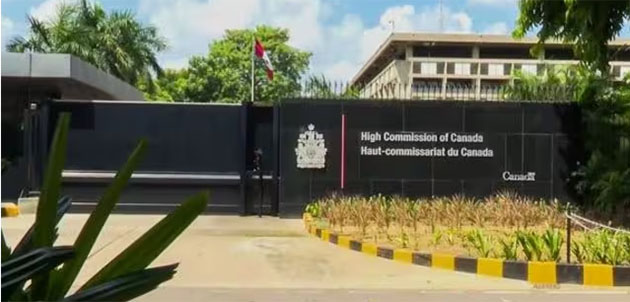
New Delhi, Sept 21: Canada's high commission in India said on Thursday that it has decided to temporarily "adjust" staff presence in the country after some diplomats received threats on social media platforms, adding to spiralling tensions between the two countries.

The statement from the high commission came soon after an Indian company published a notice that it was suspending visa services for Canadian citizens following a notice from the Indian mission. It then withdrew it minutes later before re-publishing it again.

BLS International, an Indian company offering visa facilities, said on Wednesday the notice from the Indian mission in Canada cited "operational reasons" for suspension of visa services "till further notice".

Spokespersons for the Canadian high commission and the Indian foreign ministry did not respond to queries on the two developments.

Tensions between the two countries escalated earlier this week when Canada said that it was "actively pursuing credible allegations" linking Indian government agents to the murder of a Sikh separatist leader in British Columbia in June.

Prime Minister Narendra Modi's government categorically rejected Canada's suspicions that Indian agents had links to the alleged murder.

With both nations expelling a diplomat each, analysts said relations between the two countries have touched the lowest point.

"In light of the current environment where tensions have heightened, we are taking action to ensure the safety of our diplomats," the Canadian high commission said in a statement.

"With some diplomats having received threats on various social media platforms, Global Affairs Canada is assessing its staff complement in India," it said, referring to the Canadian government department which manages Ottawa's diplomatic and consular relations.

"As a result, and out of an abundance of caution, we have decided to temporarily adjust staff presence in India," it said, without elaborating on what it meant by adjusting staff presence.

"In the context of respect for obligations under the Vienna conventions, we expect India to provide for the security of our accredited diplomats and consular officers in India, just as we are for theirs here."

After the tit-for-tat expulsions of senior diplomats, the two countries issued tit-for-tat travel advisories on Tuesday and Wednesday, with India urging its nationals in Canada, especially students, to exercise "utmost caution".

THREAT TO TRADE TIES

The tensions were sparked on Monday after Canadian Prime Minister Justin Trudeau said Ottawa was investigating "credible allegations" about the potential involvement of Indian government agents in the murder of Hardeep Singh Nijjar in British Columbia in June.

Canadian officials have so far declined to say why they believe India could be linked to Nijjar's murder.

New Delhi has also not provided evidence or details of specific incidents leading to its travel advisory that refers to "growing anti-India activities and politically condoned hate crimes and criminal violence in Canada".

Canada is a safe country, its public safety minister Dominic LeBlanc said hours after India's advisory.

Canada has the largest population of Sikhs outside the Indian state of Punjab, with about 770,000 people reporting Sikhism as their religion in the 2021 census.

Some Indian analysts say Ottawa does not curb Sikh protesters as they are a politically influential group.

The spat is also threatening trade ties, with talks on a proposed trade deal frozen last week.

Canada is India's 17th largest foreign investor, pouring in more than $3.6 billion since 2000, while Canadian portfolio investors have invested billions of dollars in Indian stock and debt markets.

Since 2018, India has been the largest source country for international students in Canada.

In 2022, their number rose 47% to nearly 320,000, accounting for about 40% of total overseas students, the Canadian Bureau of International Education says, which also helps universities and colleges provide a subsidised education to domestic students.

Industry estimates show the Comprehensive Economic Partnership Agreement (CEPA) between Canada and India could boost two-way trade by as much as $6.5 billion, yielding a GDP gain of $3.8 billion to $5.9 billion for Canada by 2035.

 

Comments

Add new comment

  • Coastaldigest.com reserves the right to delete or block any comments.
  • Coastaldigset.com is not responsible for its readers’ comments.
  • Comments that are abusive, incendiary or irrelevant are strictly prohibited.
  • Please use a genuine email ID and provide your name to avoid reject.
News Network
November 27,2025

siddDKS.jpg

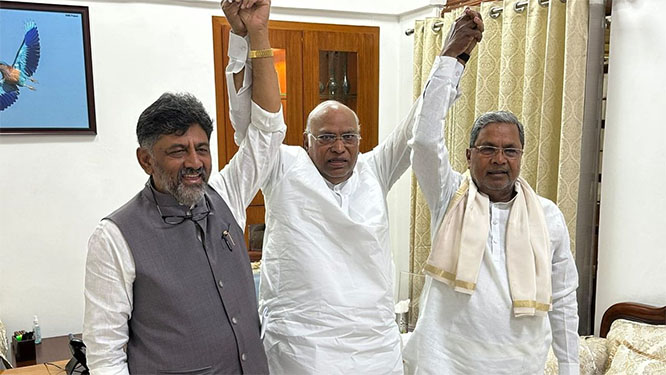
Congress president Mallikarjun Kharge on Thursday announced that he will convene a high-level meeting in New Delhi with senior leaders — including Rahul Gandhi, Karnataka Chief Minister Siddaramaiah and Deputy Chief Minister D.K. Shivakumar — to resolve the escalating leadership turmoil in Karnataka and “put an end to the confusion.”

Kharge said the discussions would focus on the way forward for the ruling party, as rumours of a possible leadership change continue to swirl. The speculation has intensified after the Congress government crossed the halfway mark of its five-year term on November 20, reviving talk of an alleged 2023 “power-sharing agreement” between Siddaramaiah and Shivakumar.

“After reaching Delhi, I will call three or four important leaders and hold discussions. Once we talk, we will decide how to move ahead and end this confusion,” Kharge told reporters in Bengaluru, according to PTI.

When asked specifically about calling Siddaramaiah and Shivakumar to Delhi, he responded: “Certainly, we should call them. We will discuss with them and settle the issue.”

He confirmed that Rahul Gandhi, the Chief Minister, the Deputy Chief Minister and other senior members would be part of the deliberations. “After discussing with everyone, a decision will be made,” he said.

Meanwhile, Siddaramaiah held a separate strategy meeting at his Bengaluru residence with ministers and leaders seen as his close confidants, including G. Parameshwara, Satish Jarkiholi, H.C. Mahadevappa, K. Venkatesh and K.N. Rajanna.
Signalling calm, the Chief Minister told reporters, “Will go to Delhi if the high command calls.”

Shivakumar echoed a similar stance, saying he too would head to the national capital if summoned by the party leadership.

Comments

Add new comment

  • Coastaldigest.com reserves the right to delete or block any comments.
  • Coastaldigset.com is not responsible for its readers’ comments.
  • Comments that are abusive, incendiary or irrelevant are strictly prohibited.
  • Please use a genuine email ID and provide your name to avoid reject.
News Network
November 24,2025

israelsyra.jpg

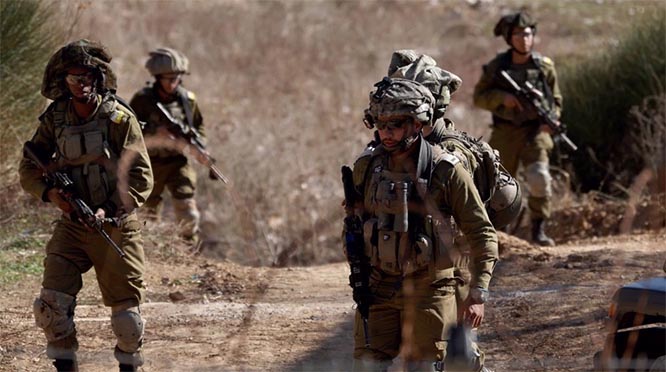
Israeli forces have pushed over the Syrian frontier, erecting a checkpoint and stopping vehicles in the southwestern city of Quneitra, in yet another breach of the Arab country’s sovereignty.

The violation took place on Sunday, when the troops made their way across the border, setting up the outpost near the Ain al-Bayda junction in northern Quneitra, Syrian outlets reported.

According to the al-Ikhbariya paper, an Israeli detachment positioned itself at the junction, halting cars and conducting searches.

The Syrian Arab News Agency (SANA) reported that three Israeli military vehicles then moved further into the northern countryside, deploying between the town of Jubata al-Khashab and the villages of Ofaniya and Ain al-Bayda. The agency added that a separate Israeli unit mounted a new incursion in the central region, approaching the villages of Umm Batina and al-Ajraf.

Residents said such activities have surged in recent months, pointing to Israeli advances onto farmland, leveling of extensive forested areas, arrests, and spread of mobile checkpoints.

The Israeli regime began markedly increasing its military aggression against Syria last year.

The escalation coincided with increasingly ferocious onslaughts throughout the country by the so-called Hay'at Tahrir al-Sham (HTS) Takfiri terrorist group, which the government of President Bashar al-Assad had confined to northwestern Syria. The HTS, however, managed to overthrow the government as the Israeli attacks would pummel the country’s civilian and defensive infrastructure.

Various reports have shown that, during the escalation, the regime conducted more than 1,000 airstrikes on the Syrian territory and over 400 ground raids into the south.

Following the collapse of the Assad government, Tel Aviv also widened its grip over the occupied Golan Heights by taking control of a demilitarized buffer zone, in defiance of a 1974 Disengagement Agreement. Earlier this month, senior Israeli officials, including Prime Minister Benjamin Netanyahu, visited the buffer zone, prompting expressions of alarm on the part of the United Nations.

The United States, the regime’s biggest ally, has, meanwhile, been fraternizing the HTS head Abu Mohammed al-Jolani amid the widely reported prospect of rapprochement with Tel Aviv.

Comments

Add new comment

  • Coastaldigest.com reserves the right to delete or block any comments.
  • Coastaldigset.com is not responsible for its readers’ comments.
  • Comments that are abusive, incendiary or irrelevant are strictly prohibited.
  • Please use a genuine email ID and provide your name to avoid reject.
News Network
December 4,2025

Mangaluru: Chaos erupted at Mangaluru International Airport (MIA) after IndiGo flight 6E 5150, bound for Mumbai, was repeatedly delayed and ultimately cancelled, leaving around 100 passengers stranded overnight. The incident highlights the ongoing country-wide operational disruptions affecting the airline, largely due to the implementation of new Flight Duty Time Limitations (FDTL) norms for crew.

The flight was initially scheduled for 9:25 PM on Tuesday but was first postponed to 11:40 PM, then midnight, before being cancelled around 3:00 AM. Passengers expressed frustration over last-minute communication and the lack of clarity, with elderly and ailing travellers particularly affected. “Though the airline arranged food, there was no proper communication, leaving us confused,” said one family member.

An IndiGo executive at MIA cited the FDTL rules, designed to prevent pilot fatigue by limiting crew working hours, as the cause of the cancellation. While alternative arrangements, including hotel stays, were offered, about 100 passengers chose to remain at the airport, creating tension. A replacement flight was arranged but also faced delays due to the same constraints, finally departing for Mumbai around 1:45 PM on Wednesday. Passengers either flew, requested refunds, or postponed their travel.

The Mangaluru delay is part of a broader crisis for IndiGo. The airline has been forced to make “calibrated schedule adjustments”—a euphemism for widespread cancellations and delays—after stricter FDTL norms came into effect on November 1.

While an IndiGo spokesperson acknowledged unavoidable flight disruptions due to technology issues, operational requirements, and the updated crew rostering rules, the DGCA has intervened, summoning senior airline officials to explain the chaos and outline corrective measures.

The ripple effect has been felt across the country, with major hubs like Bengaluru and Mumbai reporting numerous cancellations. The Mangaluru incident underscores the systemic operational strain currently confronting India’s largest carrier, leaving passengers nationwide grappling with uncertainty and delays.

Comments

Add new comment

  • Coastaldigest.com reserves the right to delete or block any comments.
  • Coastaldigset.com is not responsible for its readers’ comments.
  • Comments that are abusive, incendiary or irrelevant are strictly prohibited.
  • Please use a genuine email ID and provide your name to avoid reject.