



China bats for Pakistan’s inclusion in BRICS; Modi says India supports expansion based on consensus

News Network
August 23, 2023

Modi.jpg

Johannesburg, Aug 23: China wants to integrate Pakistan into the BRICS alliance (Brazil-Russia-India-China-South Africa), and Chinese President XI Jinping’s attempt has triggered a diplomatic complexity. This development arises as China argues that the BRICS coalition should expand its membership to include more developing nations, using this rationale to advocate for Pakistan's inclusion.

Earlier in 2023, Pakistan, along with other countries like Argentina, Turkey, and Saudi Arabia, expressed their interest in joining BRICS. 

The motivations behind this inclination toward BRICS are rooted in developing nations' dissatisfaction with the stringent conditions imposed by Western-dominated institutions. Additionally, there is scepticism among these countries about Western values, viewing them as a façade to advance self-serving agendas.

Meanwhile, several Indian media reports claimed that Prime Minister Narendra Modi-led government has opposed China’s bid for inclusion of Pakistan and expressed fear that it could dilute the alliance's core objectives and consensus built among its existing members. 

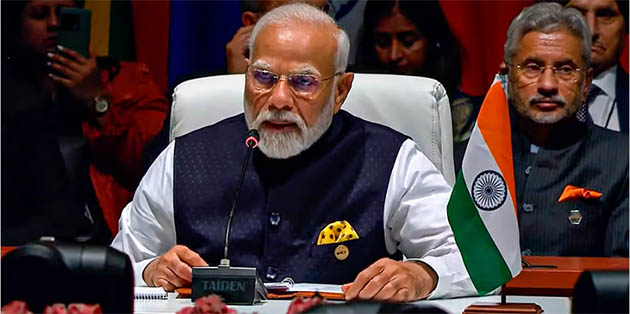
However, addressing the annual summit of leaders of BRICS in Johannesburg on Wednesday, Modi asserted that for a "future-ready" BRICS, the societies of these five countries will have to be "future-ready" and extended India's support to the expansion of the grouping based on consensus.

The Indian PM also hoped that India's proposal to make the African Union a permanent member of the G20 will be supported by BRICS member nations.

"We will have to make our societies future-ready to make BRICS future-ready," he said at the meet in Johannesburg. 

Welcoming the move to give special importance to countries of the Global South under the South African presidency of the BRICS, Modi said India has given the "highest priority" to the countries of the Global South under its G20 presidency as well.

India fully supports the expansion of BRICS and welcomes the move to take forward the proposal based on consensus, he said.

The Prime Minister said the BRICS embarked on a long and amazing journey in the last two decades and highlighted how the New Development Bank of the grouping is playing an important role in carrying forward developmental activities in the Global South.

India suggested measures in areas of Railway research networks, and cooperation among MSMEs and start-ups and there has been significant progress in these fields, Modi said.

Comments

Add new comment

  • Coastaldigest.com reserves the right to delete or block any comments.
  • Coastaldigset.com is not responsible for its readers’ comments.
  • Comments that are abusive, incendiary or irrelevant are strictly prohibited.
  • Please use a genuine email ID and provide your name to avoid reject.
News Network
January 23,2026

Mangaluru: The Karnataka Government Polytechnic (KPT), Mangaluru, has achieved autonomous status from the All India Council for Technical Education (AICTE), becoming the first government polytechnic in the country to receive such recognition in its 78-year history. The status was granted by AICTE, New Delhi, and subsequently approved by the Karnataka Board of Technical Education in October last year.

Officials said the autonomy was conferred a few months ago. Until recently, AICTE extended autonomous status only to engineering colleges, excluding diploma institutions. However, with a renewed national focus on skill development, several government polytechnics across India have now been granted autonomy.

KPT, the second-largest polytechnic in Karnataka, was established in 1946 with four branches and has since expanded to offer eight diploma programmes, including computer science and polymer technology. The institution is spread across a 19-acre campus.

Ravindra M Keni, the first dean of the institution, told The Times of India that AICTE had proposed autonomous status for polytechnic institutions that are over 25 years old. “Many colleges applied. In the first round, 100 institutions were shortlisted, which was further narrowed down to 15 in the second round. We have already completed one semester after becoming an autonomous institution,” he said. He added that nearly 500 students are admitted annually across eight three-year diploma courses.

Explaining the factors that helped KPT secure autonomy, Keni said the institution has consistently recorded 100 per cent admissions and placements for its graduates. He also noted its strong performance in sports, with the college emerging champions for 12 consecutive years, along with active student participation in NCC and NSS activities.

Autonomous status allows KPT to design industry-oriented curricula, conduct examinations, prepare question papers, and manage academic documentation independently. The institution can also directly collaborate with industries and receive priority funding from AICTE or the Ministry of Education. While academic autonomy has been granted, financial control will continue to rest with the state government.

“There will be separate committees for examinations, question paper setting, boards of studies, and boards of examiners. The institution will now have the freedom to conduct admissions without government notifications and issue its own marks cards,” Keni said, adding that new academic initiatives would be planned after a year of functioning under the autonomous framework.

Comments

Add new comment

  • Coastaldigest.com reserves the right to delete or block any comments.
  • Coastaldigset.com is not responsible for its readers’ comments.
  • Comments that are abusive, incendiary or irrelevant are strictly prohibited.
  • Please use a genuine email ID and provide your name to avoid reject.