Covid crisis brings regime change for the world’s central banks

News Network
November 12, 2020

corona.jpg

Just eight months after they swung into action to avert a crippling depression and credit crunch, central banks are in the uncomfortable position of relying on governments to power fragile economic rebounds.

The decisions their counterparts make will affect not just the growth outlook for the next few quarters but could shape central banks’ policy options, and even their credibility, for years to come.

Monetary authorities entered the Covid-19 crisis with the least conventional policy space -- namely, interest-rate cuts -- of any postwar downturn. After pulling down borrowing costs near or even below zero and deploying massive asset-purchase programs, they are now practically begging governments to step up.

Without aggressive fiscal stimulus now, the danger is that economies develop deep scars that hobble growth over the longer term. That could then leave central banks unable to reset and prepare for the next shock or recession. Monetary policy and fiscal policy are now interdependent.

 “This is definitely a new regime -- there simply isn’t enough demand in the global economy, and monetary policy can’t generate demand,” said Torsten Slok, chief economist at Apollo Global Management Inc. in New York.

Federal Reserve Chair Jerome Powell, who along with European Central Bank President Christine Lagarde and Bank of England Governor Andrew Bailey will be addressing the ECB’s annual forum on Thursday, is among those calling attention to the risk of long-term damage.

“There is a real threat here of those things,” Powell said at a press conference last week, referring to the risk of more business bankruptcies and long, skill-eroding periods of unemployment. “We’ll have a stronger recovery if we can just get at least some more fiscal support when it’s appropriate.”

British policymakers emphasised the power of dual action on March 11, when a BOE emergency rate cut was explicitly timed hours before the government outlined its own spending plans, and stress their ongoing coordination.

Even while they encourage fiscal cooperation, central bankers have kept up their guard to preserve their independence. After all, from Europe to Japan they were granted autonomy decades ago out of recognition of the need to wall off money creation from political impulses.

Bailey was explicit in addressing the risk last week.

“It’s perfectly possible to have coordinated policy and obviously be very cognizant of the importance of the independence of the Bank of England,” the BOE chief told reporters Nov. 5.

Even so, escalating government debt burdens will make future monetary tightening all the more costly, potentially limiting central banks’ room to maneuver.

Already, an uptick in US government bond yields this week, spurred in part by investor optimism over prospects for an effective coronavirus vaccine, has strengthened expectations for further Fed asset purchases as soon as by year-end.

Lagarde, speaking to the ECB’s virtual conference Wednesday, highlighted that asset purchases along with long-term bank funding are the tools to focus on in the next wave of monetary stimulus. Fed watchers see the potential for adjustments in the quantitative easing program next month.

The Catch-22 for central banks is that the longer they keep their balance sheets bloated and interest rates near zero, the greater the risk of their being seen as having limited power.

‘Second Fiddle’

“Right now, fiscal policy is doing what it has to do and monetary policy is playing second fiddle,” said Erik Nielsen, group chief economist at UniCredit SpA. “Most central bankers now are saying, this is the right policy at this time, but boy am I uncomfortable about it.”

Every central banker knows what lies at the end of a policy response that fails to restore the economy’s longer-term growth track: Japanification.

Since it adopted a zero-rate policy two decades ago, Japan’s central bank has gone on to snap up over 40% of the country’s government bond market, blowing its balance sheet out to more than 138% of gross domestic product.

A Bloomberg survey showed last month that a majority of forecasters doesn’t expect the Bank of Japan to tighten policy even over the longer term. The cost of that widespread assumption: Japan’s central bank has effectively lost the tool of forward guidance. Its tweaks in recent years, including the adoption of a commitment to overshoot its 2% inflation target, haven’t produced notable market reactions.

Bright Lines

The BOJ’s counterparts are determined to prevent any perception that they become little more than financing agencies for fiscal authorities.

Powell drew a bright line on money-financed fiscal policy last week, even as the Fed scoops up $80 billion a month of Treasuries.

“That’s not something we do -- we have different jobs,” Powell said in response to a question at his Nov. 5 press conference. “The job of taxation and spending goes to people who have stood for election and been elected and that’s the way it should be.”

The Fed chair also underscored that the unprecedented emergency lending programs unveiled this year, which provided a backstop for everything from municipalities to mid-size businesses, is a temporary arrangement.

“That shouldn’t be a permanent thing where we’re just another federal financing agency,” Powell said.

Bundesbank President Jens Weidmann put it another way in a speech on Nov. 5. “In the current environment, monetary and fiscal policy are working in harmony,” he said. “Their respective goals are aligned. But we should not pretend that such harmony will be a permanent condition.”

Comments

Add new comment

  • Coastaldigest.com reserves the right to delete or block any comments.
  • Coastaldigset.com is not responsible for its readers’ comments.
  • Comments that are abusive, incendiary or irrelevant are strictly prohibited.
  • Please use a genuine email ID and provide your name to avoid reject.
News Network
December 2,2025

DKSsiddu.jpg

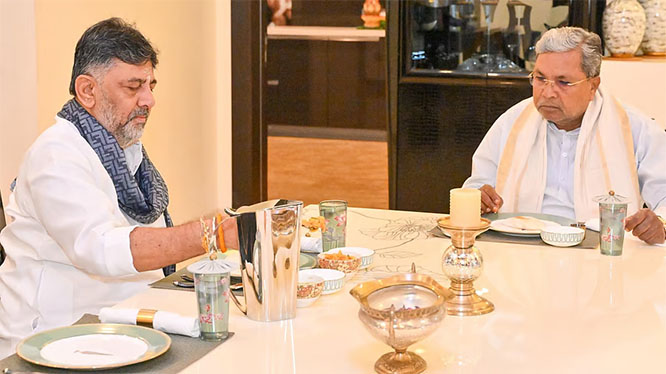
Bengaluru: 'Nati koli saaru' (country chicken curry) considered one of Chief Minister Siddaramaiah’s favourites along with steaming hot idlis was on the breakfast menu at Deputy CM D K Shivakumar’s residence on Tuesday, according to official sources.

The spread also included 'nati koli' fry, vada and pongal, among other items, they said.

In an apparent show of unity, Siddaramaiah visited Shivakumar’s residence for breakfast, just days after the two leaders shared a meal amid a simmering power tussle in the state Congress.

Siddaramaiah drove to the Deputy CM’s residence in Sadashivanagar, where he was received by Shivakumar and his brother D K Suresh, who is a former Congress MP.

Suresh and Kunigal MLA H D Ranganath, a relative of Shivakumar, joined them for breakfast, which featured a mix of vegetarian and non-vegetarian dishes.

Speaking to reporters later, Siddaramaiah said Shivakumar had invited him during his visit to the CM’s residence for breakfast on Saturday.

Asked about the difference between the two meals, the chief minister said, "At his (Shivakumar’s) house it was non-veg, while at my house it was veg. He is a vegetarian, I am a non-vegetarian. I had not prepared non-veg. I told DK to get chicken from the village as you won’t get the original in Bengaluru."

Shivakumar said he had initially invited Siddaramaiah to his residence, but the CM had suggested visiting his place first and reciprocating later. "It was a vegetarian breakfast at the CM’s house on Saturday," he noted.

"Today, I invited him (the CM) to my house. He enjoyed the breakfast, which had his Mysuru taste," Shivakumar added. At this point, Siddaramaiah remarked that Shivakumar’s wife is also from Mysuru.

Saturday’s breakfast at Siddaramaiah’s official residence, held as part of efforts by the Congress high command to ease tensions in the leadership dispute between the two, reportedly included idlis and sambar, according to official sources.

Comments

Add new comment

  • Coastaldigest.com reserves the right to delete or block any comments.
  • Coastaldigset.com is not responsible for its readers’ comments.
  • Comments that are abusive, incendiary or irrelevant are strictly prohibited.
  • Please use a genuine email ID and provide your name to avoid reject.
News Network
December 1,2025

hindutvaboy.jpg

Udupi, Dec 1: A horrific case of alleged rape has unfolded in Udupi, where a worker from a Hindutva organisation, previously arrested and released on bail for harassing a young woman, is now accused of waylaying and sexually assaulting her.

The arrested individual has been identified as Pradeep Poojary (26), a member of the Hindu Jagarana Vedike's Nairkode unit in Perdur.

Poojary had allegedly been relentlessly harassing the young woman, pressuring her to marry him. When she bravely stood up to him and refused his demands, she filed a formal complaint at the Hiriyadka police station. He was subsequently arrested in that initial harassment case but was later granted bail.

According to police reports, driven by the same malicious grudge, Poojary allegedly intercepted the woman again on November 29. While she was walking through a deserted area, the accused is claimed to have threatened her by grabbing her neck. When she again refused to marry him, he allegedly proceeded to rape her.

The survivor immediately informed her family about the traumatic assault. Following this, her parents lodged a complaint at the Udupi women’s police station.

Police arrested Poojary again and produced him before the court. He has since been remanded to judicial custody.

Comments

Add new comment

  • Coastaldigest.com reserves the right to delete or block any comments.
  • Coastaldigset.com is not responsible for its readers’ comments.
  • Comments that are abusive, incendiary or irrelevant are strictly prohibited.
  • Please use a genuine email ID and provide your name to avoid reject.
Agencies
November 22,2025

indiapak.jpg

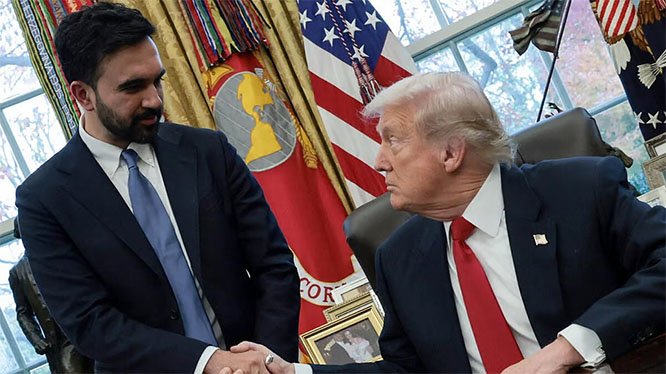
New York/Washington: US President Donald Trump has again claimed to have solved the conflict between India and Pakistan, repeating his assertion during a meeting with New York City Mayor-elect Zohran Mamdani in the Oval Office.

Mamdani flew to Washington DC for his first meeting with Trump in the White House on Friday. Trump said he “enjoyed” the meeting, which he described as “great.”

During remarks in the Oval Office, with Mamdani standing next to him, Trump repeated his claim that he solved the May conflict between India and Pakistan.

"I did eight peace deals of countries, including India and Pakistan,” he said.

On Wednesday, Trump had said he threatened to put 350 per cent tariffs on India and Pakistan if they did not end their conflict, repeating his claim that he solved the fighting between the nuclear-armed neighbours and that Prime Minister Narendra Modi had called him to say “we're not going to go to war.”

Since May 10, when Trump announced on social media that India and Pakistan had agreed to a “full and immediate” ceasefire after a “long night” of talks mediated by Washington, he has repeated his claim over 60 times that he “helped settle” the tensions between India and Pakistan.

India has consistently denied any third-party intervention. India launched Operation Sindoor on May 7, targeting terror infrastructure in Pakistan and Pakistan-occupied Kashmir in retaliation for the April 22 Pahalgam attack that killed 26 civilians. India and Pakistan reached an understanding on May 10 to end the conflict after four days of intense cross-border drone and missile strikes.

Mamdani emerged victorious in the closely-watched battle for New York City Mayor, becoming the first South Asian and Muslim to be elected to sit at the helm of the largest city in the US.

He had been the front-runner in the NYC Mayoral election for months and defeated Republican nominee Curtis Sliwa and political heavyweight former New York State Governor Andrew Cuomo, who ran as an independent candidate and was officially endorsed by Trump just hours before the elections.

Indian-descent Mamdani is the son of renowned filmmaker Mira Nair and Columbia University professor Mahmood Mamdani. He was born and raised in Kampala, Uganda and moved to New York City with his family when he was 7. Mamdani became a naturalised US citizen only recently, in 2018.

Comments

Add new comment

  • Coastaldigest.com reserves the right to delete or block any comments.
  • Coastaldigset.com is not responsible for its readers’ comments.
  • Comments that are abusive, incendiary or irrelevant are strictly prohibited.
  • Please use a genuine email ID and provide your name to avoid reject.