Embattled Imran Khan nominates former chief justice as caretaker PM of Pak

News Network
April 4, 2022

khanPM.jpg

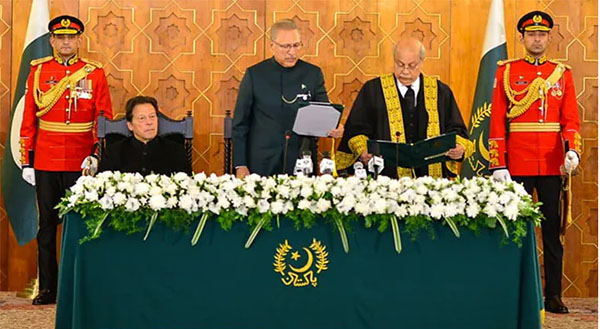
New Delhi: Embattled Pakistani leader Imran Khan on Monday nominated former Chief Justice Gulzar Ahmed for the post of caretaker Prime Minister.

Mr Khan is supposed to continue as Prime Minister until a caretaker premier is appointed, according to a notification issued by President Arif Alvi.

President Alvi has also written a letter to Prime Minister Khan and Leader of the Opposition in the outgoing National Assembly Shehbaz Sharif, asking them to propose names, the Dawn newspaper reported.

The letter said that the National Assembly (NA) and the federal Cabinet had been dissolved on Sunday as per the Constitution.

Mr Alvi told them in case they do not agree on the appointment within three days of the dissolution of the NA, they shall forward two nominees each to a committee to be constituted by the speaker, comprising eight members of the outgoing NA, or the Senate, or both, having equal representation from the treasury and the opposition, it said.

The members of that committee from the treasury and Opposition benches are to be nominated by the prime minister and the leader of the Opposition.

The Constitution has empowered the president to appoint a caretaker prime minister in consultation with the Prime Minister and the leader of the Opposition in the outgoing NA, the President's Secretariat said in a statement.

Meanwhile, Shehbaz Sharif said that he would not take part in the process and termed it "illegal", saying that the president and the prime minister had broken the law and questioned how they could approach the Opposition.

Reacting to Mr Sharif's decision, outgoing information minister Fawad Chaudhry said: "Pakistan is gearing up for the elections... Shehbaz has said he will not be a part of the process, that's his choice.

"We have sent two names (to the president) today. If (Shehbaz) does not send the names within seven days, one of these will be finalised".

Earlier in the day, the Cabinet Secretariat issued a notification stating that Khan had "ceased to hold the office of the prime minister of Pakistan with immediate effect".

However, under Article 94 of the Constitution, the president "may ask the Prime Minister to continue to hold office until his successor enters upon the office of Prime Minister".

"Mr. Imran Ahmad Khan Niazi, shall continue as Prime Minister till the appointment of caretaker Prime Minister under Article 224 A (4) of the Constitution of the Islamic Republic of Pakistan," the President said on Twitter.

President Alvi had dissolved the NA on the advice of Prime Minister Khan, minutes after Deputy Speaker Qasim Suri rejected a no-confidence motion against the premier, who had effectively lost the majority in the 342-member lower house of Parliament.

Supreme Court Chief Justice Umar Ata Bandial, after taking a suo motu cognizance of the political situation in the country, said that all orders and actions initiated by the Prime Minister and the President regarding the dissolution of the National Assembly will be subject to the court's order as he adjourned for one day the hearing of the high-profile case.

A three-member bench held the initial hearing despite the weekend and issued notices to all the respondents, including President Alvi and Deputy Speaker of the NA Suri.

The Supreme Court ordered all parties not to take any "unconstitutional" measures and adjourned the hearing until Monday.

Ahsan Bhoon, President, Supreme Court Bar, said that the action of the prime minister and deputy speaker was against the constitution and "they should be prosecuted for treason under Article 6 of the constitution.

The crisis erupted after Suri rejected the no-confidence motion, providing Prime Minister Khan to send an advice to the president of the country to dissolve Parliament, which he could not do until any outcome of the no-confidence vote.

Leading constitutional lawyer Salman Akram Raja said that the "entire procure by the deputy speaker and the advice by the premier to dissolve the assembly was unconstitutional".

Mr Raja said the illegality of the ruling would also make the advice as illegal as the prime minister cannot give advice to the assembly after a no-confidence motion was presented in the parliament against him.


Comments

Add new comment

  • Coastaldigest.com reserves the right to delete or block any comments.
  • Coastaldigset.com is not responsible for its readers’ comments.
  • Comments that are abusive, incendiary or irrelevant are strictly prohibited.
  • Please use a genuine email ID and provide your name to avoid reject.
News Network
November 21,2025

Bengaluru, Nov 21: The Karnataka government is facing pressure to overhaul its employment system after a high-level Cabinet sub-committee recommended the complete phase-out of job outsourcing in government offices, boards, and corporations by March 2028. The move is aimed at tackling a systemic issue that has led to the potential violation of constitutional reservation policies and the exploitation of workers.

The Call for Systemic Change

With over three lakh vacant posts currently being filled through private agencies on an outsource, insource, or daily wage basis, the sub-committee highlighted a significant lapse. "As a result, reservations are not being followed as per the Constitution and state laws. It’s an urgent need to take serious steps to change the system. It has been recommended to completely stop the system of outsourcing by March 2028," the panel stated in a document.

The practice of outsourcing involves private companies hiring workers to perform duties for a government agency. Critics argue this model results in lesser salaries, a lack of social security benefits (otherwise available to permanent government employees), and a failure to adhere to the provisions of Articles 14 and 15 of the Constitution, which guarantee equality before the law and prohibit discrimination.

The 'Bidar Model' as a Stop-Gap Solution

To regulate the current mode of employment and reduce worker exploitation until the 2028 deadline, the government plans to establish workers’ services multi-purpose cooperative societies across all districts, following the successful "Bidar Model."

The Bidar District Services of Labour Multi-purpose Cooperative Society Ltd., which operates under the District Commissioner, is cited as a successful example of providing a measure of social security to outsourced staff. Labour Department officials argue this society ensures workers receive their due wages and statutory facilities like ESI (Employees' State Insurance) and PF (Provident Fund), in exchange for a 1% service fee collected from the employees.

legislative push and Priority Insourcing

The recommendations, led by the sub-committee headed by Law and Parliamentary Affairs Minister H K Patil, are set to be discussed at the next Cabinet meeting. The committee has proposed the introduction of the Karnataka Outsourced Employees (Regulation, Placement and Welfare) Bill 2025.

In a move addressing immediate concerns, Labour Minister Santosh Lad, a member of the sub-committee, has reportedly assured that steps will be taken over the next 2-3 years to insource workers in "life-threatening services" on a priority basis. This includes essential personnel like pourakarmikas (sanitation workers), drivers, electrical staff in the Energy Department, and Health Department staff handling contagious diseases. The transition aims to grant these workers the long-term security and benefits they currently lack under the outsourcing system. 

Comments

Add new comment

  • Coastaldigest.com reserves the right to delete or block any comments.
  • Coastaldigset.com is not responsible for its readers’ comments.
  • Comments that are abusive, incendiary or irrelevant are strictly prohibited.
  • Please use a genuine email ID and provide your name to avoid reject.
P A Hameed Padubidri
November 26,2025

CD.jpg

Constitution Day, also known as Samvidhan Divas, is observed every year on November 26 to honor the adoption of the Constitution of India and to recognize the visionary effort that shaped the world’s largest democracy.

Historical Background

It’s on November 26, 1949, the Constituent Assembly of India formally adopted the Constitution.This date is commemorated to acknowledge the completion of nearly three years of drafting, debate, and refinement.

On January 26, 1950, the Constitution came into force, marking India’s transition from a dominion to a sovereign republic.

The date 26 January was chosen to honor the “Purna Swaraj” declaration made in 1930 that marked the relentless efforts & sacrifices of the many. 

Why Constitution Day is Celebrated

* To honor & remember the framers of the Constitution, especially Dr. B. R. Ambedkar, the Chairman of the Drafting Committee, & many others. 

* To remind the citizens of the values, responsibilities, and rights enshrined in the Constitution.

* To promote constitutional values & literacy among students, institutions, and the general public.

* To reaffirm the nation’s commitment to justice, equality, liberty, fraternity and secular values. 

Vision and Significance of the Constitution

It establishes the fundamental political and legal framework for the nation.

Defines the structure, powers and functions of:
    •    The Executive
    •    The Legislature
    •    The Judiciary
    •    Guarantees a comprehensive set of Fundamental Rights, including:

-Equality before law
-Freedom of speech & expression
-Protection of life and personal liberty
-Freedom of religion
-Embeds Directive Principles of State Policy, guiding governance toward social justice and welfare.
-Introduces Fundamental Duties to ensure civic responsibility among citizens.

Key Features Celebrated on Constitution Day

-The Indian constitution is considered one of the longest written constitutions of the world. It’s systematically drafted considering almost all aspects that properly fits to the country. 

-Blend of multiple global constitutional principles while staying rooted in Indian values and realities.

-Framework that balances Federalism, Secularism, Democracy and Rule of Law. This makes everyone-from President to common man-below the law & are equal in the sight of law. 

-Another feature is that it’s based on built-in mechanisms for amendments, ensuring the Constitution grows with changing needs.

Message of the Day

The core ethos of this  Constitution Day is not merely about looking back at history-it’s a reminder of the continuous duty to protect democratic values, respect diversity and uphold the principles that define India as a sovereign, socialist, secular and democratic republic.

Happy Constitution Day to all my compatriots

Comments

Add new comment

  • Coastaldigest.com reserves the right to delete or block any comments.
  • Coastaldigset.com is not responsible for its readers’ comments.
  • Comments that are abusive, incendiary or irrelevant are strictly prohibited.
  • Please use a genuine email ID and provide your name to avoid reject.
News Network
November 24,2025

israelsyra.jpg

Israeli forces have pushed over the Syrian frontier, erecting a checkpoint and stopping vehicles in the southwestern city of Quneitra, in yet another breach of the Arab country’s sovereignty.

The violation took place on Sunday, when the troops made their way across the border, setting up the outpost near the Ain al-Bayda junction in northern Quneitra, Syrian outlets reported.

According to the al-Ikhbariya paper, an Israeli detachment positioned itself at the junction, halting cars and conducting searches.

The Syrian Arab News Agency (SANA) reported that three Israeli military vehicles then moved further into the northern countryside, deploying between the town of Jubata al-Khashab and the villages of Ofaniya and Ain al-Bayda. The agency added that a separate Israeli unit mounted a new incursion in the central region, approaching the villages of Umm Batina and al-Ajraf.

Residents said such activities have surged in recent months, pointing to Israeli advances onto farmland, leveling of extensive forested areas, arrests, and spread of mobile checkpoints.

The Israeli regime began markedly increasing its military aggression against Syria last year.

The escalation coincided with increasingly ferocious onslaughts throughout the country by the so-called Hay'at Tahrir al-Sham (HTS) Takfiri terrorist group, which the government of President Bashar al-Assad had confined to northwestern Syria. The HTS, however, managed to overthrow the government as the Israeli attacks would pummel the country’s civilian and defensive infrastructure.

Various reports have shown that, during the escalation, the regime conducted more than 1,000 airstrikes on the Syrian territory and over 400 ground raids into the south.

Following the collapse of the Assad government, Tel Aviv also widened its grip over the occupied Golan Heights by taking control of a demilitarized buffer zone, in defiance of a 1974 Disengagement Agreement. Earlier this month, senior Israeli officials, including Prime Minister Benjamin Netanyahu, visited the buffer zone, prompting expressions of alarm on the part of the United Nations.

The United States, the regime’s biggest ally, has, meanwhile, been fraternizing the HTS head Abu Mohammed al-Jolani amid the widely reported prospect of rapprochement with Tel Aviv.

Comments

Add new comment

  • Coastaldigest.com reserves the right to delete or block any comments.
  • Coastaldigset.com is not responsible for its readers’ comments.
  • Comments that are abusive, incendiary or irrelevant are strictly prohibited.
  • Please use a genuine email ID and provide your name to avoid reject.