



In a first, Congress overrides Trump veto of defense bill

Agencies
January 2, 2021

Washington, Jan 2: Congress has overridden President Donald Trump's veto of a defense policy bill, a first by lawmakers since he took office nearly four years ago.

In an extraordinary New Year's Day session, the Republican-controlled Senate easily turned aside the veto, dismissing Trump's objections to the USD 740 billion bill and handing him a stinging rebuke just weeks before his term ends.

Trump had lashed out at GOP lawmakers on Twitter, charging earlier this week that "Weak and tired Republican 'leadership' will allow the bad Defense Bill to pass." Trump called the looming override vote a "disgraceful act of cowardice and total submission by weak people to Big Tech. Negotiate a better Bill, or get better leaders, NOW!"

The 81-13 vote in the Senate followed an earlier 322-87 override vote in the House of the widely popular defense measure. The bill provides a 3 per cent pay raise for US troops and guides defense policy, cementing decisions about troop levels, new weapons systems and military readiness, personnel policy and other military goals.

Many programs, including military construction, can only go into effect if the bill is approved.

Senate Majority Leader Mitch McConnell, R-Ky., said before the vote that Congress has passed the National Defense Authorization Act every year for 59 years in a row, "and one way or another, we are going to complete the 60th annual NDAA and pass it into law before this Congress concludes on Sunday.''

The bill "looks after our brave men and women who volunteer to wear the uniform," McConnell said.

"But it's also a tremendous opportunity: to direct our national security priorities to reflect the resolve of the American people and the evolving threats to their safety, at home and abroad. It's our chance to ensure we keep pace with competitors like Russia and China.''

The Senate override was delayed after Sen. Bernie Sanders, I-Vt., objected to moving ahead until McConnell allowed a vote on a Trump-backed plan to increase COVID-19 relief payments to USD 2,000. McConnel did not allow that vote; instead he used his parliamentary power to set a vote limiting debate on the defense measure, overcoming a filibuster threat by Sanders and Senate Democratic leader Chuck Schumer of New York.

Without a bipartisan agreement, a vote on the bill could have been delayed until Saturday night. Lawmakers, however, agreed to an immediate roll call Friday once the filibuster threat was stopped.

Trump rejected the defense measure last week, saying it failed to limit social media companies he claimed were biased against him during his failed reelection campaign. Trump also opposed language that allows for the renaming of military bases that honor Confederate leaders.

Sen. Jim Inhofe, R-Okla., chairman of the Senate Armed Services Committee, said he was "disappointed" with Trump's veto and called the bill "absolutely vital to our national security and our troops."

"This is the most important bill we have," Inhofe said.

"It puts members of the military first."

Trump has succeeded throughout his four-year term in enforcing party discipline in Congress, with few Republicans willing to publicly oppose him. The bipartisan overrides on the defense bill showed the limits of Trump's influence in the final weeks of his term.

Earlier this week, 130 House Republicans voted against the Trump-backed COVID relief checks, with many arguing they were unnecessary and would increase the federal budget deficit.

The Democratic-controlled House approved the larger payments, but the plan is dead in the Senate, another sign of Trump's fading hold over Congress.

Besides his concerns about social media and military base names, Trump also said the defense bill restricted his ability to conduct foreign policy, "particularly my efforts to bring our troops home."

Trump was referring to provisions in the bill that impose conditions on his plan to withdraw thousands of troops from Afghanistan and Germany. The measures require the Pentagon to submit reports certifying that the proposed withdrawals would not jeopardise US national security.

Trump has vetoed eight other bills, but those were all sustained because supporters did not gain the two-thirds vote needed in each chamber for the bills to become law without Trump's signature.

Rhode Island Sen. Jack Reed, the top Democrat on the Senate Armed Services Committee, called Trump's December 23 veto a "parting gift" to Russian President Vladimir Putin "and a lump of coal for our troops. Donald Trump is showing more devotion to Confederate base names than to the men and women who defend our nation".

Comments

Add new comment

  • Coastaldigest.com reserves the right to delete or block any comments.
  • Coastaldigset.com is not responsible for its readers’ comments.
  • Comments that are abusive, incendiary or irrelevant are strictly prohibited.
  • Please use a genuine email ID and provide your name to avoid reject.
News Network
January 23,2026

Mangaluru: The Karnataka Government Polytechnic (KPT), Mangaluru, has achieved autonomous status from the All India Council for Technical Education (AICTE), becoming the first government polytechnic in the country to receive such recognition in its 78-year history. The status was granted by AICTE, New Delhi, and subsequently approved by the Karnataka Board of Technical Education in October last year.

Officials said the autonomy was conferred a few months ago. Until recently, AICTE extended autonomous status only to engineering colleges, excluding diploma institutions. However, with a renewed national focus on skill development, several government polytechnics across India have now been granted autonomy.

KPT, the second-largest polytechnic in Karnataka, was established in 1946 with four branches and has since expanded to offer eight diploma programmes, including computer science and polymer technology. The institution is spread across a 19-acre campus.

Ravindra M Keni, the first dean of the institution, told The Times of India that AICTE had proposed autonomous status for polytechnic institutions that are over 25 years old. “Many colleges applied. In the first round, 100 institutions were shortlisted, which was further narrowed down to 15 in the second round. We have already completed one semester after becoming an autonomous institution,” he said. He added that nearly 500 students are admitted annually across eight three-year diploma courses.

Explaining the factors that helped KPT secure autonomy, Keni said the institution has consistently recorded 100 per cent admissions and placements for its graduates. He also noted its strong performance in sports, with the college emerging champions for 12 consecutive years, along with active student participation in NCC and NSS activities.

Autonomous status allows KPT to design industry-oriented curricula, conduct examinations, prepare question papers, and manage academic documentation independently. The institution can also directly collaborate with industries and receive priority funding from AICTE or the Ministry of Education. While academic autonomy has been granted, financial control will continue to rest with the state government.

“There will be separate committees for examinations, question paper setting, boards of studies, and boards of examiners. The institution will now have the freedom to conduct admissions without government notifications and issue its own marks cards,” Keni said, adding that new academic initiatives would be planned after a year of functioning under the autonomous framework.

Comments

Add new comment

  • Coastaldigest.com reserves the right to delete or block any comments.
  • Coastaldigset.com is not responsible for its readers’ comments.
  • Comments that are abusive, incendiary or irrelevant are strictly prohibited.
  • Please use a genuine email ID and provide your name to avoid reject.
News Network
January 20,2026

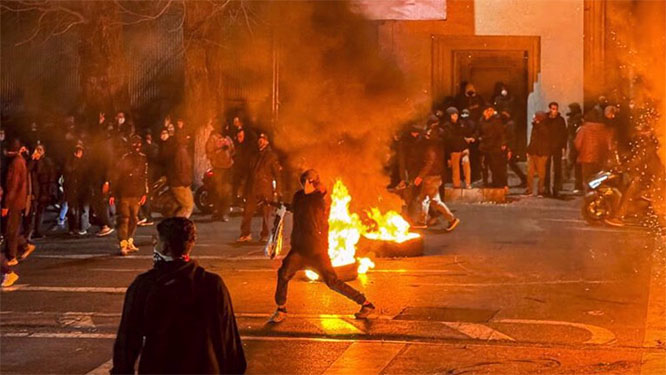
iran.jpg

Iranian security and intelligence forces have captured more than 470 individuals in three provinces, identified as key figures behind the recent wave of violent unrest and terrorist activities linked to foreign-backed networks.

The Intelligence Ministry's provincial office in Khorasan Razavi announced on Monday the arrest of 192 armed terrorists, identified as the main agents behind recent riots in the region. 

According to an official statement, the detainees were involved in the killing of several security personnel and civilians, setting fire to mosques, public service facilities, and buses, as well as attacks on military and law enforcement centers.

The seized items from the group include several bulletproof vests, Kalashnikov rifles, hunting weapons, Winchester rifles, and various cold weapons such as daggers, swords, brass knuckles, tactical knives, crossbows, and chains.

Evidence indicates that some of the individuals were tied to hostile movements and terrorist organizations, with links overseas. Others were identified as members of violent criminal gangs, actively taking part in the unrest alongside their associates.

Simultaneously, in the western province of Lorestan, the IRGC announced the arrest of 134 individuals as the main leaders and influential field agents of a US-Israeli terrorist network.

The IRGC statement stated that these individuals formed terrorist cells during the recent unrest, committing "Daesh-like" acts.

They wounded security forces with firearms and cold weapons, and burned and destroyed public and private properties, including mosques, shops, banks, and private and public vehicles.

In the northwestern province of Zanjan, the police reported detaining 150 people identified as principal leaders and agents behind recent riots.

Authorities noted that these individuals were responsible for destroying public and private property and intentionally setting fire to vehicles in the province's squares.

Their crimes include shedding the blood of innocent people, destroying public and private property, attempting to enter military sites, disrupting public order, and spreading terror among citizens.

A variety of cold weapons were reportedly seized from the detainees.

What began late last month as peaceful protests over economic hardship across Iran turned violent after public statements by US and Israeli regime figures encouraged vandalism and disorder.

During the unrest, foreign-backed mercenaries rampaged through cities, killing security forces and civilians and damaging public property.

Comments

Add new comment

  • Coastaldigest.com reserves the right to delete or block any comments.
  • Coastaldigset.com is not responsible for its readers’ comments.
  • Comments that are abusive, incendiary or irrelevant are strictly prohibited.
  • Please use a genuine email ID and provide your name to avoid reject.
News Network
January 20,2026

Mangaluru: In a major step towards strengthening rural innovation, the Office of the Principal Scientific Adviser (PSA) to the Government of India is supporting the establishment of RuTAGe Smart Village Centres (RSVCs) across the country through collaborations with academic institutions, civil society organisations and philanthropic partners.

As part of this national initiative, Nitte (Deemed to be University) will set up the first RSVCs in the region at Nitte GP in Udupi district and at the Nitte Health Centre, Sevanjali Trust, Farangipete, in Dakshina Kannada district. The centres will be inaugurated on January 21. In South India, the programme is being implemented by the Section Infin-8 Foundation (SI-8).

Speaking to reporters on Monday, SI-8 founder-director Vishwas US said experts from Nitte University and SI-8 would work closely with farmers, students, youth and local entrepreneurs to adapt and deploy technologies tailored to local needs.

Project head Prof Iddya Karunasagar, representing Nitte DU, said the RSVCs at Nitte and Farangipete would serve as demonstration hubs for a wide range of agriculture, energy, skill-development and assistive technologies. These include solar dryers for fruits, vegetables and crops; soil-testing solutions; power weeders and women-friendly farm tools; wind-powered devices for rural artisans; grain storage systems; grass-cutting and tree-climbing equipment; and liquid fertiliser production using cowshed waste.

SI-8 CEO Aravind C Kumar said the centres would also provide access to digital and knowledge-based platforms such as ISRO applications, government scheme portals, market linkage tools and gamified learning resources, along with assistive technologies for persons with visual impairments.

Highlighting the broader impact of the initiative, Principal Scientific Adviser Prof Ajay Kumar Sood said it demonstrated how applied research could bridge the rural–urban divide and help create self-reliant, technology-enabled villages.

The initiative has been made possible through philanthropic support from Dr NC Murthy of ACM Business Solutions, LLC, USA. Dr Sapna Poti, Director (Strategic Alliances) at the Office of the Principal Scientific Adviser, said the long-term objective is to build self-sufficient, technology-driven communities capable of generating sustainable livelihoods on their own.

Comments

Add new comment

  • Coastaldigest.com reserves the right to delete or block any comments.
  • Coastaldigset.com is not responsible for its readers’ comments.
  • Comments that are abusive, incendiary or irrelevant are strictly prohibited.
  • Please use a genuine email ID and provide your name to avoid reject.