



‘Hands were tied, blackmailed’: Imran Khan goes all guns blazing against Pak Army

News Network
June 2, 2022

Islamabad, Jun 2: In an unusual attack on Pakistan's military, ousted Prime Minister Imran Khan has admitted that his government was a "weak one" which was "blackmailed from everywhere" as the power was not with him and "everyone knows where that is".

Imran Khan was ousted from power in April after losing a no-confidence vote in his leadership, which he alleged was part of a US-led conspiracy targeting him because of his independent foreign policy decisions on Russia, China and Afghanistan.

In an interview to Pakistan's Bol News on Wednesday, Imran Khan was asked to recall the events of the night of the no-confidence vote against him, who was issuing orders and who had impeded the cases against the Pakistan Peoples Party (PPP) and Pakistan Muslim League-Nawaz (PML-N) leaders, Pakistan's Dawn newspaper reported.

The Pakistan Tehreek-e-Insaf chief said his government had been "weak" when it came to power and had to seek coalition partners, adding that if the same situation were to arise again, he would opt for re-elections and seek a majority government or none at all.

"Our hands were tied. We were blackmailed from everywhere. Power wasn't with us. Everyone knows where the power lies in Pakistan so we had to rely on them," the 69-year-old cricketer-turned-politician said, without elaborating any further who he was referring to.

Imran Khan, who came to power in 2018, reportedly with the backing of the military, is the only Pakistani Prime Minister to be ousted in a no-confidence vote in Parliament. He was replaced by PML-N's Shehbaz Sharif.

He said it was imperative for the country to have a "strong army" due to the threat posed by the enemies but said there was also the need to strike a "balance" between having a strong army and a strong government.

"We relied on them all the time. They did a lot of good things too but they didn't do many things that should've been done. They have the power because they control institutions such as NAB (National Accountability Bureau), which wasn't in our control," he said.

The former Prime Minister said while his government had the responsibility, it did not have all the power and the authority.

The Pakistan Army, which has ruled the coup-prone country for more than half of its 73 plus years of existence, has hitherto wielded considerable power in the matters of security and foreign policy. However, the army has continuously denied its involvement in politics.

According to experts, Imran Khan, who was ousted on April 10 after the National Assembly passed a no-confidence motion against him, had apparently lost support of the Army after he refused to endorse the appointment of Lt Gen Nadeem Anjum as the ISI spy agency chief last year. Finally, he agreed but it soured his ties with the Army.

During the interview, Imran Khan said, "No management works if I have responsibility but have no complete power and authority. A system works only when responsibility and authority are in one place."

Mr Khan said the current political situation was a problem for the country as well as the establishment.

"If the establishment doesn't make the right decisions then I can assure in writing that (before everyone else) they and the army will be destroyed because of what will become of the country if it goes bankrupt," he said.

"Pakistan is going towards a default. If that happens then which institution will be (the worst) hit? The army. After it is hit, what concession will be taken from us? Denuclearisation," Mr Khan said.

Imran Khan said that if Pakistan were to lose its nuclear deterrent capability, it would be fragmented into three pieces. "If the right decisions aren't made at this time then the country is going towards suicide," he warned.

Prodded further to share his thoughts on the night of the no-confidence vote, Imran Khan declined to go into details and said: "History never forgives anyone. Things come out. If you ask me, I won't go into details, but when history will be written then it'll be counted as such a night in which Pakistan and its institutions were damaged a lot."

"Those same institutions weakened Pakistan which gave it its foundation and strengthened it," he said.

Imran Khan said he had "clearly told the neutrals" that his government's economic performance, despite the Covid-19 pandemic, was nothing short of a "miracle".

"I told them if you do this and if this conspiracy (to remove my government) is successful then our economy will go down," he said.

Imran Khan said the country stood on the cusp of a "defining moment", calling it a "trial for the establishment". "Everyone knows they're the powerbrokers, so they're on trial. This is a trial of the judiciary and the Supreme Court (as well)."

Comments

Add new comment

  • Coastaldigest.com reserves the right to delete or block any comments.
  • Coastaldigset.com is not responsible for its readers’ comments.
  • Comments that are abusive, incendiary or irrelevant are strictly prohibited.
  • Please use a genuine email ID and provide your name to avoid reject.
News Network
January 23,2026

Karnataka Governor Thaawarchand Gehlot read only three lines from the 122-paragraph address prepared by the Congress-led state government while addressing the joint session of the Legislature on Thursday, effectively bypassing large sections critical of the BJP-led Union government.

The omitted portions of the customary Governor’s address outlined what the state government described as a “suppressive situation in economic and policy matters” under India’s federal framework. The speech also sharply criticised the Centre’s move to replace the Mahatma Gandhi National Rural Employment Guarantee Act (MGNREGA) with the Viksit Bharat–Guarantee for Rozgar and Ajeevika Mission (Gramin) Act, commonly referred to as the VB-GRAM (G) Act.

Governor Gehlot had earlier conveyed his objection to several paragraphs that were explicitly critical of the Union government. On Thursday, he confined himself to the opening lines — “I extend a warm welcome to all of you to the joint session of the State legislature. I am extremely pleased to address this august House” — before jumping directly to the concluding sentence of the final paragraph.

He ended the address by reading the last line of paragraph 122: “Overall, my government is firmly committed to doubling the pace of the State’s economic, social and physical development. Jai Hind — Jai Karnataka.”

According to the prepared speech, the Karnataka government demanded the scrapping of the VB-GRAM (G) Act, describing it as “contractor-centric” and detrimental to rural livelihoods, and called for the full restoration of MGNREGA. The state government argued that the new law undermines decentralisation, weakens labour protections, and centralises decision-making in violation of constitutional norms.

Key points from the unread sections of the speech:

•    Karnataka facing a “suppressive” economic and policy environment within the federal system

•    Repeal of MGNREGA described as a blow to rural livelihoods

•    VB-GRAM (G) Act accused of protecting corporate and contractor interests

•    New law alleged to weaken decentralised governance

•    Decision-making said to be imposed by the Centre without consulting states

•    Rights of Adivasis, women, backward classes and agrarian communities curtailed

•    Labourers allegedly placed under contractor control

•    States facing mounting fiscal stress due to central policies

•    VB-GRAM (G) Act accused of enabling large-scale corruption

Comments

Add new comment

  • Coastaldigest.com reserves the right to delete or block any comments.
  • Coastaldigset.com is not responsible for its readers’ comments.
  • Comments that are abusive, incendiary or irrelevant are strictly prohibited.
  • Please use a genuine email ID and provide your name to avoid reject.
News Network
January 20,2026

Mangaluru: In a major step towards strengthening rural innovation, the Office of the Principal Scientific Adviser (PSA) to the Government of India is supporting the establishment of RuTAGe Smart Village Centres (RSVCs) across the country through collaborations with academic institutions, civil society organisations and philanthropic partners.

As part of this national initiative, Nitte (Deemed to be University) will set up the first RSVCs in the region at Nitte GP in Udupi district and at the Nitte Health Centre, Sevanjali Trust, Farangipete, in Dakshina Kannada district. The centres will be inaugurated on January 21. In South India, the programme is being implemented by the Section Infin-8 Foundation (SI-8).

Speaking to reporters on Monday, SI-8 founder-director Vishwas US said experts from Nitte University and SI-8 would work closely with farmers, students, youth and local entrepreneurs to adapt and deploy technologies tailored to local needs.

Project head Prof Iddya Karunasagar, representing Nitte DU, said the RSVCs at Nitte and Farangipete would serve as demonstration hubs for a wide range of agriculture, energy, skill-development and assistive technologies. These include solar dryers for fruits, vegetables and crops; soil-testing solutions; power weeders and women-friendly farm tools; wind-powered devices for rural artisans; grain storage systems; grass-cutting and tree-climbing equipment; and liquid fertiliser production using cowshed waste.

SI-8 CEO Aravind C Kumar said the centres would also provide access to digital and knowledge-based platforms such as ISRO applications, government scheme portals, market linkage tools and gamified learning resources, along with assistive technologies for persons with visual impairments.

Highlighting the broader impact of the initiative, Principal Scientific Adviser Prof Ajay Kumar Sood said it demonstrated how applied research could bridge the rural–urban divide and help create self-reliant, technology-enabled villages.

The initiative has been made possible through philanthropic support from Dr NC Murthy of ACM Business Solutions, LLC, USA. Dr Sapna Poti, Director (Strategic Alliances) at the Office of the Principal Scientific Adviser, said the long-term objective is to build self-sufficient, technology-driven communities capable of generating sustainable livelihoods on their own.

Comments

Add new comment

  • Coastaldigest.com reserves the right to delete or block any comments.
  • Coastaldigset.com is not responsible for its readers’ comments.
  • Comments that are abusive, incendiary or irrelevant are strictly prohibited.
  • Please use a genuine email ID and provide your name to avoid reject.
News Network
January 19,2026

trump.jpg

Donald Trump has linked his repeated threats to seize Greenland to his failure to win the Nobel Peace Prize, in a letter to Norwegian Prime Minister Jonas Gahr Støre.

The authenticity of the letter, in which Trump says he no longer feels obligated to “think purely of peace,” was confirmed by Støre to the Norwegian newspaper VG.

“Considering your country decided not to give me the Nobel Peace Prize for having stopped eight wars plus, I no longer feel an obligation to think purely of peace,” Trump wrote, adding he can now “think about what is good and proper for the United States.”

Støre said Trump’s letter was in response to a short message he had sent earlier, on behalf of himself and Finland’s President Alexander Stubb.

Trump has escalated rhetoric toward Greenland, a self-governing Danish territory, insisting the US will take control “one way or the other.” Over the weekend, he tweeted: “Now it is time, and it will be done!!!”

On Saturday, Trump threatened a 10% tariff on imports from Denmark, Norway, Sweden, France, Germany, the UK, the Netherlands, and Finland from 1 February until the US is allowed to purchase the island. EU diplomats met for emergency talks on possible retaliatory tariffs and sanctions.

In his letter, Trump argued Denmark “cannot protect” Greenland from Russia or China, questioning Danish ownership: “There are no written documents; it’s only that a boat landed there hundreds of years ago.” He added that NATO should support the US, claiming the world is “not secure unless we have complete and total control of Greenland.”

Trump’s stance has unsettled the EU and NATO, as he refused to rule out military action to take control of the mineral-rich island.

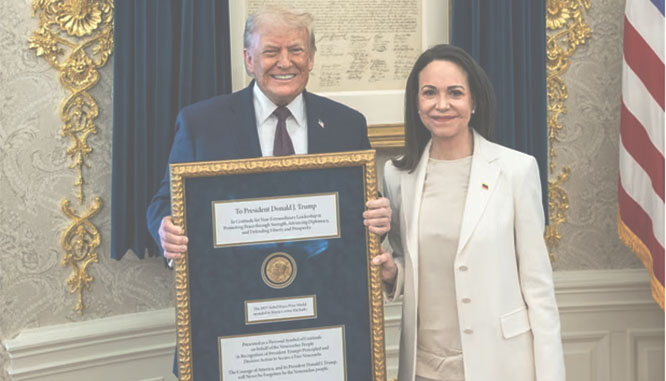
The Nobel Peace Prize is awarded by the independent Norwegian Nobel Committee, not the government. Trump had campaigned for last year’s prize, which went to Venezuelan opposition leader María Corina Machado, who dedicated her award to him.

Støre reiterated that the Nobel Prize decision rests solely with the committee.

Comments

Add new comment

  • Coastaldigest.com reserves the right to delete or block any comments.
  • Coastaldigset.com is not responsible for its readers’ comments.
  • Comments that are abusive, incendiary or irrelevant are strictly prohibited.
  • Please use a genuine email ID and provide your name to avoid reject.