



Here's why the global Covid-19 death toll may be closer to 1.8 million

News Network
September 29, 2020

The world officially recorded 1 million deaths from Covid-19 in one of the most sobering milestones of the pandemic, but the real tally might be almost double that.

Actual fatalities from the worst outbreak in a century may be closer to 1.8 million -- a toll that could grow to as high as 3 million by the end of the year, according to Alan Lopez, a laureate professor and director of the University of Melbourne’s global burden of disease group. The coronavirus’s rapid spread and ability to transmit in people who show no signs of the disease have enabled it to outrun measures to accurately quantify cases through widespread diagnostic testing.

“One million deaths has meaning by itself, but the question is whether it’s true,” Lopez said in an interview before the tally was reached. “It’s fair to say that the 1 million deaths, as shocking as it sounds, is probably an underestimate -- a significant underestimate.”

Even in countries with sophisticated health systems, mortality is difficult to accurately gauge. Tens of thousands of probable Covid-19 deaths in the us weren’t captured by official statistics between March and May, a study in July found, frustrating efforts to track and mitigate the pandemic’s progression.

The dearth of accurate data undermines the ability of governments to implement timely strategies and policies to protect public health and promote economic recovery. If the mortality from Covid-19 reaches 3 million as Lopez predicted, it would rank the disease among the world’s worst killers. An undercount in deaths could also give some people a false sense of security, and may allow governments to downplay the virus and overlook the pandemic’s burden.

No System

India has confirmed more than 6 million Covid-19 cases, but accounts for only about 95,000 of the 1 million reported deaths worldwide, according to data collected by Johns Hopkins University. The country, which has the highest number of infections after the us, lacks a reliable national vital statistics registration system to track deaths in real time. Meanwhile, in Indiana in the US researchers found that although nursing home residents weren’t routinely tested for the virus, they represented 55% of the state’s Covid-19 deaths.

“Yes, cases are reported daily everywhere, but as soon as you get to the next tier down, like how many were admitted to hospitals, there have just been huge gaps in the data,” said Christopher J. Murray, director of the Institute for Health Metrics and Evaluation at the University of Washington in Seattle. Medical data, including duration of illness and symptoms, help to ascribe a probable cause of death, he said.

Patients with heart disease, diabetes, cancer and other chronic conditions are at greater risk of dying from Covid-19. Some governments, including Russia, are attributing the cause of deaths in some of these patients to the pre-existing condition, raising questions about the veracity of official mortality data.

WHO Guidelines

In July, Russia recorded 5,922 fatalities due to Covid-19. At least 4,157 other deaths were linked to the coronavirus, but not included in the tally because of how the nation defines such deaths. Overall, it recorded 29,925 more deaths in July than in the same month of 2019.

The WHO laid out guidance for classifying coronavirus deaths in June, advising countries to count fatalities if patients had symptoms of the disease regardless of whether they were a confirmed case, and unless there was a clear alternative cause. A Covid-19 fatality should be counted as such even if pre-existing conditions exacerbated the disease, said the organization. The US Centers for Disease Control and Prevention released similar guidelines.

Still, it may take health workers certifying deaths time to adopt the methodology, the University of Melbourne’s Lopez said. His research has received funding by Bloomberg Philanthropies, set up by Michael Bloomberg, founder and majority owner of Bloomberg News’ parent Bloomberg LP.

“Doctors often are learning as they go along, so they’re not certifying all the deaths that are due to Covid as Covid deaths,” Lopez said.

Japan Drop

Although the pandemic has altered mortality patterns worldwide, not all of the changes are a direct result of the pandemic, he said. Physical distancing measures may have reduced road fatalities and deaths caused by influenza. In Japan, which has been scrutinized for its lack of widespread testing and relatively lax containment efforts, deaths fell by 3.5% in May from a year earlier even as Covid-19 cases peaked.

“The pandemic actually works in contradictory ways to affect mortality,” Lopez said.

Likewise, the economic cost of the pandemic -- which may top $35.3 trillion through 2025 -- will be driven more by changes in people’s spending patterns than number of deaths and government-mandated “lockdown” measures, according to Warwick McKibbin, a professor of economics at the Australian National University and a non-resident senior fellow at the Brookings Institution in Washington.

“We estimate this outbreak is going to cost tens of trillions to the world economy,” McKibbin said in an interview. “The change in economic outcomes is caused by individuals changing their behavior, not because the government mandated a shutdown.”

Worldwide, the growth in the number of daily deaths has eased since spiking in March and April, helped by improved medical care and ways to treat the disease. But as resurgences flare in Europe and North America ahead of winter and the flu season, Covid-19 fatalities may rise sharply again. It took nine days for cases in the UK to double to 3,050 in mid September, compared with the previous doubling time of five weeks, the BMJ journal said last week.

Covid-19 patients between ages 75 to 84 are 220 times more likely to die from the disease than 18-to-29-year-olds, according to the CDC. Seniors over 85 years have a 630 times higher risk of dying. The older age of fatal Covid-19 cases has made some people think “they’re old people, they’re going to die anyway,” said Michael Osterholm, an epidemiologist and director of the Center for Infectious Disease Research and Policy at the University of Minnesota.

“I have a really hard time with that,” Osterholm said in an interview. “That’s an unfortunate and very sad way to come to understand this pandemic. Many of those people who died are very important loved ones to so many of us that it’s hard to just dismiss it as it’s just a number.”

Comments

Add new comment

  • Coastaldigest.com reserves the right to delete or block any comments.
  • Coastaldigset.com is not responsible for its readers’ comments.
  • Comments that are abusive, incendiary or irrelevant are strictly prohibited.
  • Please use a genuine email ID and provide your name to avoid reject.
News Network
February 1,2026

US President Donald Trump on Saturday claimed that the government of India led by Prime Minister Narendra Modi has made a deal to buy Venezuelan oil, as opposed to purchasing it from Iran.

"We've already made that deal, the concept of the deal," he told reporters on Air Force One.

Trump had imposed 25% tariffs on countries buying Venezuelan oil, including India, in March 2025. He had also hit India with tariffs for buying Russian oil, saying it was "funding" President Vladimir Putin's war against Ukraine.

Trump has said that the US has taken control of the oil-rich Venezuela after capturing former President Nicolas Maduro in January.

A fleet of 18 ships loaded with crude oil bound for refineries in Texas, Louisiana, and Mississippi in January, the most since December 2024, according to a report by the news agency Bloomberg.

Combined crude deliveries to the US will reach about 2,75,000 barrels a day, more than doubling volumes seen in December last year. Shipments to China, which averaged 4,00,000 barrels a day last year, fell to zero in January.

PM Modi, Venezuelan President Agree To Expand Ties

Prime Minister Narendra Modi and Venezuela's acting President Delcy Rodriguez spoke on Friday and agreed to take the bilateral relations to "new heights" in the years ahead.

It was the first phone call between the two leaders since the capture of Maduro and his wife by the US on January 3.

"Spoke with Acting President of Venezuela, Ms. Delcy Rodriguez. We agreed to further deepen and expand our bilateral partnership in all areas, with a shared vision of taking India-Venezuela relations to new heights in the years ahead," PM Modi said in a post on X.

A statement from Prime Minister Modi's office said the two leaders agreed to further expand and deepen the India-Venezuela partnership in all areas, including trade and investment, energy, digital technology, health, agriculture, and people-to-people ties.

They exchanged views on various regional and global issues of mutual interest and underscored the importance of their close cooperation for the Global South, the statement said.

Rodriguez also said that they discussed partnerships in the fields of agriculture, science and technology, mining, and tourism, as well as the pharmaceutical and automotive industries.

Comments

Add new comment

  • Coastaldigest.com reserves the right to delete or block any comments.
  • Coastaldigset.com is not responsible for its readers’ comments.
  • Comments that are abusive, incendiary or irrelevant are strictly prohibited.
  • Please use a genuine email ID and provide your name to avoid reject.
News Network
February 1,2026

Bengaluru: The Karnataka High Court has refused to quash an investigation against a WhatsApp group administrator accused of allowing the circulation of obscene and offensive images depicting Hindutva politicians and idols in 2021.

Justice M Nagaprasanna observed that, prima facie, the ingredients of the offence under Section 295A of the Indian Penal Code were made out. “The offence under Section 295A of the IPC is met to every word of its ingredient, albeit prima facie,” the judge said.

The petitioner, Sirajuddin, a resident of Belthangady taluk in Dakshina Kannada district, had challenged the FIR registered against him at the CEN (Cyber, Economics and Narcotics) police station, Mangaluru, for offences under Section 295A of the IPC and Section 67 of the Information Technology Act. Section 295A relates to punishment for deliberate and malicious acts intended to outrage the religious feelings of any class of citizens.

According to the complaint filed by K Jayaraj Salian, also a resident of Belthangady taluk, he received a WhatsApp group link from an unknown source and was added to the group after accessing it. The group reportedly had six administrators and around 250 participants, where obscene and offensive images depicting Hindu deities and certain political figures were allegedly circulated repeatedly.

Sirajuddin was arrested in connection with the case and later released on bail on February 16, 2021. He argued before the court that he was being selectively targeted, while other administrators—including the creator of the group—were neither arrested nor investigated. He also contended that the Magistrate could not have taken cognisance of the offence under Section 295A without prior sanction under Section 196(1) of the CrPC.

Rejecting the argument, Justice Nagaprasanna held that prior sanction is required only at the stage of taking cognisance, and not at the stage of registration of the crime or during investigation.

The judge noted that the State had produced the entire investigation material before the court. “A perusal of the material reveals depictions of Hindu deities in an extraordinarily obscene, demeaning and profane manner. The content is such that its reproduction in a judicial order would itself be inappropriate,” the court said, adding that the material, on its face, had the tendency to outrage religious feelings and disturb communal harmony.

Observing that the case was still at the investigation stage, the court said it could not interdict the probe at this juncture. However, it expressed concern that the investigating officer appeared to have not proceeded uniformly against all administrators. The court clarified that if the investigation revealed the active involvement of any member in permitting the circulation of such content, they must also be proceeded against.

“At this investigative stage, any further observation by this Court would be unnecessary,” the order concluded.

Comments

Add new comment

  • Coastaldigest.com reserves the right to delete or block any comments.
  • Coastaldigset.com is not responsible for its readers’ comments.
  • Comments that are abusive, incendiary or irrelevant are strictly prohibited.
  • Please use a genuine email ID and provide your name to avoid reject.
News Network
January 20,2026

iran.jpg

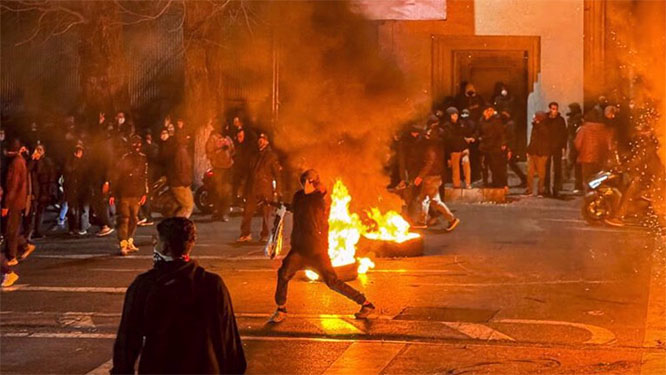
Iranian security and intelligence forces have captured more than 470 individuals in three provinces, identified as key figures behind the recent wave of violent unrest and terrorist activities linked to foreign-backed networks.

The Intelligence Ministry's provincial office in Khorasan Razavi announced on Monday the arrest of 192 armed terrorists, identified as the main agents behind recent riots in the region. 

According to an official statement, the detainees were involved in the killing of several security personnel and civilians, setting fire to mosques, public service facilities, and buses, as well as attacks on military and law enforcement centers.

The seized items from the group include several bulletproof vests, Kalashnikov rifles, hunting weapons, Winchester rifles, and various cold weapons such as daggers, swords, brass knuckles, tactical knives, crossbows, and chains.

Evidence indicates that some of the individuals were tied to hostile movements and terrorist organizations, with links overseas. Others were identified as members of violent criminal gangs, actively taking part in the unrest alongside their associates.

Simultaneously, in the western province of Lorestan, the IRGC announced the arrest of 134 individuals as the main leaders and influential field agents of a US-Israeli terrorist network.

The IRGC statement stated that these individuals formed terrorist cells during the recent unrest, committing "Daesh-like" acts.

They wounded security forces with firearms and cold weapons, and burned and destroyed public and private properties, including mosques, shops, banks, and private and public vehicles.

In the northwestern province of Zanjan, the police reported detaining 150 people identified as principal leaders and agents behind recent riots.

Authorities noted that these individuals were responsible for destroying public and private property and intentionally setting fire to vehicles in the province's squares.

Their crimes include shedding the blood of innocent people, destroying public and private property, attempting to enter military sites, disrupting public order, and spreading terror among citizens.

A variety of cold weapons were reportedly seized from the detainees.

What began late last month as peaceful protests over economic hardship across Iran turned violent after public statements by US and Israeli regime figures encouraged vandalism and disorder.

During the unrest, foreign-backed mercenaries rampaged through cities, killing security forces and civilians and damaging public property.

Comments

Add new comment

  • Coastaldigest.com reserves the right to delete or block any comments.
  • Coastaldigset.com is not responsible for its readers’ comments.
  • Comments that are abusive, incendiary or irrelevant are strictly prohibited.
  • Please use a genuine email ID and provide your name to avoid reject.