



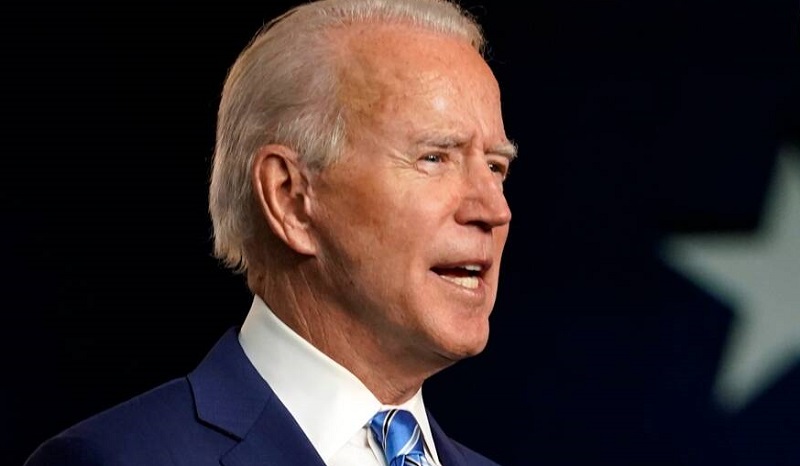
Joe Biden was fresh off winning the Michigan primary and effectively capturing the Democratic presidential nomination, a prize he’d sought for the better part of three decades. Instead of plotting a strategy to build momentum, he was contemplating an abrupt halt.
He gathered his senior team in a conference room on the 19th floor of his campaign’s Philadelphia headquarters, the type of in-person meeting that would soon be deemed a public health risk. A former surgeon general and Food and Drug Administration commissioner joined on speakerphone.
As the coronavirus began to explode across the United States that March, Biden asked a question that would ultimately guide the campaign’s thinking for months: “What should I be modeling?”
The health experts recommended the 77-year-old Biden step away from campaigning as soon as possible, both for his safety and that of staff and supporters. Biden agreed. He decided that he and every staff member would work from home starting that weekend. All field offices would be closed.
He wouldn’t return to in-person campaigning for 174 days.
It was a decision without precedent in modern American politics. Barack Obama and John McCain returned to Washington in the final weeks of the 2008 campaign to respond to that year’s financial collapse, but only briefly. In an era when voters are accustomed to seeing their presidential candidates constantly, the idea of a complete withdrawal was unthinkable.
That was especially true for Biden, whose tactile approach to politics is legendary.
“It was a hard call,” said Jake Sullivan, a senior Biden adviser. “If there’s no pandemic, he gets a chance to get out and do what he does, which is retail campaigning, meeting people where they are, having the opportunity to sit with folks and speak to crowds and walk down the street. That’s what he would have preferred, obviously.”
For Biden, who has been elected the 46th president of the United States, perhaps no decision was more consequential to his victory, making it possible to flip states such as Arizona and Wisconsin, where coronavirus infections and hospitalizations spiked the week of the election. Still, the cautious approach prompted ridicule from President Donald Trump, who constantly teased Biden for “hiding in his basement” and returned to large in-person events much sooner than his rival, and with far fewer precautions.
Some Democrats also worried. Several state party chairs and down-ballot candidates privately urged the campaign to resume in-person events and canvassing. Texas Democratic Chairman Gilberto Hinojosa warned that Latino turnout could suffer. The lack of personal outreach has been blamed for contributing to Biden’s poor showing with Latinos in Florida, a battleground that Trump carried.
But Biden refused to change course, defining himself early on as a responsible foil to Trump, someone who could make difficult choices and serve as something of a role model to a country facing a historic set of crises.
It was a theme Biden would return to repeatedly in the months ahead as millions of people lost their jobs, the largest protest movement since the civil rights era bloomed in response to police killings of Black people, and Trump threatened central elements of American democracy by refusing to commit to a peaceful transfer of power if he lost.
This account of Biden’s rise to the presidency is based on interviews with more than a dozen people who hold senior positions in the Biden and Trump campaigns along with strategists and donors in each party. Many spoke on the condition of anonymity to discuss the turbulent campaign with candor.
They all agree on one thing: The coronavirus fundamentally reshaped the race.
———
In the early hours of Friday, Oct. 2, a senior official at the Republican National Committee texted a colleague with a dire message about the fate of Trump’s campaign: It was hopeless.
The president had just announced that he and his wife, Melania, had tested positive for the coronavirus, joining the 7 million Americans already infected. By the end of the day, Trump would be taken to Walter Reed National Military Medical Center on Marine One, the short helicopter ride over the Washington skyline captured on live television.
Trump’s illness presented serious medical concerns and raised alarm about the stability of the U.S. government. At 74, Trump was at a higher risk of serious complications from the virus. He refused to temporarily cede power to Vice President Mike Pence as he recovered.
“I talked to him that night. I talked to him the whole hospitalization,” said GOP Sen. Lindsey Graham of South Carolina, one of Trump’s closest allies in Washington. “Friday night, he wasn’t feeling good.”
Trump’s infection was both a stunning twist and entirely predictable. He’d been cavalier about the virus for months, painting Democrats as reactionaries using the pandemic to take away individual rights. He mocked mask-wearing recommendations from scientists and returned to his trademark rallies, packing thousands of mostly unmasked supporters together, sometimes over the objection of local health officials.
He held large-scale events on the South Lawn of the White House, including the introduction of Supreme Court nominee Amy Coney Barrett less than a week before his diagnosis.
Perhaps the biggest surprise was that Trump hadn’t contracted the virus sooner.
After three nights in the hospital, Trump, who was still infectious, staged a dramatic return to the White House. Just in time for the evening newscasts on the major networks, the former reality television star climbed the South Portico steps, turned to the cameras and removed his mask to declare “I feel good.” He entered the White House, where aides were visible milling about the Blue Room, without wearing a face covering.
The move, less than a month before Election Day, was designed to show a president in control. It also threatened his relationship with the official wing of his party. On Capitol Hill, Republicans maintained their public support of Trump, eager to avoid enraged tweets that could threaten their political futures.
But at the RNC, frustration was building that Trump was missing obvious opportunities.
Party officials believed Trump could have been on track to win as much as 60% of the vote had he taken a more empathetic approach to the pandemic. Instead, he adopted a combative and dismissive attitude toward the science that guided most of his decisions in the election’s final weeks.
The party questioned Trump’s spending and messaging. The campaign spent untold millions on aggressive ads resembling WWE commercials blanketing TV, but none of them moved the needle. The ads were in many instances approved by Trump personally and aired on stations in Washington, targeted to an audience of one — the president — in a heavily Democratic city.
By early October, the RNC had had enough of the Trump campaign’s scattered message and decided to produce its own advertisements offering a more sober message on health care. The message tested better than anything the Trump campaign had done previously.
Despite their public confidence, Trump’s own staff seemed increasingly aware of the impending loss. In the final weeks of the campaign, White House staff offices began rotating in aides who had not yet been on Air Force One or not as frequently as others, to give them that experience while they still had the chance.
Trump himself was grappling with his fate in public.
“How the hell can we be tied?” he said at a rally in Carson City, Nevada.
———
Vermont Sen. Bernie Sanders knew his White House ambitions were over. Biden assumed a commanding lead in the Democratic primary by late March and the pandemic dashed any hopes of a comeback — or even a spirited exchange of ideas that could last until the summer convention.
But before he exited the race, the progressive icon wanted significant policy concessions on health care and education.
Sanders knew that Biden wouldn’t agree to support “Medicare for All.” The former vice president had aggressively run against it during in the primary. But Sanders believed he could get Biden to agree to lower the age for Medicare eligibility.
Sanders wanted Biden to drop the age to 55 from the current 65. Senior staff from both sides hammered out a compromise, which was later sealed during a private conversation between Sanders and Biden. A few days after Sanders formally stepped aside, Biden announced that he supported lowering the Medicare age to 60.
“Based on the calls that the senator had with the vice president, I think there was confidence they were serious about trying to have common ground — that progressives would not only be involved in the electoral process but also governing,” said Jeff Weaver, Sanders’ chief adviser.
For many Democrats, the scars of Sanders’ 2016 primary battle against Hillary Clinton had never really healed. Some argued Sanders didn’t do enough to support Clinton, damaging her in the general election against Trump. Progressives countered that the party didn’t take Sanders seriously and worked to thwart him.
Biden’s Medicare concession was an important step in building trust between the wings of the party. The relationship was further solidified after Biden agreed to form several policy committees that featured high-profile figures from opposing factions.
Among the participants on Biden’s climate committee: former Sen. John Kerry of Massachusetts and New York Rep. Alexandria Ocasio-Cortez, one of Sanders’ most vocal supporters. Biden didn’t issue the invitation to Ocasio-Cortez personally, but was fully on board with bringing her onto the panel.
She’d go on to become a consistent advocate for the 77-year-old establishment figure’s election, a stark contrast to the 2016 dynamics Clinton faced from the left flank.
———
Trump suddenly had an opportunity to divert attention from the pandemic.
A round of sometimes violent unrest exploded in Kenosha, Wisconsin, following the police shooting of Jacob Blake, an unarmed Black man, in August.
Some large cities contended with isolated instances of unrest during the summer as part of a broader movement against racial injustice and police violence toward Black Americans. But the events in Kenosha seemed different: The unrest was spreading to smaller cities and in a premier swing state, no less.
Trump had been roundly criticized after mostly peaceful protesters were forcibly removed from a street near the White House in June. But Kenosha fueled his call for “law and order,” the mantra championed by presidential candidates Richard Nixon and George Wallace in 1968.
Biden’s team worried that his consistent lead in critical Upper Midwest states could deteriorate if Trump’s appeal to the fears of white voters resonated. The focus on Kenosha peaked just as Trump hosted the Republican National Convention, drawing fairly positive reviews for delivering a program aimed at expanding his political coalition.
“It was a moment that could have gone sideways,” said Biden deputy campaign manager Kate Bedingfield. “We made a strategic decision to take it head-on.”
On the very day he returned to campaigning after nearly six months at home, Biden delivered a fiery speech in Pennsylvania asking voters if they really believed they were safer under Trump’s leadership.
Biden highlighted the pandemic’s mounting death toll — more than 180,000 Americans at that time — and blamed Trump for causing the divisions that ignited the unrest in the first place.
“He can’t stop the violence because for years he’s fomented it,” Biden charged.
The direct attack on Trump’s “law and order” messaging was amplified by Democrats across the country who followed Biden’s lead. Within a matter of weeks, any momentum that Trump seemed to have coming out of his convention was forgotten.
———
“That was embarrassing for the country.”
Immediately after his first presidential debate against Trump, Biden shared his disgust about his opponent’s performance with family and senior staff in a hold room backstage where they dissected the most chaotic 90 minutes in modern presidential politics.
Biden long believed that the opening debate on Sept. 29 could be an opportunity for Trump to reshape the race, and Biden prepared accordingly. Biden and his team spent weeks getting ready.
No one was more meticulous than senior adviser Bob Bauer, a White House counsel under Obama who had played Sanders during Biden’s primary debate practice sessions and agreed to embrace the role of Trump.
Like a football coach preparing for a Super Bowl opponent, Bauer watched hundreds of hours of tape on Trump, studying every primary and debate performance from his 2016 campaign, and virtually every rally and news conference in the four years since.
By the time Bauer and Biden stood behind makeshift podiums for their first full 90-minute mock debate inside Biden’s home in Wilmington, Delaware, Bauer had mastered the president’s style, his intonations, gestures and, perhaps most important, the specific attacks Trump was most likely to use and how he would deliver them.
Bauer was ruthless in the private sessions, leaning into deeply personal attacks about Biden’s family, his decision to step away from campaigning and the perception that he may not have the physical or mental strength to serve as president.
Yet no amount of preparation could truly prepare Biden for what he faced when the real moment came.
With more than 73 million people watching, a belligerent Trump badgered Biden and moderator Chris Wallace with a ceaseless flood of interruptions that rendered the high-profile debate almost unwatchable. Biden didn’t have any notable stumbles, but he lost his patience at times and slapped at Trump with unplanned insults.
“Will you shut up, man?” the Democrat said at one point.
The line would later inspire one of the campaign’s bestselling T-shirts.
In the hold room afterward, Biden gathered with his wife, his sister Valerie Biden Owens and a couple of senior aides. They believed Biden had clearly bested his opponent, but he was concerned that Trump had debased the debate process itself, something he considered a sacred institution in U.S. politics.
“It’s disappointing that the president of the United States would act like that on the debate stage,” Biden told them.
———
In the end, nothing Trump could say or do distracted voters from his fundamental inability to control the pandemic — or even take it seriously as the death toll surged past 232,000 Americans on the eve of the election.
As Biden stayed laser-focused on the health threat, Trump and his top lieutenants fought to convince Americans that the pandemic was almost over. Five days before Election Day, Donald Trump Jr. said on Fox News that coronavirus deaths had dropped to “almost nothing.”
That same day, the United States reported more than 90,000 new confirmed COVID-19 infections, another single-day record. The day after Election Day, more than 100,000 Americans tested positive for the first time.
Still, the president kept on mocking Biden’s cautiousness.
“When you’re president of the United States, you can’t lock yourself into a basement,” Trump told thousands of Pennsylvania supporters crammed into an outdoor venue, most without masks, the weekend before the election.
Despite the large crowds, people close to Trump were aware that his presidency was hanging by a thread.
The president boarded Air Force One in Miami to start his final day of travel seemingly in a bad mood. Holding a red MAGA hat, he offered a soft wave to reporters but didn’t do a customary wave for cameras at the top of the steps.
At the first of five events that day, he wasn’t showing much confidence when asked about Wisconsin, where coronavirus spiked to a new record high on Election Day: “I could lose it, I could win it,” Trump said.
Biden, too, was on edge as he watched election returns at home in Wilmington that initially showed a much closer race than pre-election polls had suggested. But he became increasingly confident as the vote counting stretched into the weekend.
He was sitting in his backyard with his wife enjoying an unseasonably warm Saturday afternoon when the excited screams of his grandchildren from inside the house confirmed his victory.
In the end, the president-elect earned more than 74 million votes, setting a record and besting Trump by more than 4 million votes nationally. He won by flipping states Trump previously carried in the Midwest and the Southwest and he was even narrowly ahead in Georgia, a Deep South state no Democrat had claimed in nearly three decades.
Trump pledged to fight the results, making wild and unsubstantiated claims of voter fraud. But his inner circle was in disarray as news emerged that his chief of staff had been infected with the coronavirus.
Biden was committed as ever to his health experts’ recommendations even in victory. He addressed the nation Saturday night from an outdoor stage in a Wilmington parking lot facing supporters gathered in their cars for a drive-in celebration.
Biden walked on stage for the first time as president-elect wearing a mask.
“Our work begins with getting COVID under control,” he said. He later added: “We will lead not only by the example of our power, but by the power of our example.”


Comments
Add new comment