Indianapolis Sikhs mourn FedEx shooting victims; questions about gunman’s motive linger

Agencies
April 18, 2021

indiana.jpg

Indianapolis, Apr 18: For decades now, Sikhs have come by the thousands to Central Indiana seeking good jobs, quiet lives and affordable homes. Some became doctors or police officers, but many others worked as truckers or in warehouses, toiling overnight and out of the public eye to support their families.

They were people like Jaswinder Singh, who was active at his temple and was excited about his new job. And Amarjeet Kaur Johal, a grandmother in her 60s who loved to watch Indian soap operas. And Amarjit Sekhon, who had two teenage sons. And Jasvinder Kaur, who planned to make her famous yogurt this weekend for a family birthday party.

But late Thursday at a sprawling FedEx facility near the edge of city limits, Singh, Johal, Sekhon and Kaur were among eight people killed by a gunman who had previously been investigated by the FBI and whose motives the police have still not described. The gunman also killed Matthew Alexander, Samaria Blackwell, Karli Smith and John Weisert before killing himself at the FedEx facility where he used to work.

The deaths, and the gunshot wounds suffered by at least seven others during a shift change on a chilly night, jolted a nation where mass killings are commonplace. At least four of the victims were members of the Sikh community, and the attack renewed the fears of American Sikhs, who have over the years been accosted for wearing turbans and attacked in a house of worship.

“The shock wave went through the entire Sikh community,” said Kanwal Prakash Singh, who has watched the Indianapolis-area Sikh population grow from a handful of individuals to thousands since he arrived in the late 1960s. “Why would a 19-year-old,” he asked, “do that to these innocent people?”

The gunman, identified by the police as Brandon Scott Hole, had in 2020 been reported to the police by his mother, who warned last year that he might attempt “suicide by cop,” officials said. At that time, authorities seized a shotgun and placed him in detention for mental health reasons.

Hole was armed with a rifle during the attack at FedEx, officials said. His family released a statement Saturday that apologized to the victims and said, “We tried to get him the help he needed.” Authorities have not said whether hate or bias might have played a role in the attack.

Members of the Sikh community still recall the painful aftermath of Sept. 11, 2001, when, in a wave of anti-Muslim sentiment, some Americans also targeted Sikhs with taunts of “Go home” or “Osama bin Laden.” And Sikhs continue to mourn the killing of six people by a white supremacist at a Wisconsin temple in 2012.

“We don’t know whether this was targeted or a coincidence,” said Dr. Sukhwinder Singh, 29, a leader at his gurdwara, or Sikh temple, southeast of Indianapolis. “We are all so numb. This is something that will take weeks to process.”

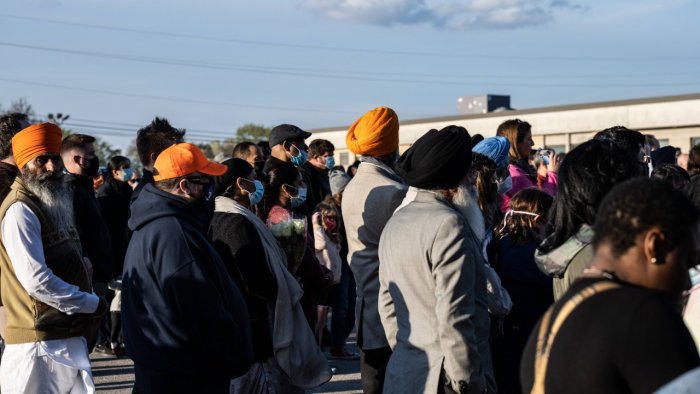
As vigils were planned Saturday across Indianapolis, the grief was not limited to the Sikh community. Flags atop the Indiana Statehouse were at half-staff. And in the parking lot of a Baptist church on the city’s west side, activists whose families had been impacted by gun violence gathered to express their support.

Weisert, who at 74 was the oldest victim, had once been a mechanical engineer and liked to play country and western and bluegrass music on his guitar, said his son, Mike. He had been considering retirement.

“He was hunched and arched over with his back,” Mike Weisert said. “The job was killing him by inches, slowly. His career had been winding down, and some of us were worried.”

Alexander, 32, had once attended Butler University. He loved to watch St. Louis Cardinals baseball and had worked at FedEx for several years, according to a friend, Ryan Sheets. He had recently bought a home in Avon, an Indianapolis suburb, Sheets said.

“Matt was someone who was the perfect friend,” Sheets said. “Not a jealous bone in his body; he was generous.”

Blackwell, 19, had worked as a lifeguard and dreamed of becoming a police officer, her parents said.

“On the court or the soccer field, she had a tough game face, but that quickly turned to a smile outside of competition,” Blackwell’s parents said in a statement provided by a family friend. “Samaria loved people, especially those of advanced age. She always found time to invest in the older generation, whether it was by listening or serving.”

Smith, also 19, was a softball player and fan of hip-hop music whose family said she graduated from high school last year. “She was the kind of girl that if she saw someone having a bad day, she’d go out of her way to make them smile,” said her brother, Brandon Smith. “She made a lot of people happy.”

At Sikh temples across Indianapolis, members gathered Saturday to mourn, pray and reflect on the circumstances of the shooting. Many of them described the victims from their community as hard workers, dedicated to their families and committed to their faith, which is known for its tradition of service, including supporting victims of natural disasters and organizing food drives during the coronavirus pandemic.

Many Sikhs were among the 875 employees at FedEx’s 300,000-square-foot sorting facility near Indianapolis International Airport where parcels are whisked away into an automated system where they are digitally scanned, weighed and measured, shuttled around by conveyor belt and sorted. A job posting for package handlers at the facility promises up to $17 per hour.

Jaswinder Singh, a new hire at FedEx who was excited to receive his first paycheck, was a daily presence at a temple in Greenwood, just outside Indianapolis, where he would cut vegetables for temple visitors, mop the floors and serve food. He sometimes stopped by the temple before heading to work.

“He was a simple man,” said Harjap Singh Dillon, whose sister was married to one of Jaswinder Singh’s sons. “He used to pray and meditate a lot, and he did community service.”

Jigna Shah, who got to know Sekhon through their temple, said her friend was a regular at Sikh services, where she prepared lentils and served food to visitors. “She was a very sweet person,” Shah said. “She was like an aunt to our family.”

Rimpi Girn said Sekhon, her aunt, had moved to Indiana from Ohio to be closer to family. Sekhon began working at FedEx about six months ago on an overnight shift from 11 p.m. to 11 a.m., Girn said, and had two sons, ages 14 and 19.

“We can’t even think of what to tell him,” Girn said of the younger son. “All of a sudden last night, his mom went to work, and she never came back today.”

Girn also knew Kaur, the mother of her sister-in-law. She said Kaur had planned to make a yogurt recipe that she had perfected for her granddaughter’s second birthday on Saturday and hoped to soon get a driver’s license.

“And today we’re gathering to plan a funeral,” Girn said.

With few details being provided by law enforcement by Saturday afternoon, there was debate within the Sikh community about whether bias motivated the shooting and about how they should discuss that possibility in public. Some members of the community suggested it may have been a tragic coincidence in a country awash in gun violence, while others were skeptical of that conclusion.

“These events didn’t take place in a vacuum,” said Taranjit Singh, 27, a history teacher at an Indianapolis school, after he and others at his temple met to discuss what language to include in a news release about the shooting. “There is no way you can’t talk about gun violence and white supremacy.”

As the Sikh population in Indianapolis grew over the past few decades, as many as 10 temples opened across the city and its suburbs. A Sikh Day parade became part of the city’s social calendar. New community members continued to come to Indiana, some directly from India, but many others from states on the East and West coasts.

Johal, matriarch of her family of 25, followed that path to Indiana. Like many others in the community, she moved to the United States decades ago to be closer to her children and their families, part of a broader wave of Sikh migration to North America that began in earnest in the 1980s. She lived for a time in California before coming to Indianapolis.

Johal, a FedEx employee for about four years, had worked a half-shift Thursday and was planning to celebrate a relative’s birthday when she got home that night. She was waiting for her carpool outside the building when she was shot, a grandson said.

“We all told her there was no need for her to work,” said Komal Chohan, 25, a granddaughter. “She could stay home and live leisurely, spending time with her grandchildren. But she wanted something of her own, she wanted to work, and she was great at her job. She built a community at FedEx.” 

Comments

Add new comment

  • Coastaldigest.com reserves the right to delete or block any comments.
  • Coastaldigset.com is not responsible for its readers’ comments.
  • Comments that are abusive, incendiary or irrelevant are strictly prohibited.
  • Please use a genuine email ID and provide your name to avoid reject.
News Network
January 20,2026

KCFabudhabi.jpg

KCF, a global socio-cultural organisation of Karnataka expatriates, is actively involved in education, humanitarian initiatives and community well-being across several countries. The awardees were selected following a structured evaluation of nominations by the Annual Council Program Committee, based on the depth, consistency and long-term impact of their social service.

One of the award recipients, Abdul Razak Haji, a prominent UAE-based entrepreneur from the Qamcon Group of Companies, was honoured for his significant contributions to society. Through both his professional journey and personal initiatives, he has supported numerous employees and families, while also extending assistance in education, housing for the underprivileged and various charitable causes, largely carried out quietly over the years. His award was presented earlier during the Annual Council Program held at the KCF Abu Dhabi office.

The second award was conferred on Latheef Kakkinje, a young social worker based in Abu Dhabi, in recognition of his active involvement in community engagement programmes, sports initiatives, talent festivals and family-oriented social activities. His consistent volunteering efforts and commitment to humanitarian causes were highly appreciated by the selection committee.

The award presentation ceremony for Latheef Kakkinje was held at the Zayed Cricket Stadium (Astro Turf Ground) in the presence of Kedumbady Ibrahim Saqafi, President of KCF UAE; Ibrahim, General Secretary; Kabeer Bayambady, President of KCF Abu Dhabi; Ummer Ishwaramangila, General Secretary; along with other members of the KCF Abu Dhabi cabinet.

Congratulating both awardees, KCF leaders reiterated the organisation’s commitment to recognising individuals who selflessly work for social upliftment and community service.

KCFabudhabi1.jpg

Comments

Add new comment

  • Coastaldigest.com reserves the right to delete or block any comments.
  • Coastaldigset.com is not responsible for its readers’ comments.
  • Comments that are abusive, incendiary or irrelevant are strictly prohibited.
  • Please use a genuine email ID and provide your name to avoid reject.
News Network
February 1,2026

Bengaluru: The Karnataka High Court has refused to quash an investigation against a WhatsApp group administrator accused of allowing the circulation of obscene and offensive images depicting Hindutva politicians and idols in 2021.

Justice M Nagaprasanna observed that, prima facie, the ingredients of the offence under Section 295A of the Indian Penal Code were made out. “The offence under Section 295A of the IPC is met to every word of its ingredient, albeit prima facie,” the judge said.

The petitioner, Sirajuddin, a resident of Belthangady taluk in Dakshina Kannada district, had challenged the FIR registered against him at the CEN (Cyber, Economics and Narcotics) police station, Mangaluru, for offences under Section 295A of the IPC and Section 67 of the Information Technology Act. Section 295A relates to punishment for deliberate and malicious acts intended to outrage the religious feelings of any class of citizens.

According to the complaint filed by K Jayaraj Salian, also a resident of Belthangady taluk, he received a WhatsApp group link from an unknown source and was added to the group after accessing it. The group reportedly had six administrators and around 250 participants, where obscene and offensive images depicting Hindu deities and certain political figures were allegedly circulated repeatedly.

Sirajuddin was arrested in connection with the case and later released on bail on February 16, 2021. He argued before the court that he was being selectively targeted, while other administrators—including the creator of the group—were neither arrested nor investigated. He also contended that the Magistrate could not have taken cognisance of the offence under Section 295A without prior sanction under Section 196(1) of the CrPC.

Rejecting the argument, Justice Nagaprasanna held that prior sanction is required only at the stage of taking cognisance, and not at the stage of registration of the crime or during investigation.

The judge noted that the State had produced the entire investigation material before the court. “A perusal of the material reveals depictions of Hindu deities in an extraordinarily obscene, demeaning and profane manner. The content is such that its reproduction in a judicial order would itself be inappropriate,” the court said, adding that the material, on its face, had the tendency to outrage religious feelings and disturb communal harmony.

Observing that the case was still at the investigation stage, the court said it could not interdict the probe at this juncture. However, it expressed concern that the investigating officer appeared to have not proceeded uniformly against all administrators. The court clarified that if the investigation revealed the active involvement of any member in permitting the circulation of such content, they must also be proceeded against.

“At this investigative stage, any further observation by this Court would be unnecessary,” the order concluded.

Comments

Add new comment

  • Coastaldigest.com reserves the right to delete or block any comments.
  • Coastaldigset.com is not responsible for its readers’ comments.
  • Comments that are abusive, incendiary or irrelevant are strictly prohibited.
  • Please use a genuine email ID and provide your name to avoid reject.
coastaldigest.com news network
January 19,2026

rizwanzameer.jpg

Bengaluru: As the dust settles on the recent legislative session, the corridors of Vidhana Soudha are buzzing with more than just policy talk. A high-stakes game of political musical chairs has begun, exposing a deepening rift within the Congress party’s Muslim leadership as a major Cabinet reshuffle looms.

With the party hierarchy signaling a "50% refresh" to gear up for the 2028 Assembly elections, the race to fill three projected Muslim ministerial berths has transformed from a strategic discussion into an all-out turf war.

The "Star Son" Spark

The internal friction turned public this week following provocative remarks by Zaid Khan, actor and son of Wakf Minister Zameer Ahmed Khan. Zaid’s claim—that his father "helped" secure a ticket for Shivajinagar MLA Rizwan Arshad in 2023—has acted as a lightning rod for resentment.

Rizwan’s camp was quick to fire back, dismissing the comment as a desperate attempt by Zameer to manufacture seniority. "Rizwan’s political pedigree was forged in the NSUI and Youth Congress long before Zameer even stepped into the party," a supporter noted, highlighting Rizwan’s tenure as an AICC secretary and his two-term presidency of the State Youth Congress.

A Tale of Two Loyalists

While both Zameer Ahmed Khan and Rizwan Arshad are staunch allies of Chief Minister Siddaramaiah and represent Bengaluru strongholds, their political DNA could not be more different:

•    Zameer Ahmed Khan: A four-time MLA who crossed over from JD(S) in 2018. Known for his "overzealous" and often polarizing outreach during communal flashpoints—from the DJ Halli riots to the recent Wakf land notice controversy—his style has frequently left the Congress high command in a state of "discomfort."

•    Rizwan Arshad: A homegrown organizational man. Seen as a "quiet performer," Arshad represents the sophisticated, moderate face of the party, preferred by those who find Zameer’s brand of politics too volatile.

The Outsiders Looking In

The bickering isn't limited to a duo. The "Beary" community, represented by leaders like N A Haris and Saleem Ahmed, is demanding its pound of flesh. Saleem Ahmed, the Chief Whip in the Legislative Council, has dropped the veil of diplomacy, openly declaring his ministerial aspirations.

"I was the only working president not included in the Cabinet last time," Saleem noted pointedly, signaling that the "loyalty quota" is no longer enough to keep the peace.

As Chief Minister Siddaramaiah prepares to finalize the list, he faces a delicate balancing act: rewarding the aggressive grassroots mobilization of Zameer’s camp without alienating the organizational stalwarts and minority sub-sects who feel increasingly sidelined by the "Chamarajpet-Shivajinagar" binary.

Comments

Add new comment

  • Coastaldigest.com reserves the right to delete or block any comments.
  • Coastaldigset.com is not responsible for its readers’ comments.
  • Comments that are abusive, incendiary or irrelevant are strictly prohibited.
  • Please use a genuine email ID and provide your name to avoid reject.