



India's role in production of vaccine critical in containing covid-19: Bill Gates

Agencies
September 15, 2020

Washington, Sept 15: Billionaire philanthropist Bill Gates has said India's willingness to play a "big role" in manufacturing Covid-19 vaccine and allow it to supply to other developing countries will be a critical part in containing the coronavirus pandemic globally.

In an exclusive interview to PTI, Gates, whose foundation is focusing on fighting the pandemic, called it the "next biggest thing" the world has been confronted with after the World War.

The Microsoft co-founder said the world is looking to India for large scale production of Covid-19 vaccine once it is rolled out.

"Obviously, all of us want to get a vaccine out in India as fast as we can, once we know that it's very effective and very safe, and so the plans are coming into focus that sometime next year, it's very likely that roll-out will take place and take place in fairly big volume," he said.

"The world is also looking to India for some of that capacity to be available to other developing countries. Exactly what that allocation formula looks like will have to be figured out," Gates added.

Scientists and pharmaceutical companies globally are racing against time to find a vaccine for the coronavirus pandemic which has killed about 9,32,000 people and infected around 24 million. Some of the vaccine candidates have entered the third and final phase of testing.

"This is not like a world war, but it's the next biggest thing after that that we've ever had," he said.

The Bill and Melinda Gates Foundation, one of the world's largest charities, has been involved in global efforts to contain the pandemic. In India, the foundation has entered into a partnership with the Serum Institute to accelerate the manufacturing and delivery of Covid-19 vaccines.

"India's willingness to play a big role in the manufacturing and to allow some of those vaccines to go to other developing countries will be an absolutely critical part of that," said Gates.

"India will be helping to make sure we have equity. We have a model that shows that getting the vaccine out to those who need it the most will save half the lives that you'd lose if you only send it out to the rich countries," he said.

In the telephonic interview, the Microsoft co-founder who has donated billions of dollars to fight poverty and diseases, talked extensively about India's strength in production of vaccines and referred to companies like Serum Institute, Bio E and Bharat Biotech.

"We've been brokering the idea of taking a vaccine and manufacturing it in India, even if it comes from AstraZeneca, Oxford or Novavax or Johnson & Johnson. We've publicly talked about the arrangement where a Serum will be able to make very high volume of the AstraZeneca and the Novavax vaccine," said Gates.

"There's discussions with Bio E, their connection with the Johnson & Johnson vaccine, and whether they'll be able to ramp that up," he said.

Gates also said that the foundation has been having "great discussions" with India's NITI-Aayog, adding the ICMR is looking at the regulatory aspects of the Covid-19 vaccines.

"I'm actually very impressed with how our discussions with the government on these issues and the companies, including the Western companies collaborating with these new companies, that's all gone very well," Gates said.

The American business magnate said he was optimistic that by the first quarter of next year, that several of these vaccines will reach the phase three emergency licence approval.

"We still could be disappointed in that. But we have a variety of constructs and the early data from the phase one and phase two, for example the antibody levels, looks pretty promising for quite a few of these vaccines," he said.

He said the focus should be to keep the cost of the vaccines low and it should be ensured that they can be made in very high volume.

"We have to remember that even once a vaccine is approved, the bar for that vaccine in terms of the effectiveness was set as 50 per cent, and so we still may want to continue with other vaccines to get higher effectiveness," he said.

Gates also complimented India's digital cash transfer scheme.

"Getting payments out through digital cash transfers, that has been a fantastic thing, and obviously, India has done that at a scale that no other country ever has," he said.

"The whole Aadhaar digital financial system in India has proven to be once again a huge asset," he said, adding it can be extended to all the countries of the world.

The philanthropist also referred to the foundation's annual Goalkeepers report saying it normally takes stock of the ongoing progress on things like economic growth, literacy, child survival and average lifespan.

"This year's report, unfortunately, we're unable to say that there's been progress. In fact, we talk about the setback, and one way we dimensionalise that for like vaccine coverage globally, which went from 84 per cent to 70 per cent, is we say that's a 25-year setback," he said.

Asked whether India's economic downturn will impact implementation of social welfare schemes, Gates said the foundation is a huge believer that investments in health pay off very strongly.

"It's tragic that all health activities have been so disrupted, and that will lead to increased deaths from other diseases, not just COVID," he said.

"In fact, in many places, and I'm not sure if India will be included in this, but there's a chance that there would be more deaths from other diseases because of the health disruption than from COVID itself," he said.

Comments

Add new comment

  • Coastaldigest.com reserves the right to delete or block any comments.
  • Coastaldigset.com is not responsible for its readers’ comments.
  • Comments that are abusive, incendiary or irrelevant are strictly prohibited.
  • Please use a genuine email ID and provide your name to avoid reject.
News Network
January 19,2026

trump.jpg

Donald Trump has linked his repeated threats to seize Greenland to his failure to win the Nobel Peace Prize, in a letter to Norwegian Prime Minister Jonas Gahr Støre.

The authenticity of the letter, in which Trump says he no longer feels obligated to “think purely of peace,” was confirmed by Støre to the Norwegian newspaper VG.

“Considering your country decided not to give me the Nobel Peace Prize for having stopped eight wars plus, I no longer feel an obligation to think purely of peace,” Trump wrote, adding he can now “think about what is good and proper for the United States.”

Støre said Trump’s letter was in response to a short message he had sent earlier, on behalf of himself and Finland’s President Alexander Stubb.

Trump has escalated rhetoric toward Greenland, a self-governing Danish territory, insisting the US will take control “one way or the other.” Over the weekend, he tweeted: “Now it is time, and it will be done!!!”

On Saturday, Trump threatened a 10% tariff on imports from Denmark, Norway, Sweden, France, Germany, the UK, the Netherlands, and Finland from 1 February until the US is allowed to purchase the island. EU diplomats met for emergency talks on possible retaliatory tariffs and sanctions.

In his letter, Trump argued Denmark “cannot protect” Greenland from Russia or China, questioning Danish ownership: “There are no written documents; it’s only that a boat landed there hundreds of years ago.” He added that NATO should support the US, claiming the world is “not secure unless we have complete and total control of Greenland.”

Trump’s stance has unsettled the EU and NATO, as he refused to rule out military action to take control of the mineral-rich island.

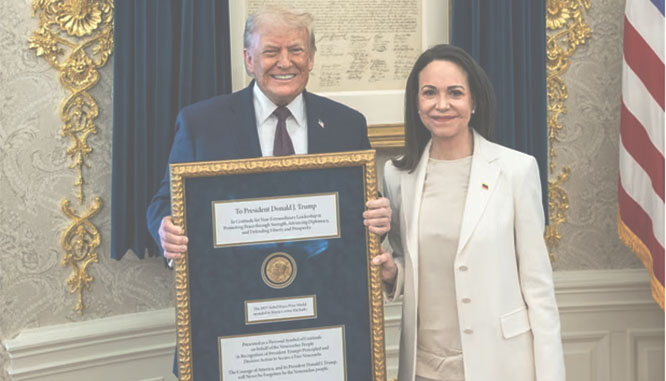
The Nobel Peace Prize is awarded by the independent Norwegian Nobel Committee, not the government. Trump had campaigned for last year’s prize, which went to Venezuelan opposition leader María Corina Machado, who dedicated her award to him.

Støre reiterated that the Nobel Prize decision rests solely with the committee.

Comments

Add new comment

  • Coastaldigest.com reserves the right to delete or block any comments.
  • Coastaldigset.com is not responsible for its readers’ comments.
  • Comments that are abusive, incendiary or irrelevant are strictly prohibited.
  • Please use a genuine email ID and provide your name to avoid reject.
News Network
February 1,2026

Bengaluru, Feb 1: For travelers landing at Kempegowda International Airport (KIA), the sleek, wood-paneled curves of Terminal 2 promise a world-class welcome. But the famed “Garden City” charm quickly withers at the curb. As India’s aviation sector swells to record numbers—handling over 43 million passengers in Bengaluru alone this past year—the “last mile” has turned into a marathon of frustration.

The Bengaluru Logjam: Rules vs Reality

While the city awaits the 2027 completion of the Namma Metro Blue Line, the interim has been chaotic. Recent “decongestion” rules at Terminal 1 have pushed app-based cab pickups to distant parking zones, forcing weary passengers into a 20-minute walk with luggage.

“I landed after ten months away and felt like a stranger in my own city,” says Ruchitha Jain, a Koramangala resident. “My driver couldn’t find me, staff couldn’t guide me, and the so-called ‘Premium’ lane is just a fancy tax on convenience.”

•    The Cost of Distance: A 40-km cab ride can now easily cross ₹1,500, driven by demand pricing and airport surcharges.

•    The Bus Gap: While Vayu Vajra remains a lifeline, its ₹300–₹400 fare is often cited as the most expensive airport bus service in the country.

A National Pattern of Disconnect

The struggle is not unique to Karnataka. From Chennai’s coast to Hyderabad’s plateau, India’s airports tell a familiar story: brilliant runways, broken exits.

City:    Primary Issue   |    Recent Development

Bengaluru:    Cab pickup restrictions & distance  |    App-based taxis shifted to far parking zones; long walks and fare spikes reported

Chennai:    Multi-Level Parking (MLCP) hike  |    Passengers report 40-minute walks to reach cab pickup points

Hyderabad:    “Taxi mafia” & touting  |    Over 440 touting cases reported; security presence intensified

Mumbai:    Fare scams  |     Tourists charged ₹18,000 for just 400 metres, triggering police action

In Hyderabad, travelers continue to battle entrenched local groups that intimidate Uber and Ola drivers, pushing passengers toward overpriced private taxis. Chennai flyers, meanwhile, complain that reaching the designated pickup zones now takes longer than short-haul flights from cities like Coimbatore.

The ‘Budget Day’ Hope

As Finance Minister Nirmala Sitharaman presents the Union Budget 2026 today, the aviation sector is watching closely. With the government’s renewed emphasis on multimodal integration, there is cautious hope for funding toward seamless airport-metro-bus hubs.

The vision is clear: a future where planes, trains, and metros speak the same language. Until then, passengers at KIA—and airports across India—will continue to discover that the hardest part of flying isn’t the thousands of kilometres in the air, but the last few on the ground.

Comments

Add new comment

  • Coastaldigest.com reserves the right to delete or block any comments.
  • Coastaldigset.com is not responsible for its readers’ comments.
  • Comments that are abusive, incendiary or irrelevant are strictly prohibited.
  • Please use a genuine email ID and provide your name to avoid reject.
News Network
January 23,2026

Mangaluru: The Karnataka Government Polytechnic (KPT), Mangaluru, has achieved autonomous status from the All India Council for Technical Education (AICTE), becoming the first government polytechnic in the country to receive such recognition in its 78-year history. The status was granted by AICTE, New Delhi, and subsequently approved by the Karnataka Board of Technical Education in October last year.

Officials said the autonomy was conferred a few months ago. Until recently, AICTE extended autonomous status only to engineering colleges, excluding diploma institutions. However, with a renewed national focus on skill development, several government polytechnics across India have now been granted autonomy.

KPT, the second-largest polytechnic in Karnataka, was established in 1946 with four branches and has since expanded to offer eight diploma programmes, including computer science and polymer technology. The institution is spread across a 19-acre campus.

Ravindra M Keni, the first dean of the institution, told The Times of India that AICTE had proposed autonomous status for polytechnic institutions that are over 25 years old. “Many colleges applied. In the first round, 100 institutions were shortlisted, which was further narrowed down to 15 in the second round. We have already completed one semester after becoming an autonomous institution,” he said. He added that nearly 500 students are admitted annually across eight three-year diploma courses.

Explaining the factors that helped KPT secure autonomy, Keni said the institution has consistently recorded 100 per cent admissions and placements for its graduates. He also noted its strong performance in sports, with the college emerging champions for 12 consecutive years, along with active student participation in NCC and NSS activities.

Autonomous status allows KPT to design industry-oriented curricula, conduct examinations, prepare question papers, and manage academic documentation independently. The institution can also directly collaborate with industries and receive priority funding from AICTE or the Ministry of Education. While academic autonomy has been granted, financial control will continue to rest with the state government.

“There will be separate committees for examinations, question paper setting, boards of studies, and boards of examiners. The institution will now have the freedom to conduct admissions without government notifications and issue its own marks cards,” Keni said, adding that new academic initiatives would be planned after a year of functioning under the autonomous framework.

Comments

Add new comment

  • Coastaldigest.com reserves the right to delete or block any comments.
  • Coastaldigset.com is not responsible for its readers’ comments.
  • Comments that are abusive, incendiary or irrelevant are strictly prohibited.
  • Please use a genuine email ID and provide your name to avoid reject.