Israel Bombed World's Largest Gas Field in Iran: World Can’t Ignore It!

Agencies
June 15, 2025

gasfield.jpg

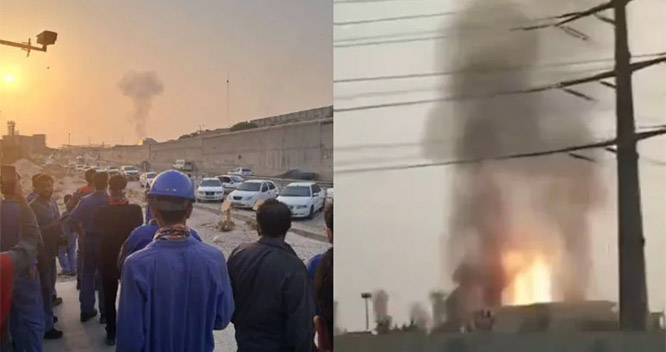
In a significant and highly provocative escalation, Israel launched a direct airstrike on Iran’s South Pars gas field, the largest natural gas reserve in the world. The strike hit Phase 14 of the offshore site, sparking a fire and forcing Iran to suspend production of 12 million cubic metres of gas per day.

This is believed to be the first direct Israeli strike on Iran’s civilian energy infrastructure, marking a sharp departure from previous attacks that primarily targeted military and nuclear facilities. The global implications of such a move are potentially severe, as the strike puts shared and strategic energy assets in the Persian Gulf in direct danger.

What Is South Pars and Why Is It So Important?

South Pars, located off the coast of Bushehr Province, is shared between Iran and Qatar (which calls its section the North Field). Together, this reservoir is the world’s largest source of natural gas.

Iran relies on South Pars for over 65 percent of its domestic gas consumption, which powers electricity generation, heating, and the petrochemical sector. While sanctions have limited Iran’s exports, countries like Iraq still receive Iranian gas.

Meanwhile, Qatar's portion of the same field helps supply Europe and Asia with 77 million tonnes of liquefied natural gas (LNG) each year. It is developed with the backing of energy giants such as Shell and ExxonMobil.

A direct strike on such an asset threatens not just Iran but the entire region's stability, raising alarm about the possibility of attacks on other energy hubs.

Has Israel Crossed a Red Line?

Energy experts and geopolitical analysts suggest this strike represents a strategic shift.

“This is probably the most significant attack on energy infrastructure since Abqaiq,” said Jorge Leon of Rystad Energy, referring to the 2019 drone strike on Saudi Arabia’s oil facilities that sent shockwaves through global markets.

The targeting of civilian energy infrastructure adds a new, dangerous dimension to the conflict, signaling that economic warfare is now part of the confrontation. With South Pars located near the Strait of Hormuz—a chokepoint for 21 percent of global LNG exports and 14 million barrels of oil daily—any escalation could have worldwide consequences.

Global Energy at Risk

Though South Pars primarily serves Iran’s domestic market, the potential for broader fallout is significant. Escalation could lead to retaliatory attacks on other vital infrastructure, including Qatar’s LNG terminals and Kharg Island, Iran’s main oil export hub.

Oil prices surged up to 14 percent, settling near $73 per barrel, amid fears of a broader energy crisis. With OPEC’s third-largest producer under attack, the possibility of disruptions in the Strait of Hormuz could cause dramatic spikes in fuel costs and inflation across Europe, Asia, and beyond.

Iran’s Response and Energy Crisis

Iranian President Masoud Pezeshkian denounced the strike, calling it a “cowardly attack on the lifeline of the Iranian people,” and vowed a strong response. Even before the strike, Iran was battling a worsening energy crisis, with blackouts and gas shortages costing the economy an estimated $250 million per day.

“Damaging this infrastructure is not only inhumane but economically catastrophic,” said Abdollah Babakhani, an Iranian energy expert based in Germany. “Repairing it will take months, possibly years.”

A Precedent With Global Fallout

The strike may signal a new phase of the Iran-Israel conflict, where energy infrastructure becomes a legitimate target. This shift could open the floodgates for regional instability and global energy insecurity, especially if other countries or non-state actors retaliate in kind.

The international community must recognize what’s at stake. If the world’s largest gas field can be bombed with impunity, no energy hub is truly safe—a scenario that could lead to spiraling conflict, inflation, and disruption on a global scale.


Comments

Add new comment

  • Coastaldigest.com reserves the right to delete or block any comments.
  • Coastaldigset.com is not responsible for its readers’ comments.
  • Comments that are abusive, incendiary or irrelevant are strictly prohibited.
  • Please use a genuine email ID and provide your name to avoid reject.
News Network
November 22,2025

gaza.jpg

The Israeli regime’s forces have killed two Palestinian children in the Gaza Strip every day since the ceasefire began in early October, UNICEF has warned.

The UN children’s agency said on Friday that Israeli forces continue to attack Palestinians in Gaza even though the agreement was meant to stop the killing.

“Since 11 October, while the ceasefire has been in effect, at least 67 children have been killed in conflict-related incidents in the Gaza Strip. Dozens more have been injured. That is an average of almost two children killed every day since the ceasefire took effect,” UNICEF spokesperson Ricardo Pires said in Geneva, reminding that each number in the statistics represents a child whose life had ended violently.

“These are not statistics,” he said. “Each child had a story, a family, and a future that was stolen from them.”

Data from Palestinian factions, human rights groups, and government bodies recorded since the US-brokered ceasefire deal went into effect on October 10 show that Israeli forces have carried out numerous attacks, each constituting a separate ceasefire violation.

UNICEF teams say they repeatedly continue to witness heart-wrenching scenes of fearful Palestinian children sleeping outdoors with amputated limbs, while others live as orphans in flooded, makeshift shelters.

“I saw this myself in August. There is no safe place for them. The world cannot normalize their suffering,” Pires said, lamenting that the UN could “do a lot more if the aid that is really needed was entering faster.”

The UNICEF spokesperson warned that with the advent of winter, the risks for hundreds of thousands of displaced children will increase.

He warned, “The stakes are incredibly high” for children as winter acts as a threat multiplier, where children have no heating, no insulation, and few blankets. He said respiratory infections rise.

“Too many children have already paid the highest price,” Pires said. “Too many are still paying it, even under a ceasefire. The world promised them it would stop and that we would protect them.”

“Now we must act like it,” the UNICEF spokesperson added.

Since the Israeli regime launched its genocidal war against Palestinians in Gaza in October 2023, it has killed nearly 70,000 people in the territory, most of them women and children, and injured over 170,000 more, while reducing most of the structures in the enclave to rubble.

Comments

Add new comment

  • Coastaldigest.com reserves the right to delete or block any comments.
  • Coastaldigset.com is not responsible for its readers’ comments.
  • Comments that are abusive, incendiary or irrelevant are strictly prohibited.
  • Please use a genuine email ID and provide your name to avoid reject.
News Network
November 21,2025

Bengaluru, Nov 21: The Karnataka government is facing pressure to overhaul its employment system after a high-level Cabinet sub-committee recommended the complete phase-out of job outsourcing in government offices, boards, and corporations by March 2028. The move is aimed at tackling a systemic issue that has led to the potential violation of constitutional reservation policies and the exploitation of workers.

The Call for Systemic Change

With over three lakh vacant posts currently being filled through private agencies on an outsource, insource, or daily wage basis, the sub-committee highlighted a significant lapse. "As a result, reservations are not being followed as per the Constitution and state laws. It’s an urgent need to take serious steps to change the system. It has been recommended to completely stop the system of outsourcing by March 2028," the panel stated in a document.

The practice of outsourcing involves private companies hiring workers to perform duties for a government agency. Critics argue this model results in lesser salaries, a lack of social security benefits (otherwise available to permanent government employees), and a failure to adhere to the provisions of Articles 14 and 15 of the Constitution, which guarantee equality before the law and prohibit discrimination.

The 'Bidar Model' as a Stop-Gap Solution

To regulate the current mode of employment and reduce worker exploitation until the 2028 deadline, the government plans to establish workers’ services multi-purpose cooperative societies across all districts, following the successful "Bidar Model."

The Bidar District Services of Labour Multi-purpose Cooperative Society Ltd., which operates under the District Commissioner, is cited as a successful example of providing a measure of social security to outsourced staff. Labour Department officials argue this society ensures workers receive their due wages and statutory facilities like ESI (Employees' State Insurance) and PF (Provident Fund), in exchange for a 1% service fee collected from the employees.

legislative push and Priority Insourcing

The recommendations, led by the sub-committee headed by Law and Parliamentary Affairs Minister H K Patil, are set to be discussed at the next Cabinet meeting. The committee has proposed the introduction of the Karnataka Outsourced Employees (Regulation, Placement and Welfare) Bill 2025.

In a move addressing immediate concerns, Labour Minister Santosh Lad, a member of the sub-committee, has reportedly assured that steps will be taken over the next 2-3 years to insource workers in "life-threatening services" on a priority basis. This includes essential personnel like pourakarmikas (sanitation workers), drivers, electrical staff in the Energy Department, and Health Department staff handling contagious diseases. The transition aims to grant these workers the long-term security and benefits they currently lack under the outsourcing system. 

Comments

Add new comment

  • Coastaldigest.com reserves the right to delete or block any comments.
  • Coastaldigset.com is not responsible for its readers’ comments.
  • Comments that are abusive, incendiary or irrelevant are strictly prohibited.
  • Please use a genuine email ID and provide your name to avoid reject.
Agencies
November 22,2025

indiapak.jpg

New York/Washington: US President Donald Trump has again claimed to have solved the conflict between India and Pakistan, repeating his assertion during a meeting with New York City Mayor-elect Zohran Mamdani in the Oval Office.

Mamdani flew to Washington DC for his first meeting with Trump in the White House on Friday. Trump said he “enjoyed” the meeting, which he described as “great.”

During remarks in the Oval Office, with Mamdani standing next to him, Trump repeated his claim that he solved the May conflict between India and Pakistan.

"I did eight peace deals of countries, including India and Pakistan,” he said.

On Wednesday, Trump had said he threatened to put 350 per cent tariffs on India and Pakistan if they did not end their conflict, repeating his claim that he solved the fighting between the nuclear-armed neighbours and that Prime Minister Narendra Modi had called him to say “we're not going to go to war.”

Since May 10, when Trump announced on social media that India and Pakistan had agreed to a “full and immediate” ceasefire after a “long night” of talks mediated by Washington, he has repeated his claim over 60 times that he “helped settle” the tensions between India and Pakistan.

India has consistently denied any third-party intervention. India launched Operation Sindoor on May 7, targeting terror infrastructure in Pakistan and Pakistan-occupied Kashmir in retaliation for the April 22 Pahalgam attack that killed 26 civilians. India and Pakistan reached an understanding on May 10 to end the conflict after four days of intense cross-border drone and missile strikes.

Mamdani emerged victorious in the closely-watched battle for New York City Mayor, becoming the first South Asian and Muslim to be elected to sit at the helm of the largest city in the US.

He had been the front-runner in the NYC Mayoral election for months and defeated Republican nominee Curtis Sliwa and political heavyweight former New York State Governor Andrew Cuomo, who ran as an independent candidate and was officially endorsed by Trump just hours before the elections.

Indian-descent Mamdani is the son of renowned filmmaker Mira Nair and Columbia University professor Mahmood Mamdani. He was born and raised in Kampala, Uganda and moved to New York City with his family when he was 7. Mamdani became a naturalised US citizen only recently, in 2018.

Comments

Add new comment

  • Coastaldigest.com reserves the right to delete or block any comments.
  • Coastaldigset.com is not responsible for its readers’ comments.
  • Comments that are abusive, incendiary or irrelevant are strictly prohibited.
  • Please use a genuine email ID and provide your name to avoid reject.