Israel Bombed World's Largest Gas Field in Iran: World Can’t Ignore It!

Agencies
June 15, 2025

gasfield.jpg

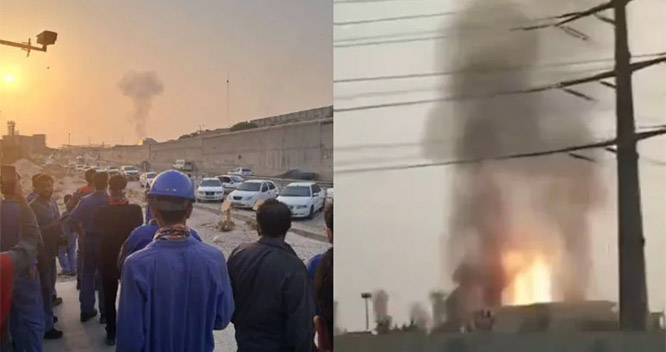
In a significant and highly provocative escalation, Israel launched a direct airstrike on Iran’s South Pars gas field, the largest natural gas reserve in the world. The strike hit Phase 14 of the offshore site, sparking a fire and forcing Iran to suspend production of 12 million cubic metres of gas per day.

This is believed to be the first direct Israeli strike on Iran’s civilian energy infrastructure, marking a sharp departure from previous attacks that primarily targeted military and nuclear facilities. The global implications of such a move are potentially severe, as the strike puts shared and strategic energy assets in the Persian Gulf in direct danger.

What Is South Pars and Why Is It So Important?

South Pars, located off the coast of Bushehr Province, is shared between Iran and Qatar (which calls its section the North Field). Together, this reservoir is the world’s largest source of natural gas.

Iran relies on South Pars for over 65 percent of its domestic gas consumption, which powers electricity generation, heating, and the petrochemical sector. While sanctions have limited Iran’s exports, countries like Iraq still receive Iranian gas.

Meanwhile, Qatar's portion of the same field helps supply Europe and Asia with 77 million tonnes of liquefied natural gas (LNG) each year. It is developed with the backing of energy giants such as Shell and ExxonMobil.

A direct strike on such an asset threatens not just Iran but the entire region's stability, raising alarm about the possibility of attacks on other energy hubs.

Has Israel Crossed a Red Line?

Energy experts and geopolitical analysts suggest this strike represents a strategic shift.

“This is probably the most significant attack on energy infrastructure since Abqaiq,” said Jorge Leon of Rystad Energy, referring to the 2019 drone strike on Saudi Arabia’s oil facilities that sent shockwaves through global markets.

The targeting of civilian energy infrastructure adds a new, dangerous dimension to the conflict, signaling that economic warfare is now part of the confrontation. With South Pars located near the Strait of Hormuz—a chokepoint for 21 percent of global LNG exports and 14 million barrels of oil daily—any escalation could have worldwide consequences.

Global Energy at Risk

Though South Pars primarily serves Iran’s domestic market, the potential for broader fallout is significant. Escalation could lead to retaliatory attacks on other vital infrastructure, including Qatar’s LNG terminals and Kharg Island, Iran’s main oil export hub.

Oil prices surged up to 14 percent, settling near $73 per barrel, amid fears of a broader energy crisis. With OPEC’s third-largest producer under attack, the possibility of disruptions in the Strait of Hormuz could cause dramatic spikes in fuel costs and inflation across Europe, Asia, and beyond.

Iran’s Response and Energy Crisis

Iranian President Masoud Pezeshkian denounced the strike, calling it a “cowardly attack on the lifeline of the Iranian people,” and vowed a strong response. Even before the strike, Iran was battling a worsening energy crisis, with blackouts and gas shortages costing the economy an estimated $250 million per day.

“Damaging this infrastructure is not only inhumane but economically catastrophic,” said Abdollah Babakhani, an Iranian energy expert based in Germany. “Repairing it will take months, possibly years.”

A Precedent With Global Fallout

The strike may signal a new phase of the Iran-Israel conflict, where energy infrastructure becomes a legitimate target. This shift could open the floodgates for regional instability and global energy insecurity, especially if other countries or non-state actors retaliate in kind.

The international community must recognize what’s at stake. If the world’s largest gas field can be bombed with impunity, no energy hub is truly safe—a scenario that could lead to spiraling conflict, inflation, and disruption on a global scale.


Comments

Add new comment

  • Coastaldigest.com reserves the right to delete or block any comments.
  • Coastaldigset.com is not responsible for its readers’ comments.
  • Comments that are abusive, incendiary or irrelevant are strictly prohibited.
  • Please use a genuine email ID and provide your name to avoid reject.
News Network
November 26,2025

students.jpg

Bengaluru, Nov 26: Karnataka is taking its first concrete steps towards lifting a three-decade-old ban on student elections in colleges and universities. Deputy Chief Minister D.K. Shivakumar announced Wednesday that the state government will form a small committee to study the reintroduction of campus polls, a practice halted in 1989 following incidents of violence.

Speaking at a 'Constitution Day' event organised by the Karnataka Congress, Mr. Shivakumar underscored the move's aim: nurturing new political leadership from the grassroots.

"Recently, (Leader of the Opposition in Lok Sabha) Rahul Gandhi wrote a letter to me and Chief Minister (Siddaramaiah) asking us to think about restarting student elections," Shivakumar stated. "I'm announcing today that we'll form a small committee and seek a report on this."

Student elections were banned in Karnataka in 1989, largely due to concerns over violence and the infiltration of political party affiliates into campus life. The ban effectively extinguished vibrant student bodies and the pipeline of young leaders they often produced.

Mr. Shivakumar, who also serves as the Karnataka Congress president, said that former student leaders will be consulted to "study the pros and cons" of the re-introduction.

Acknowledging the history of the ban, he added, "There were many criminal activities taking place back then. We’ll see how we can conduct (student) elections by regulating such criminal activities."

The Deputy CM reminisced about his own journey, which began on campus. He recalled his political activism at Sri Jagadguru Renukacharya College leading to his first Assembly ticket in 1985 at the age of 23. "That's how student leadership was at the time. Such leadership has gone today. College elections have stopped," he lamented, adding that for many, college elections were "like a big movement" where leaders were forged.

The move, driven by the Congress high command's push to cultivate young talent, will face scrutiny from academics and university authorities who have, in the past, expressed concern that the return of polls could disrupt the peaceful academic environment and turn campuses into political battlegrounds.

Comments

Add new comment

  • Coastaldigest.com reserves the right to delete or block any comments.
  • Coastaldigset.com is not responsible for its readers’ comments.
  • Comments that are abusive, incendiary or irrelevant are strictly prohibited.
  • Please use a genuine email ID and provide your name to avoid reject.
coastaldigest.com news network
November 28,2025

roadshow.jpg

Udupi district transformed into a sea of saffron and celebration on Friday, November 28, as Prime Minister Narendra Modi’s roadshow swept through the coastal temple town. Thousands of residents lined the streets, turning the event into a vibrant public spectacle filled with cheers, flags, and festive energy.

The procession route—from the helipad to the historic Sri Krishna Math—was decked with buntings, saffron flags, and multilayered security barricades. One of the district’s largest-ever security deployments was put in place for the high-profile visit, with over 3,000 police personnel on duty. The arrangement included ten SPs, 27 DSPs, 49 inspectors, 127 sub-inspectors, 232 assistant sub-inspectors, 1,608 constables, and 39 women staff.

Six platoons of the Karnataka State Reserve Police, six Quick Response Teams, bomb detection units, and dog squads were stationed across Udupi. Enhanced surveillance covered Adi Udupi, Bannanje bus stand, and the Sri Krishna Math parking zone, with combing operations carried out along the roadshow corridor.

At the 800-year-old Sri Krishna Math, preparations reached a ceremonial peak. Paryaya Puttige Math seer Sugunendra Teertha Swamiji said the Prime Minister would take part in the Laksha Kantha Geetha Parayana, a mass chanting of the Bhagavad Gita by one lakh devotees, and inaugurate the new Suvarna Teertha Mantapa.

“He will first offer floral tributes to saint-poet Kanakadasa and then unveil the golden covering over the Kanakana Kindi,” the seer said.

The Prime Minister will also receive a Poorna Kumbha welcome and have darshan of Lord Sri Krishna, Mukhyaprana Devaru, and the Suvarna Paduke. Union Minister Pralhad Joshi, Karnataka Governor Thaawarchand Gehlot, Minister Bairathi Suresh, Dharmadhikari D. Veerendra Heggade, and seers from the Ashta Maths are expected to join the ceremony.

Ahead of his arrival, the Prime Minister posted on X that he felt “honoured” to attend the spiritually significant gathering. “This is a special occasion that brings together people from different sections of society for a recital of the Gita. This Matha has a very special significance in our cultural life,” he wrote, noting the institution’s long-standing legacy rooted in the teachings of Sri Madhvacharya.

roadshow2.jpg

Comments

Add new comment

  • Coastaldigest.com reserves the right to delete or block any comments.
  • Coastaldigset.com is not responsible for its readers’ comments.
  • Comments that are abusive, incendiary or irrelevant are strictly prohibited.
  • Please use a genuine email ID and provide your name to avoid reject.
News Network
November 24,2025

israelsyra.jpg

Israeli forces have pushed over the Syrian frontier, erecting a checkpoint and stopping vehicles in the southwestern city of Quneitra, in yet another breach of the Arab country’s sovereignty.

The violation took place on Sunday, when the troops made their way across the border, setting up the outpost near the Ain al-Bayda junction in northern Quneitra, Syrian outlets reported.

According to the al-Ikhbariya paper, an Israeli detachment positioned itself at the junction, halting cars and conducting searches.

The Syrian Arab News Agency (SANA) reported that three Israeli military vehicles then moved further into the northern countryside, deploying between the town of Jubata al-Khashab and the villages of Ofaniya and Ain al-Bayda. The agency added that a separate Israeli unit mounted a new incursion in the central region, approaching the villages of Umm Batina and al-Ajraf.

Residents said such activities have surged in recent months, pointing to Israeli advances onto farmland, leveling of extensive forested areas, arrests, and spread of mobile checkpoints.

The Israeli regime began markedly increasing its military aggression against Syria last year.

The escalation coincided with increasingly ferocious onslaughts throughout the country by the so-called Hay'at Tahrir al-Sham (HTS) Takfiri terrorist group, which the government of President Bashar al-Assad had confined to northwestern Syria. The HTS, however, managed to overthrow the government as the Israeli attacks would pummel the country’s civilian and defensive infrastructure.

Various reports have shown that, during the escalation, the regime conducted more than 1,000 airstrikes on the Syrian territory and over 400 ground raids into the south.

Following the collapse of the Assad government, Tel Aviv also widened its grip over the occupied Golan Heights by taking control of a demilitarized buffer zone, in defiance of a 1974 Disengagement Agreement. Earlier this month, senior Israeli officials, including Prime Minister Benjamin Netanyahu, visited the buffer zone, prompting expressions of alarm on the part of the United Nations.

The United States, the regime’s biggest ally, has, meanwhile, been fraternizing the HTS head Abu Mohammed al-Jolani amid the widely reported prospect of rapprochement with Tel Aviv.

Comments

Add new comment

  • Coastaldigest.com reserves the right to delete or block any comments.
  • Coastaldigset.com is not responsible for its readers’ comments.
  • Comments that are abusive, incendiary or irrelevant are strictly prohibited.
  • Please use a genuine email ID and provide your name to avoid reject.