Joe Biden and Donald Trump are locked in tight race as uncounted votes remain

News Network
November 4, 2020

New York, Nov 4: President Donald Trump won a series of key battlegrounds early Wednesday morning, including Florida, Ohio and Iowa, as Joe Biden expressed confidence he would ultimately prevail across key Northern states and Arizona as the presidential contest turned into a state-by-state slog that could drag deeper into the week.

“We believe we are on track to win this election,” Biden said in a brief speech after 12:30 a.m. Eastern, saying he was “optimistic” about the outcome once all the votes were counted.

No full states had yet flipped from their 2016 results as of 1 a.m., but several key states had huge portions of ballots still to be counted. Biden did flip a single Electoral College vote that Trump had won in 2016, carrying Nebraska’s 2nd Congressional District, which includes Omaha.

With millions of legitimate votes still waiting to be counted, Trump prematurely and recklessly declared that “frankly we did win this election” from the White House. He pressed for more vote counting in Arizona, where he is behind, and called to stop the count where he is ahead as he baselessly declared the election “a fraud on the American public.”

So far, Trump was holding off Biden in two Southern states that the former vice president had hoped to snatch back from the Republican column: Georgia and North Carolina. These were not must-win states for Biden, but he spent heavily in both states and visited them in the final stretch of the campaign. Biden lost Texas, a long-shot hope that some Democrats invested in late in hopes of earning a landslide repudiation of Trump that did not arrive.

Georgia has not gone Democratic since 1992. But while Trump held a narrow lead, much of the remaining vote to be counted appeared to be in the Atlanta area, where Biden performed strongest.

Shortly after Biden spoke, Trump responded on Twitter, misleadingly saying he was “up big” and claiming without evidence that “they are trying to STEAL the election.” Twitter immediately marked it as content that was “disputed and might be misleading.”

The most encouraging sign on the map for Biden was in Arizona, where he was leading in a state that Trump won in 2016. He won New Hampshire and Minnesota, two states that Hillary Clinton had only narrowly carried four years ago and that Trump had once hoped to flip in 2020.

“We’re going to win this,” Biden said, urging “patience.”

Biden’s win in Nebraska’s 2nd District was only one of the 270 Electoral College votes that he needs. But it could prove important. It opened a potential pathway to the White House without winning Pennsylvania, if Biden carried all the states that Clinton did and added Michigan, Arizona and Wisconsin, plus Nebraska’s lone vote.

In a briefing for donors Tuesday night, Biden campaign officials acknowledged underperforming among Cuban Americans in the Miami area, but saw positive signs with their strength in some suburbs in Ohio that they said could be predictive across the Midwest, according to two people familiar with the matter.

Campaign officials signaled that Biden’s team was preparing to wait for votes to be counted in three Northern battlegrounds that Trump carried in 2016 — Pennsylvania, Michigan and Wisconsin — where it still feels bullish.

North Carolina and Arizona could still be called relatively quickly. But vote-counting in the so-called former “blue wall” that Trump flipped in 2016 — Michigan, Wisconsin and Pennsylvania — was not expected to be completed until later in the week.

Trump Wins Florida on Strength of Drastic Gains Among Latinos in Miami

President Donald Trump was declared the winner in Florida after pulling off a remarkable turnaround from 2016 in the Miami area, wooing conservative Cuban American voters and other Latino groups in numbers sufficient to overcome Joe Biden’s middling gains with white Floridians.

It was a big moment for his reelection hopes, mainly because it would have been all but impossible for him to win back the White House without capturing this state’s 29 Electoral College votes again.

Four years ago, Trump lost the Miami-Dade area by nearly 30 percentage points to Hillary Clinton; As of late Tuesday, that margin had shrunk to about 8 percentage points with Biden at the top of the ticket — with Trump’s vote totals in that critical area increasing from 334,000 in 2016 to around 500,000 this year.

Biden spent far more time and resources courting Black voters, and he began to heavily invest in a major Latino outreach operation only late in the campaign. He had hoped he would come close to Clinton’s bench mark, while siphoning off votes from Trump among disenchanted suburban whites and older voters.

If Biden could take any consolation from the loss, it was the fact that he marginally outperformed Clinton in the county that includes Jacksonville, defeating Trump there, while he exceeded her performance in Tampa and its suburbs, again by a small amount.

Polls had shown the race very tight — with many showing Biden with a lead — but Democrats were hardly confident going into the night, given the closeness of the polls.

Democrats’ Path to Senate Control Narrows

Democrats’ path to seizing the Senate was narrowing early Wednesday as the two parties continued to fight to control the upper chamber in close contests across the country.

Democrats early in the night won a critical seat, with former Gov. John Hickenlooper defeating Sen. Cory Gardner in the high-profile fight for Colorado’s Senate seat, and early returns in Arizona showed Sen. Martha McSally badly trailing Mark Kelly, a former astronaut. Those victories were essential to Democrats’ push to take the Senate majority.

In Georgia, the Rev. Raphael G. Warnock, a Democrat, advanced to a runoff election against Sen. Kelly Loeffler, the Republican incumbent. The other race in the state, between Jon Ossoff, the Democratic challenger, and Sen. David Perdue, a Republican, was too close to call.

But Republicans across the country were successful in holding off well-funded Democratic challengers. In Iowa, Sen. Joni Ernst defeated Theresa Greenfield, a businesswoman who had styled herself as a “scrappy farm kid.” In South Carolina, Sen. Lindsey Graham, a Republican, hung onto his seat, fending off the toughest challenge of his political career from Jaime Harrison, a Black Democrat whose upstart campaign electrified progressives across the country and inspired a record-setting onslaught of campaign cash.

Sen. John Cornyn, R-Texas, also defeated a challenge from M.J. Hegar, a former Air Force pilot who Democrats hoped could have an outside chance of winning in the rapidly changing state. In Kentucky, Sen. Mitch McConnell, the Senate majority leader, easily won reelection, defeating Amy McGrath, a Democrat who struggled to gain ground despite an outpouring of financial support from her party’s supporters around the nation. And Republicans succeeded in ousting Sen. Doug Jones, D-Ala., who came to power in a 2017 special election against Roy Moore, who was accused of sexually assaulting and pursuing teenage girls.

And early returns showed Sen. Thom Tillis, R-N.C., with a lead over his Democratic challenger, Cal Cunningham, in a seat that strategists in both parties identified as a possible tipping point.

There were still several crucial Senate races that were not yet called that Democrats hope to win, including Maine and Montana.

Comments

Add new comment

  • Coastaldigest.com reserves the right to delete or block any comments.
  • Coastaldigset.com is not responsible for its readers’ comments.
  • Comments that are abusive, incendiary or irrelevant are strictly prohibited.
  • Please use a genuine email ID and provide your name to avoid reject.
News Network
January 20,2026

iran.jpg

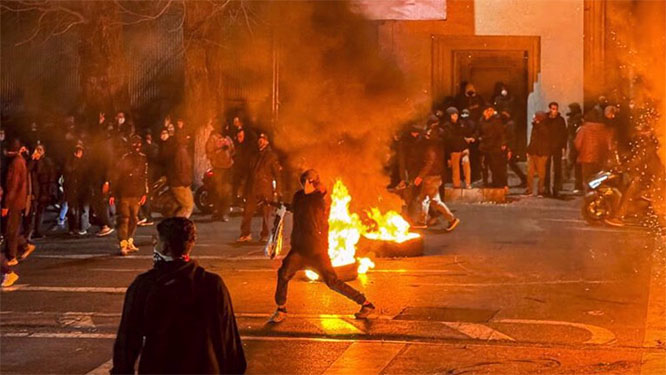
Iranian security and intelligence forces have captured more than 470 individuals in three provinces, identified as key figures behind the recent wave of violent unrest and terrorist activities linked to foreign-backed networks.

The Intelligence Ministry's provincial office in Khorasan Razavi announced on Monday the arrest of 192 armed terrorists, identified as the main agents behind recent riots in the region. 

According to an official statement, the detainees were involved in the killing of several security personnel and civilians, setting fire to mosques, public service facilities, and buses, as well as attacks on military and law enforcement centers.

The seized items from the group include several bulletproof vests, Kalashnikov rifles, hunting weapons, Winchester rifles, and various cold weapons such as daggers, swords, brass knuckles, tactical knives, crossbows, and chains.

Evidence indicates that some of the individuals were tied to hostile movements and terrorist organizations, with links overseas. Others were identified as members of violent criminal gangs, actively taking part in the unrest alongside their associates.

Simultaneously, in the western province of Lorestan, the IRGC announced the arrest of 134 individuals as the main leaders and influential field agents of a US-Israeli terrorist network.

The IRGC statement stated that these individuals formed terrorist cells during the recent unrest, committing "Daesh-like" acts.

They wounded security forces with firearms and cold weapons, and burned and destroyed public and private properties, including mosques, shops, banks, and private and public vehicles.

In the northwestern province of Zanjan, the police reported detaining 150 people identified as principal leaders and agents behind recent riots.

Authorities noted that these individuals were responsible for destroying public and private property and intentionally setting fire to vehicles in the province's squares.

Their crimes include shedding the blood of innocent people, destroying public and private property, attempting to enter military sites, disrupting public order, and spreading terror among citizens.

A variety of cold weapons were reportedly seized from the detainees.

What began late last month as peaceful protests over economic hardship across Iran turned violent after public statements by US and Israeli regime figures encouraged vandalism and disorder.

During the unrest, foreign-backed mercenaries rampaged through cities, killing security forces and civilians and damaging public property.

Comments

Add new comment

  • Coastaldigest.com reserves the right to delete or block any comments.
  • Coastaldigset.com is not responsible for its readers’ comments.
  • Comments that are abusive, incendiary or irrelevant are strictly prohibited.
  • Please use a genuine email ID and provide your name to avoid reject.
News Network
January 19,2026

trump.jpg

Donald Trump has linked his repeated threats to seize Greenland to his failure to win the Nobel Peace Prize, in a letter to Norwegian Prime Minister Jonas Gahr Støre.

The authenticity of the letter, in which Trump says he no longer feels obligated to “think purely of peace,” was confirmed by Støre to the Norwegian newspaper VG.

“Considering your country decided not to give me the Nobel Peace Prize for having stopped eight wars plus, I no longer feel an obligation to think purely of peace,” Trump wrote, adding he can now “think about what is good and proper for the United States.”

Støre said Trump’s letter was in response to a short message he had sent earlier, on behalf of himself and Finland’s President Alexander Stubb.

Trump has escalated rhetoric toward Greenland, a self-governing Danish territory, insisting the US will take control “one way or the other.” Over the weekend, he tweeted: “Now it is time, and it will be done!!!”

On Saturday, Trump threatened a 10% tariff on imports from Denmark, Norway, Sweden, France, Germany, the UK, the Netherlands, and Finland from 1 February until the US is allowed to purchase the island. EU diplomats met for emergency talks on possible retaliatory tariffs and sanctions.

In his letter, Trump argued Denmark “cannot protect” Greenland from Russia or China, questioning Danish ownership: “There are no written documents; it’s only that a boat landed there hundreds of years ago.” He added that NATO should support the US, claiming the world is “not secure unless we have complete and total control of Greenland.”

Trump’s stance has unsettled the EU and NATO, as he refused to rule out military action to take control of the mineral-rich island.

The Nobel Peace Prize is awarded by the independent Norwegian Nobel Committee, not the government. Trump had campaigned for last year’s prize, which went to Venezuelan opposition leader María Corina Machado, who dedicated her award to him.

Støre reiterated that the Nobel Prize decision rests solely with the committee.

Comments

Add new comment

  • Coastaldigest.com reserves the right to delete or block any comments.
  • Coastaldigset.com is not responsible for its readers’ comments.
  • Comments that are abusive, incendiary or irrelevant are strictly prohibited.
  • Please use a genuine email ID and provide your name to avoid reject.
News Network
January 20,2026

Mangaluru: In a major step towards strengthening rural innovation, the Office of the Principal Scientific Adviser (PSA) to the Government of India is supporting the establishment of RuTAGe Smart Village Centres (RSVCs) across the country through collaborations with academic institutions, civil society organisations and philanthropic partners.

As part of this national initiative, Nitte (Deemed to be University) will set up the first RSVCs in the region at Nitte GP in Udupi district and at the Nitte Health Centre, Sevanjali Trust, Farangipete, in Dakshina Kannada district. The centres will be inaugurated on January 21. In South India, the programme is being implemented by the Section Infin-8 Foundation (SI-8).

Speaking to reporters on Monday, SI-8 founder-director Vishwas US said experts from Nitte University and SI-8 would work closely with farmers, students, youth and local entrepreneurs to adapt and deploy technologies tailored to local needs.

Project head Prof Iddya Karunasagar, representing Nitte DU, said the RSVCs at Nitte and Farangipete would serve as demonstration hubs for a wide range of agriculture, energy, skill-development and assistive technologies. These include solar dryers for fruits, vegetables and crops; soil-testing solutions; power weeders and women-friendly farm tools; wind-powered devices for rural artisans; grain storage systems; grass-cutting and tree-climbing equipment; and liquid fertiliser production using cowshed waste.

SI-8 CEO Aravind C Kumar said the centres would also provide access to digital and knowledge-based platforms such as ISRO applications, government scheme portals, market linkage tools and gamified learning resources, along with assistive technologies for persons with visual impairments.

Highlighting the broader impact of the initiative, Principal Scientific Adviser Prof Ajay Kumar Sood said it demonstrated how applied research could bridge the rural–urban divide and help create self-reliant, technology-enabled villages.

The initiative has been made possible through philanthropic support from Dr NC Murthy of ACM Business Solutions, LLC, USA. Dr Sapna Poti, Director (Strategic Alliances) at the Office of the Principal Scientific Adviser, said the long-term objective is to build self-sufficient, technology-driven communities capable of generating sustainable livelihoods on their own.

Comments

Add new comment

  • Coastaldigest.com reserves the right to delete or block any comments.
  • Coastaldigset.com is not responsible for its readers’ comments.
  • Comments that are abusive, incendiary or irrelevant are strictly prohibited.
  • Please use a genuine email ID and provide your name to avoid reject.