



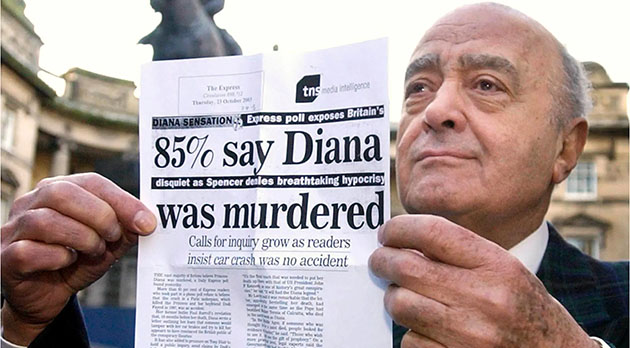
Mohamed Al Fayed, the Egyptian business tycoon whose empire of trophy properties and influence in Europe and the Middle East was overshadowed by the 1997 Paris car crash that killed his eldest son, Dodi, and Diana, the Princess of Wales, died Wednesday. He was 94.
His death was confirmed Friday in a statement by the Fulham Football Club in Britain, of which Al Fayed was a former owner. It did not say where he died.
The patriarch of a family that rose from humble origins to fabled riches, Al Fayed controlled far-flung enterprises in oil, shipping, banking and real estate, including the palatial Ritz Hotel in Paris and, for 25 years, the storied London retail emporium Harrods. Forbes estimated his net worth at $2 billion this year, ranking his wealth as 1,516th in the world.
In a sense, Al Fayed was a citizen of the world. He had homes in London, Paris, New York, Geneva, St. Tropez and other locales; a fleet of 40 ships based in Genoa, Italy, and in Cairo; and businesses that reached from the Persian Gulf to North Africa, Europe and the Americas. He held Egyptian citizenship but rarely if ever returned to his native land.
Al Fayed lived and worked mostly in Britain, where for a half-century he was a quintessential outsider, scorned by the establishment in a society still embedded with old-boy networks. He clashed repeatedly with the government and business rivals over his property acquisitions and attempts to influence members of Parliament. He campaigned noisily for British citizenship, but his applications were repeatedly denied.
“It’s the colonial, imperial fantasy,” Al Fayed told The New York Times in 1995. “Anyone who comes from a colony, as Egypt was before, they think he’s nothing. So you prove you’re better than they are. You do things that are the talk of the town. And they think, ‘How can he? He’s only an Egyptian.’”
He reveled in the trappings of a British aristocrat. He bought a castle in Scotland and sometimes wore a kilt; snapped up a popular British football club; cultivated Conservative prime ministers and members of Parliament; sponsored the Royal Horse Show at Windsor; and tried unsuccessfully to salvage Punch, the moribund satirical magazine that had lampooned the British establishment for 150 years.
His takeover of the venerable Harrods in 1985 struck many Britons as shameless brass, something akin to buying Big Ben. A year later, as if securing a jewel in the crown of British heritage, Al Fayed signed a 50-year lease on the 19th-century villa in Paris that had been the home of former King Edward VIII of Britain and Wallis Warfield Simpson, the divorced American woman for whom he abdicated his throne in 1936.
But Al Fayed’s triumph as an Anglophile was the made-for-tabloids romance between his eldest son, Emad, known as Dodi, and the Princess of Wales, who had recently been divorced from Prince Charles (now King Charles III) and alienated from the royal family. It began in the summer of 1997, when Al Fayed invited Diana and her sons to spend some time at his home on the French Riviera and on one of his yachts. Dodi was there too.
The Egyptian-born nephew of Saudi billionaire arms dealer Adnan Khashoggi, Dodi was a notorious playboy who gave lavish parties, financed films, dated beautiful women and was once briefly married. He and Diana had been acquainted, but by many accounts they fell in love on the Mediterranean sojourn. As their romance bloomed, the British press pounced. Paparazzi hounded the couple everywhere they went.
In the early hours of Aug. 31, 1997, a Mercedes-Benz carrying Diana and Dodi and driven by Henri Paul, a Fayed security agent who was drunk and traveling at a high speed trying to elude carloads of pursuing paparazzi, slammed head-on into a concrete pillar in a tunnel in Paris. All three were killed.
Controversy exploded over the cause of the crash and the implications of the affair. Some tabloids suggested that an immigrant had been an unfit suitor for a princess. But friends said that the couple had planned to marry and that the Fayed family had offered Diana and her sons a warmth that contrasted with the way Britain’s royal family had shunned her after the divorce.
As rumors and conspiracy theories swirled, Al Fayed declared that the two had been killed by “people who did not want Diana and Dodi to be together.” He said they had been engaged to marry and maintained that they had called him an hour before the crash to tell him that she was pregnant. Buckingham Palace and the princess’s family denounced his remarks as malicious fantasy.
The deaths inspired waves of books, articles and investigations of conspiracy theories, as well as a period of soul-searching among Britons, who resented the royal family’s standoffish behavior and were caught up in displays of mass grief. In 2006, British police ruled the crash an accident.
And in 2008, a British coroner’s jury rejected all conspiracy theories involving the royal family, British intelligence services and others. It attributed the deaths to “gross negligence” by the driver and the pursuing paparazzi. It also said a French pathologist had found that Diana was not pregnant.
Al Fayed called the verdict biased, but he and his lawyers did not pursue the matter further. “I’ve had enough,” he told Britain’s ITV News. “I’m leaving this to God to get my revenge.”
Mohamed Al Fayed was born Mohamed Abdel Moneim Fayed in Alexandria, Egypt, on Jan. 27, 1929, one of five children of a primary-school teacher, Aly Aly Fayed. Details about his early life are murky.
His accounts of growing up in a prosperous merchant family were discounted by British investigators. He sold sewing machines and joined his two younger brothers, Ali and Salah, in a shipping business. In the early 1950s, Adnan Khashoggi set the brothers up in a venture that exported Egyptian furniture to Saudi Arabia. It flourished.
In 1954, Al Fayed married Khashoggi’s sister, Samira. Dodi was their only child. They were divorced in 1956. In 1985, he married Heini Wathén, a Finn. They had four children, all born in Britain: Jasmine, Karim, Camilla and Omar.
Information on survivors was not immediately available.
The Fayed shipping interests profited handsomely from an oil boom in the Persian Gulf in the 1960s. Acting as middlemen for British construction companies and gulf rulers, they helped develop the port of Dubai, the Dubai Trade Center and other properties in what is now the United Arab Emirates.
Al Fayed, who made all his family’s major investment and financial decisions, moved to London in the mid-1960s. He added “Al” to his surname, implying aristocratic origins. After buying the Scottish castle, he expanded its estate to 65,000 acres; after acquiring the Fulham Football Club, he built it into a top team in a nation infatuated with the sport. (He sold the team in 2013 to a Pakistani American businessman.) A heavy contributor to the Conservative Party, he nurtured relationships with members of Parliament and Prime Ministers Margaret Thatcher and John Major.
In 1979, the Fayed brothers bought the fading Ritz Hotel in Paris for under $30 million and, with a 10-year, $250 million renovation, turned it into one of the world’s most luxurious hotels. Princess Diana and Dodi Fayed dined in the Imperial Suite before their fatal crash.
In 1984-85, in their greatest commercial coup in Britain, the Fayeds paid $840 million for the House of Fraser, the parent company of Harrods and scores of other stores, and invested $300 million more to refurbish the chain’s flagship, in London’s exclusive Knightsbridge section.
Prodded by a business rival, the government investigated the Harrods deal and in 1990 concluded that the Fayed brothers had “dishonestly misrepresented” themselves as descendants of an old landowning and shipbuilding family. The government report said the money for Harrods had probably come from the Sultan of Brunei. The sultan denied it, and Al Fayed, who was not accused of wrongdoing, called the report a smear.
In investigative reports by the press and police, Al Fayed was accused by many women of unwanted sexual advances, job-related sexual harassment of female employees at Harrods and even sexual assault involving teenage girls. He denied the allegations and, although he was questioned by authorities in Britain, he was never prosecuted on such charges.
Al Fayed was bitter about being stymied in his quest for British citizenship, although all his children by his second wife held that status. As he noted, he had lived in Britain for decades, paid millions in taxes, employed thousands of people and, through his enterprises, contributed mightily to the economy.
“They could not accept that an Egyptian could own Harrods, so they threw mud at me,” he told reporters. He sold Harrods in 2010 to Qatar Holding, the sovereign wealth fund of the Emirate of Qatar, for more than $2 billion, and announced his retirement.

Comments
Add new comment