Mohamed Al Fayed, tycoon whose son died with Princess Diana in car crash, passes away aged 94

News Network
September 2, 2023

abudodi.jpg

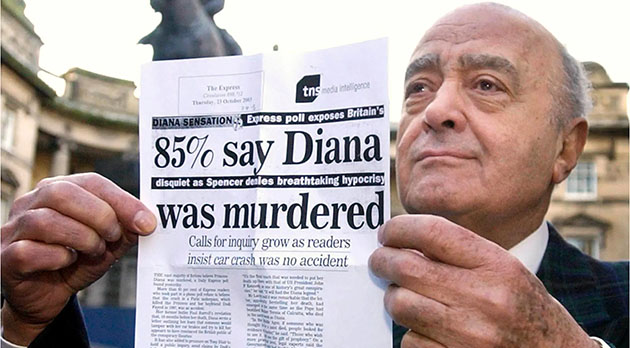
Mohamed Al Fayed, the Egyptian business tycoon whose empire of trophy properties and influence in Europe and the Middle East was overshadowed by the 1997 Paris car crash that killed his eldest son, Dodi, and Diana, the Princess of Wales, died Wednesday. He was 94.

His death was confirmed Friday in a statement by the Fulham Football Club in Britain, of which Al Fayed was a former owner. It did not say where he died.

The patriarch of a family that rose from humble origins to fabled riches, Al Fayed controlled far-flung enterprises in oil, shipping, banking and real estate, including the palatial Ritz Hotel in Paris and, for 25 years, the storied London retail emporium Harrods. Forbes estimated his net worth at $2 billion this year, ranking his wealth as 1,516th in the world.

In a sense, Al Fayed was a citizen of the world. He had homes in London, Paris, New York, Geneva, St. Tropez and other locales; a fleet of 40 ships based in Genoa, Italy, and in Cairo; and businesses that reached from the Persian Gulf to North Africa, Europe and the Americas. He held Egyptian citizenship but rarely if ever returned to his native land.

Al Fayed lived and worked mostly in Britain, where for a half-century he was a quintessential outsider, scorned by the establishment in a society still embedded with old-boy networks. He clashed repeatedly with the government and business rivals over his property acquisitions and attempts to influence members of Parliament. He campaigned noisily for British citizenship, but his applications were repeatedly denied.

“It’s the colonial, imperial fantasy,” Al Fayed told The New York Times in 1995. “Anyone who comes from a colony, as Egypt was before, they think he’s nothing. So you prove you’re better than they are. You do things that are the talk of the town. And they think, ‘How can he? He’s only an Egyptian.’”

He reveled in the trappings of a British aristocrat. He bought a castle in Scotland and sometimes wore a kilt; snapped up a popular British football club; cultivated Conservative prime ministers and members of Parliament; sponsored the Royal Horse Show at Windsor; and tried unsuccessfully to salvage Punch, the moribund satirical magazine that had lampooned the British establishment for 150 years.

His takeover of the venerable Harrods in 1985 struck many Britons as shameless brass, something akin to buying Big Ben. A year later, as if securing a jewel in the crown of British heritage, Al Fayed signed a 50-year lease on the 19th-century villa in Paris that had been the home of former King Edward VIII of Britain and Wallis Warfield Simpson, the divorced American woman for whom he abdicated his throne in 1936.

But Al Fayed’s triumph as an Anglophile was the made-for-tabloids romance between his eldest son, Emad, known as Dodi, and the Princess of Wales, who had recently been divorced from Prince Charles (now King Charles III) and alienated from the royal family. It began in the summer of 1997, when Al Fayed invited Diana and her sons to spend some time at his home on the French Riviera and on one of his yachts. Dodi was there too.

The Egyptian-born nephew of Saudi billionaire arms dealer Adnan Khashoggi, Dodi was a notorious playboy who gave lavish parties, financed films, dated beautiful women and was once briefly married. He and Diana had been acquainted, but by many accounts they fell in love on the Mediterranean sojourn. As their romance bloomed, the British press pounced. Paparazzi hounded the couple everywhere they went.

In the early hours of Aug. 31, 1997, a Mercedes-Benz carrying Diana and Dodi and driven by Henri Paul, a Fayed security agent who was drunk and traveling at a high speed trying to elude carloads of pursuing paparazzi, slammed head-on into a concrete pillar in a tunnel in Paris. All three were killed.

Controversy exploded over the cause of the crash and the implications of the affair. Some tabloids suggested that an immigrant had been an unfit suitor for a princess. But friends said that the couple had planned to marry and that the Fayed family had offered Diana and her sons a warmth that contrasted with the way Britain’s royal family had shunned her after the divorce.

As rumors and conspiracy theories swirled, Al Fayed declared that the two had been killed by “people who did not want Diana and Dodi to be together.” He said they had been engaged to marry and maintained that they had called him an hour before the crash to tell him that she was pregnant. Buckingham Palace and the princess’s family denounced his remarks as malicious fantasy.

The deaths inspired waves of books, articles and investigations of conspiracy theories, as well as a period of soul-searching among Britons, who resented the royal family’s standoffish behavior and were caught up in displays of mass grief. In 2006, British police ruled the crash an accident.

And in 2008, a British coroner’s jury rejected all conspiracy theories involving the royal family, British intelligence services and others. It attributed the deaths to “gross negligence” by the driver and the pursuing paparazzi. It also said a French pathologist had found that Diana was not pregnant.

Al Fayed called the verdict biased, but he and his lawyers did not pursue the matter further. “I’ve had enough,” he told Britain’s ITV News. “I’m leaving this to God to get my revenge.”

Mohamed Al Fayed was born Mohamed Abdel Moneim Fayed in Alexandria, Egypt, on Jan. 27, 1929, one of five children of a primary-school teacher, Aly Aly Fayed. Details about his early life are murky.

His accounts of growing up in a prosperous merchant family were discounted by British investigators. He sold sewing machines and joined his two younger brothers, Ali and Salah, in a shipping business. In the early 1950s, Adnan Khashoggi set the brothers up in a venture that exported Egyptian furniture to Saudi Arabia. It flourished.

In 1954, Al Fayed married Khashoggi’s sister, Samira. Dodi was their only child. They were divorced in 1956. In 1985, he married Heini Wathén, a Finn. They had four children, all born in Britain: Jasmine, Karim, Camilla and Omar.

Information on survivors was not immediately available.

The Fayed shipping interests profited handsomely from an oil boom in the Persian Gulf in the 1960s. Acting as middlemen for British construction companies and gulf rulers, they helped develop the port of Dubai, the Dubai Trade Center and other properties in what is now the United Arab Emirates.

Al Fayed, who made all his family’s major investment and financial decisions, moved to London in the mid-1960s. He added “Al” to his surname, implying aristocratic origins. After buying the Scottish castle, he expanded its estate to 65,000 acres; after acquiring the Fulham Football Club, he built it into a top team in a nation infatuated with the sport. (He sold the team in 2013 to a Pakistani American businessman.) A heavy contributor to the Conservative Party, he nurtured relationships with members of Parliament and Prime Ministers Margaret Thatcher and John Major.

In 1979, the Fayed brothers bought the fading Ritz Hotel in Paris for under $30 million and, with a 10-year, $250 million renovation, turned it into one of the world’s most luxurious hotels. Princess Diana and Dodi Fayed dined in the Imperial Suite before their fatal crash.

In 1984-85, in their greatest commercial coup in Britain, the Fayeds paid $840 million for the House of Fraser, the parent company of Harrods and scores of other stores, and invested $300 million more to refurbish the chain’s flagship, in London’s exclusive Knightsbridge section.

Prodded by a business rival, the government investigated the Harrods deal and in 1990 concluded that the Fayed brothers had “dishonestly misrepresented” themselves as descendants of an old landowning and shipbuilding family. The government report said the money for Harrods had probably come from the Sultan of Brunei. The sultan denied it, and Al Fayed, who was not accused of wrongdoing, called the report a smear.

In investigative reports by the press and police, Al Fayed was accused by many women of unwanted sexual advances, job-related sexual harassment of female employees at Harrods and even sexual assault involving teenage girls. He denied the allegations and, although he was questioned by authorities in Britain, he was never prosecuted on such charges.

Al Fayed was bitter about being stymied in his quest for British citizenship, although all his children by his second wife held that status. As he noted, he had lived in Britain for decades, paid millions in taxes, employed thousands of people and, through his enterprises, contributed mightily to the economy.

“They could not accept that an Egyptian could own Harrods, so they threw mud at me,” he told reporters. He sold Harrods in 2010 to Qatar Holding, the sovereign wealth fund of the Emirate of Qatar, for more than $2 billion, and announced his retirement. 

Comments

Add new comment

  • Coastaldigest.com reserves the right to delete or block any comments.
  • Coastaldigset.com is not responsible for its readers’ comments.
  • Comments that are abusive, incendiary or irrelevant are strictly prohibited.
  • Please use a genuine email ID and provide your name to avoid reject.
News Network
January 23,2026

Mangaluru: The Karnataka Government Polytechnic (KPT), Mangaluru, has achieved autonomous status from the All India Council for Technical Education (AICTE), becoming the first government polytechnic in the country to receive such recognition in its 78-year history. The status was granted by AICTE, New Delhi, and subsequently approved by the Karnataka Board of Technical Education in October last year.

Officials said the autonomy was conferred a few months ago. Until recently, AICTE extended autonomous status only to engineering colleges, excluding diploma institutions. However, with a renewed national focus on skill development, several government polytechnics across India have now been granted autonomy.

KPT, the second-largest polytechnic in Karnataka, was established in 1946 with four branches and has since expanded to offer eight diploma programmes, including computer science and polymer technology. The institution is spread across a 19-acre campus.

Ravindra M Keni, the first dean of the institution, told The Times of India that AICTE had proposed autonomous status for polytechnic institutions that are over 25 years old. “Many colleges applied. In the first round, 100 institutions were shortlisted, which was further narrowed down to 15 in the second round. We have already completed one semester after becoming an autonomous institution,” he said. He added that nearly 500 students are admitted annually across eight three-year diploma courses.

Explaining the factors that helped KPT secure autonomy, Keni said the institution has consistently recorded 100 per cent admissions and placements for its graduates. He also noted its strong performance in sports, with the college emerging champions for 12 consecutive years, along with active student participation in NCC and NSS activities.

Autonomous status allows KPT to design industry-oriented curricula, conduct examinations, prepare question papers, and manage academic documentation independently. The institution can also directly collaborate with industries and receive priority funding from AICTE or the Ministry of Education. While academic autonomy has been granted, financial control will continue to rest with the state government.

“There will be separate committees for examinations, question paper setting, boards of studies, and boards of examiners. The institution will now have the freedom to conduct admissions without government notifications and issue its own marks cards,” Keni said, adding that new academic initiatives would be planned after a year of functioning under the autonomous framework.

Comments

Add new comment

  • Coastaldigest.com reserves the right to delete or block any comments.
  • Coastaldigset.com is not responsible for its readers’ comments.
  • Comments that are abusive, incendiary or irrelevant are strictly prohibited.
  • Please use a genuine email ID and provide your name to avoid reject.
News Network
February 1,2026

US President Donald Trump on Saturday claimed that the government of India led by Prime Minister Narendra Modi has made a deal to buy Venezuelan oil, as opposed to purchasing it from Iran.

"We've already made that deal, the concept of the deal," he told reporters on Air Force One.

Trump had imposed 25% tariffs on countries buying Venezuelan oil, including India, in March 2025. He had also hit India with tariffs for buying Russian oil, saying it was "funding" President Vladimir Putin's war against Ukraine.

Trump has said that the US has taken control of the oil-rich Venezuela after capturing former President Nicolas Maduro in January.

A fleet of 18 ships loaded with crude oil bound for refineries in Texas, Louisiana, and Mississippi in January, the most since December 2024, according to a report by the news agency Bloomberg.

Combined crude deliveries to the US will reach about 2,75,000 barrels a day, more than doubling volumes seen in December last year. Shipments to China, which averaged 4,00,000 barrels a day last year, fell to zero in January.

PM Modi, Venezuelan President Agree To Expand Ties

Prime Minister Narendra Modi and Venezuela's acting President Delcy Rodriguez spoke on Friday and agreed to take the bilateral relations to "new heights" in the years ahead.

It was the first phone call between the two leaders since the capture of Maduro and his wife by the US on January 3.

"Spoke with Acting President of Venezuela, Ms. Delcy Rodriguez. We agreed to further deepen and expand our bilateral partnership in all areas, with a shared vision of taking India-Venezuela relations to new heights in the years ahead," PM Modi said in a post on X.

A statement from Prime Minister Modi's office said the two leaders agreed to further expand and deepen the India-Venezuela partnership in all areas, including trade and investment, energy, digital technology, health, agriculture, and people-to-people ties.

They exchanged views on various regional and global issues of mutual interest and underscored the importance of their close cooperation for the Global South, the statement said.

Rodriguez also said that they discussed partnerships in the fields of agriculture, science and technology, mining, and tourism, as well as the pharmaceutical and automotive industries.

Comments

Add new comment

  • Coastaldigest.com reserves the right to delete or block any comments.
  • Coastaldigset.com is not responsible for its readers’ comments.
  • Comments that are abusive, incendiary or irrelevant are strictly prohibited.
  • Please use a genuine email ID and provide your name to avoid reject.
coastaldigest.com news network
January 19,2026

rizwanzameer.jpg

Bengaluru: As the dust settles on the recent legislative session, the corridors of Vidhana Soudha are buzzing with more than just policy talk. A high-stakes game of political musical chairs has begun, exposing a deepening rift within the Congress party’s Muslim leadership as a major Cabinet reshuffle looms.

With the party hierarchy signaling a "50% refresh" to gear up for the 2028 Assembly elections, the race to fill three projected Muslim ministerial berths has transformed from a strategic discussion into an all-out turf war.

The "Star Son" Spark

The internal friction turned public this week following provocative remarks by Zaid Khan, actor and son of Wakf Minister Zameer Ahmed Khan. Zaid’s claim—that his father "helped" secure a ticket for Shivajinagar MLA Rizwan Arshad in 2023—has acted as a lightning rod for resentment.

Rizwan’s camp was quick to fire back, dismissing the comment as a desperate attempt by Zameer to manufacture seniority. "Rizwan’s political pedigree was forged in the NSUI and Youth Congress long before Zameer even stepped into the party," a supporter noted, highlighting Rizwan’s tenure as an AICC secretary and his two-term presidency of the State Youth Congress.

A Tale of Two Loyalists

While both Zameer Ahmed Khan and Rizwan Arshad are staunch allies of Chief Minister Siddaramaiah and represent Bengaluru strongholds, their political DNA could not be more different:

•    Zameer Ahmed Khan: A four-time MLA who crossed over from JD(S) in 2018. Known for his "overzealous" and often polarizing outreach during communal flashpoints—from the DJ Halli riots to the recent Wakf land notice controversy—his style has frequently left the Congress high command in a state of "discomfort."

•    Rizwan Arshad: A homegrown organizational man. Seen as a "quiet performer," Arshad represents the sophisticated, moderate face of the party, preferred by those who find Zameer’s brand of politics too volatile.

The Outsiders Looking In

The bickering isn't limited to a duo. The "Beary" community, represented by leaders like N A Haris and Saleem Ahmed, is demanding its pound of flesh. Saleem Ahmed, the Chief Whip in the Legislative Council, has dropped the veil of diplomacy, openly declaring his ministerial aspirations.

"I was the only working president not included in the Cabinet last time," Saleem noted pointedly, signaling that the "loyalty quota" is no longer enough to keep the peace.

As Chief Minister Siddaramaiah prepares to finalize the list, he faces a delicate balancing act: rewarding the aggressive grassroots mobilization of Zameer’s camp without alienating the organizational stalwarts and minority sub-sects who feel increasingly sidelined by the "Chamarajpet-Shivajinagar" binary.

Comments

Add new comment

  • Coastaldigest.com reserves the right to delete or block any comments.
  • Coastaldigset.com is not responsible for its readers’ comments.
  • Comments that are abusive, incendiary or irrelevant are strictly prohibited.
  • Please use a genuine email ID and provide your name to avoid reject.