‘Monster is Gone’: Bangladesh interim leader Muhammad Yunus hails students revolution; PM Modi extends best wishes

News Network
August 12, 2024

banglaleader.jpg

New Delhi: Nobel laureate Muhammad Yunus - who last week took oath as head of Bangladesh's interim government - has heaped praise on students who spearheaded protests against ousted Prime Minister Sheikh Hasina. "There is no doubt... because of the student-led revolution the whole government collapsed..." Mr Yunus told reporters after a Sunday night meet with the students.

"I said (to the students), 'I respect you... I admire you. What you have done is absolutely unparalleled... and because you ordered me to do this (to take charge of the interim administration) I accept...'," Mr Yunus said, recounting part of the conversation he had with the students.

Two of the student protesters - Nahid Islam and Asif Mahmud - are part of a 16-member advisory council that was sworn in with Mr Yunus. The 84-year-old won the 2006 Nobel Peace prize for his work in microfinance and setting up the Grameen Bank, which works for community development.

Mr Yunus has also stressed the wave of resignations of high-ranking public officials, including the Chief Justice of the Supreme Court and head of Bangladesh's central bank, was "conducted legally".

They had reportedly been issued ultimatums to quit.

"They want to have a new court," he said of the students. "So they went there and asked the chief justice to resign and put their pressure to make him resign."

"I'm sure they will find the legal way to justify all of this, because legally... all the steps were followed," he said. His office only agreed to publish these quotes Monday evening.

"Finally, this moment, the monster is gone," Mr Yunus also said, referring to Ms Hasina's departure and the end of what her critics said was an autocratic rule that stifled all dissent. 

However, Mr Yunus warned the interim government that public goodwill is a limited resource and that they would face many difficult decisions ahead. "The moment you start taking decisions, some people will like your decisions, some people will not like your decisions," he said. "...that's the way it works."

The interim government was formed after Bangladesh witnessed weeks of violence and clashes - triggered by protests over a jobs quota - forced Ms Hasina, a five-time PM, to resign and flee.

Sheikh Hasina left the Prime Minister's residence in Dhaka - hours before it was overrun - and flew to India in a Bangladeshi military aircraft. The 76-year-old, seen as a key ally of New Delhi, remains in an undisclosed location amid reports she will seek political asylum, possibly in the United Kingdom.

Following Ms Hasina's departure Md Yunus - who faced multiple corruption charges under the previous government and was in Europe while Sheikh Hasina was in power - was picked by the protesting to oversee democratic reforms.

His first act after being administered an oath of office - and taking the title of 'chief advisor' - was to lead a solemn tribute to the more than 450 people who died in the protests.

It is unclear when Bangladesh will hold an election to select a new Prime Minister. Whenever that is, Mrs Hasina is likely to return to contest, her son, Sajeeb Wazed Joy told The Times of India. "She will go back to Bangladesh the moment the interim government decides to hold an election," he said.

Modi's "Best Wishes"

Meanwhile, Prime Minister Narendra Modi has extended his best wishes to Mr Yunus,

"We hope for an early return to normalcy, ensuring the safety and protection of Hindus and all other minority communities. India remains committed to working with Bangladesh to fulfil the shared aspirations of both our peoples for peace, security and development," he wrote on X. 

With the change of guard in neighbouring Bangladesh, the Indian government now faces a diplomatic dilemma, even as China was also swift to welcome Dhaka's new authorities, saying it "attaches importance to the development" of relations.

 

Comments

Add new comment

  • Coastaldigest.com reserves the right to delete or block any comments.
  • Coastaldigset.com is not responsible for its readers’ comments.
  • Comments that are abusive, incendiary or irrelevant are strictly prohibited.
  • Please use a genuine email ID and provide your name to avoid reject.
News Network
January 20,2026

Mangaluru: In a major step towards strengthening rural innovation, the Office of the Principal Scientific Adviser (PSA) to the Government of India is supporting the establishment of RuTAGe Smart Village Centres (RSVCs) across the country through collaborations with academic institutions, civil society organisations and philanthropic partners.

As part of this national initiative, Nitte (Deemed to be University) will set up the first RSVCs in the region at Nitte GP in Udupi district and at the Nitte Health Centre, Sevanjali Trust, Farangipete, in Dakshina Kannada district. The centres will be inaugurated on January 21. In South India, the programme is being implemented by the Section Infin-8 Foundation (SI-8).

Speaking to reporters on Monday, SI-8 founder-director Vishwas US said experts from Nitte University and SI-8 would work closely with farmers, students, youth and local entrepreneurs to adapt and deploy technologies tailored to local needs.

Project head Prof Iddya Karunasagar, representing Nitte DU, said the RSVCs at Nitte and Farangipete would serve as demonstration hubs for a wide range of agriculture, energy, skill-development and assistive technologies. These include solar dryers for fruits, vegetables and crops; soil-testing solutions; power weeders and women-friendly farm tools; wind-powered devices for rural artisans; grain storage systems; grass-cutting and tree-climbing equipment; and liquid fertiliser production using cowshed waste.

SI-8 CEO Aravind C Kumar said the centres would also provide access to digital and knowledge-based platforms such as ISRO applications, government scheme portals, market linkage tools and gamified learning resources, along with assistive technologies for persons with visual impairments.

Highlighting the broader impact of the initiative, Principal Scientific Adviser Prof Ajay Kumar Sood said it demonstrated how applied research could bridge the rural–urban divide and help create self-reliant, technology-enabled villages.

The initiative has been made possible through philanthropic support from Dr NC Murthy of ACM Business Solutions, LLC, USA. Dr Sapna Poti, Director (Strategic Alliances) at the Office of the Principal Scientific Adviser, said the long-term objective is to build self-sufficient, technology-driven communities capable of generating sustainable livelihoods on their own.

Comments

Add new comment

  • Coastaldigest.com reserves the right to delete or block any comments.
  • Coastaldigset.com is not responsible for its readers’ comments.
  • Comments that are abusive, incendiary or irrelevant are strictly prohibited.
  • Please use a genuine email ID and provide your name to avoid reject.
News Network
February 1,2026

Bengaluru: Karnataka Deputy Chief Minister D K Shivakumar on Sunday criticised the Union Budget presented by Finance Minister Nirmala Sitharaman, claiming it offered no tangible benefit to the state.

Though he said he was yet to study the budget in detail, Shivakumar asserted that Karnataka had gained little from it. “There is no benefit for our state from the central budget. I was observing it. They have now named a programme after Mahatma Gandhi, after repealing the MGNREGA Act that was named after him,” he said.

Speaking to reporters here, the Deputy Chief Minister demanded the restoration of MGNREGA, and made it clear that the newly enacted rural employment scheme — VB-G RAM G — which proposes a 60:40 fund-sharing formula between the Centre and the states, would not be implemented in Karnataka.

“I don’t see any major share for our state in this budget,” he added.

Shivakumar, who also holds charge of Bengaluru development, said there were high expectations for the city from the Union Budget. “The Prime Minister calls Bengaluru a ‘global city’, but what has the Centre done for it?” he asked.

He also drew attention to the problems faced by sugar factories, particularly those in the cooperative sector, alleging a lack of timely decisions and support from the central government.

Noting that the Centre has the authority to fix the minimum support price (MSP) for agricultural produce, Shivakumar said the Union government must take concrete steps to protect farmers’ interests.

Comments

Add new comment

  • Coastaldigest.com reserves the right to delete or block any comments.
  • Coastaldigset.com is not responsible for its readers’ comments.
  • Comments that are abusive, incendiary or irrelevant are strictly prohibited.
  • Please use a genuine email ID and provide your name to avoid reject.
News Network
January 20,2026

iran.jpg

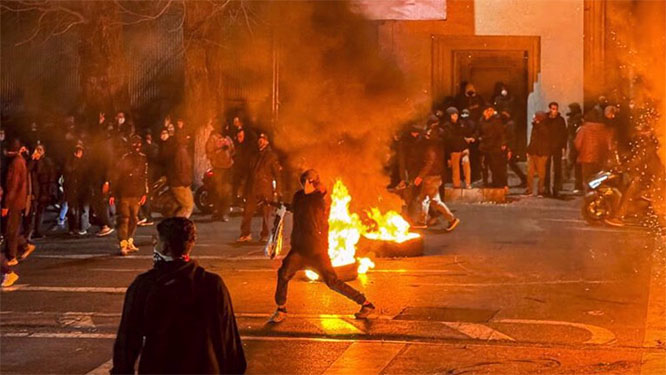
Iranian security and intelligence forces have captured more than 470 individuals in three provinces, identified as key figures behind the recent wave of violent unrest and terrorist activities linked to foreign-backed networks.

The Intelligence Ministry's provincial office in Khorasan Razavi announced on Monday the arrest of 192 armed terrorists, identified as the main agents behind recent riots in the region. 

According to an official statement, the detainees were involved in the killing of several security personnel and civilians, setting fire to mosques, public service facilities, and buses, as well as attacks on military and law enforcement centers.

The seized items from the group include several bulletproof vests, Kalashnikov rifles, hunting weapons, Winchester rifles, and various cold weapons such as daggers, swords, brass knuckles, tactical knives, crossbows, and chains.

Evidence indicates that some of the individuals were tied to hostile movements and terrorist organizations, with links overseas. Others were identified as members of violent criminal gangs, actively taking part in the unrest alongside their associates.

Simultaneously, in the western province of Lorestan, the IRGC announced the arrest of 134 individuals as the main leaders and influential field agents of a US-Israeli terrorist network.

The IRGC statement stated that these individuals formed terrorist cells during the recent unrest, committing "Daesh-like" acts.

They wounded security forces with firearms and cold weapons, and burned and destroyed public and private properties, including mosques, shops, banks, and private and public vehicles.

In the northwestern province of Zanjan, the police reported detaining 150 people identified as principal leaders and agents behind recent riots.

Authorities noted that these individuals were responsible for destroying public and private property and intentionally setting fire to vehicles in the province's squares.

Their crimes include shedding the blood of innocent people, destroying public and private property, attempting to enter military sites, disrupting public order, and spreading terror among citizens.

A variety of cold weapons were reportedly seized from the detainees.

What began late last month as peaceful protests over economic hardship across Iran turned violent after public statements by US and Israeli regime figures encouraged vandalism and disorder.

During the unrest, foreign-backed mercenaries rampaged through cities, killing security forces and civilians and damaging public property.

Comments

Add new comment

  • Coastaldigest.com reserves the right to delete or block any comments.
  • Coastaldigset.com is not responsible for its readers’ comments.
  • Comments that are abusive, incendiary or irrelevant are strictly prohibited.
  • Please use a genuine email ID and provide your name to avoid reject.